
Athaulf, King of the Visigoths [Orosius, Adversum Paganos, translated in Stephen Williams, Diocletian and the Roman Recovery, Routledge, 1985, 2000, p.218]
The annals [χρονογραφία] recognize the fratricidal Romulus, from whose name they are called Romans, was born to a whore [πορνογέννητος], that is, he was generated in defilement [adulterium]; and he made a refuge for himself where he welcomed debtors from foreign climes, runaway slaves, murderers, and people who deserved death for their crimes, and he attracted such a throng of such people that he called them Romans; from this nobility there arose those whom you call cosmocrators [κοσμοκράτορες, "world rulers"], or emperors. We, that means the Lombards, Saxons, Franks, Lotharingians, Bavarians, Swabians, Burgundians, so disdain them that we utter no other insult than 'Roman!' to our enemies when aroused, and we understand that single term, the name of the Romans, to include every baseness [ignobilitas], every cowardice, every kind of avarice, every kind of dissipation, every mendacity, indeed every vice.
Liutprand of Cremona, "The Embassy of Liudprand," The Complete Works of Liudprand of Cremona, translated by Paolo Squatriti [The Catholic Press of America, 2007, pp.246-247, translation modified]; addressed, certainly in Greek, to the Emperor Nicephorus II Phocas, who threw Liutprand into prison -- the irony here is that Liutprand represents the German King Otto I, who claims to be the "Roman Emperor," but Nicephorus, who has just called him a "Lombard," has provoked him into denouncing all the "Romans," ever since Romulus, and boasting of the many tribes of Germans, including Otto's Saxons, with the added irony that Liutprand records this in Latin, the language of the "Romans." Six major German tribes, the Visigoths, the Ostrogoths, the Vandals, the Burgundians, the Lombards, and the Franks participated in the fragmentation and the collapse of the Western Roman Empire. The Vandals were actually two tribes, the Asding and the Siling Vandals. Besides the German tribes that entered and conquered or damaged the Western Roman Empire, there were the tribes that remained back in Germany proper. These were the Saxons, the Alemanni, the Thuringians, and the Rugians. When the Rugians were destroyed by Odoacer in 487, a new confederation of Germans formed in their place, the Bavarians. All these tribes in Germany were eventually subjugated by the Franks, the Alemanni in 496 and 505, the Thuringians in 531, the Bavarians at some point after 553, and then finally the Saxons by 804. When Germany eventually separated as East Francia, the old tribal areas assumed new identities as the Stem Duchies. My sources for all these tables and maps can be found on the page for Francia and in "Decadence, Rome and Romania, the Emperors Who Weren't, and Other Reflections on Roman History." In particular, genealogies for the German kingdoms can be found in the Erzählende genealogische Stammtafeln zur europäischen Geschichte, Volume III, Europäiche Kaiser-, Königs- und Fürstenhäuser, Ergänzungsband [Andreas Thiele, R. G. Fischer Verlag, Second Edition, 2001].
This page continues and supplements the material in "Rome and Romania, 27 BC-1453 AD".
Gothic is the first attested Germanic language, preserved thanks to St. Ulfilas (Wulfila, "Little Wolf," d.c.383), who was consecrated Bishop to the Goths in 336, The Alemanni and Bavarians occupied the dialect area that developed into the Upper German dialects of High German. Eventually, "Standard" German came to be based on a Middle (or Central) German dialect of High German. This status originates with the translation of the Bible by Martin Luther (1483-1546). Luther was born and lived in Upper Saxony, teaching at Wittenberg, at one time the capital of the Elector of Saxony. Luther thus spoke the East Middle dialect of German, which today is also the speech of Berlin. My understanding is that Middle German originates with a dialect of Old Franconian and it becomes a dialect of High German mainly because of the propagation of sound changes from Upper German north across the country. Now High German therefore encompasses both Upper and Middle German and is only contrasted with Dutch (from Low Franconian), Frisian, and Low German (from Saxon). The transition remains ambiguous in the "Rhenish Fan" areas, as discussed below. The "East" dialects of Middle and Low German reflect German settlement East of the Elbe during the Middle Ages. This has been abruptly rolled back in the aftermath of World War II, with Germans simply expelled from Prussia, Further Pomerania, Silesia, the Sudetenland, and other regions, back to the Oder.
When France conquered German speaking areas in the 17th & 18th centuries, principally meaning Alsace -- where the Alsatian dialect of Upper German was spoken -- but also including areas of Lorraine -- with Low Franconian dialects -- Germans were not expelled, but a long history of cultural and political pressure began to assimilate the regions politically, culturally, and linguistically to France. Although the recovery of Alsace, in particular, was a constant goal of the Emperors in the 18th century, by the 19th the assimilation to France was far advanced, and it is not clear to me how popular, if at all, the annexation of Alsace was to Germany in 1871. The behavior of the Germans down to 1918 in Alsace and Lorraine, which were ruled like African colonies, probably did not endear itself to the locals. We do not have the information of a plebiscite in the areas either in 1871 or in 1918. Census data from 1999 (from the French Institut National de la Statistique et des Études Économiques, INSEE), however, showed 39% of adults in Alsace still able to speak German. This must have been significantly higher a century earlier, but it probably also means that the decline has been steady, as it continues among the young. Germany and France are no longer fearsome enemies; and, after the terror of the World Wars and Naziism, the idea that France might have wrongfully acquired Alsace is probably a historical dead letter.
At first I wanted to erase the Roman name and convert all Roman territory into a Gothic Empire: I longed for Romania to become Gothia, and Athaulf to be what Caesar Augustus had been. But long experience has taught me that the ungoverned wildness of the Goths will never submit to laws, and that without law, a state is not a state. Therefore I have more prudently chosen the different glory of reviving the Roman name with Gothic vigour, and I hope to be acknowledged by posterity as the initiator of a Roman restoration, since it is impossible for me to alter the character of this Empire.

Introduction
 Several other tribes were also involved, the Alans and the Suevi in particular, though the Alans were an Iranian steppe people, not Germans. The six major tribes, however, founded significant kingdoms. All of them disappeared except one, the Franks, who gave their name to Western Europe in languages like Arabic. The diagram illustrates the fate of the kingdoms, two overthrown by the Franks, two by Romania, and one by Islâm. The parts of Italy preserved from the Lombards by the Romans later, of course, fell to the Franks too (if then ceded to the Pope); and North Africa, retrieved by the Romans from the Vandals, then went to Islâm. The Frankish kingdom breaks up into the elements of Mediaeval European history. Although Burgundy and Lorraine are now gone as such, Switzerland and Monaco are Modern pieces of the former, and the Netherlands, Belgium, and Luxembourg are Modern pieces of the latter.
Index
Copyright (c) 2004, 2010, 2011, 2012, 2016, 2018 Kelley L. Ross, Ph.D. All Rights Reserved
The Germanic Languages
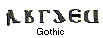 who formulated an alphabet for the language, and who then translated the Bible into it. The Gothic alphabet ceased to be used as the Gothic Nations ceased to exist. Gothic is assigned to the Eastern group of Germanic languages. Unfortunately, the other possible members of the Eastern group are long gone, and so
  little remains attested of their languages that their affinities cannot be determined with certainty. Candidates for the Eastern group are Burgundian, Lombard, Vandal, and Gepid. Except for the Gepids, who disappeared under the realms of the Avars, Bulgars, and Magyars, all the languages were spoken by tribes who ended up scattered across Roman territory. This may be an artifact of their being indeed in the Eastern Germanic language area, where they bore the front of the Hun arrival and fled west. Otherwise, the Germanic languages are divided into Western and Northern. The Western languages derive from various dialects of the languages of Germany, where the Jutes, Angles, and many Saxons colonized Britain and led to the development of English, while the German lowlands gave rise to dialects of Franconian, Saxon, and Frisian, where Low Franconian developed into modern Dutch and Saxon into Low German. West German tribes that in their day would have had distinctive dialects or languages but that have disappeared or assimilated over time would include the Franks, Saxons, Thuringians, Alemanni, Bavarians, and Suevi.
  Most of these form the basis of the Stem Duchies of Mediaeval Germany. Regional languages or dialects, like Low German (from Old Saxon) or Franconian, can still be associated with their original tribal areas.
 The Northern group of Germanic languages begins with Runic inscriptions and Old Norse (Old Icelandic) and then leads to modern languages like Icelandic, Danish, Norwegian, Faeroese, Swedish, and Gutnish. The language of the earliest Runic inscriptions (c.300 AD) is a form of Norse so archaic that it seems almost equivalent to Proto-Germanic.
| Grimm's Law | |
|---|---|
| PIE | G |
| *p | f |
| *t | þ |
| *k | x/h |
| *kw | hw |
| *b | p |
| *d | t |
| *g | k |
| *gw | kw |
| *bh | b |
| *dh | d |
| *gh | g |
| *ghw | gw/w |
The second part of the Law is that Proto-Indo-European voiced stops, b, d, g, and gw, became voiceless stops, p, t, k, and kw. Thus, Latin trabs, "wooden beam," and Lithuanian trobà, "house," correspond to Old English þorp, "farm, estate," and the New English suffix, "-thorp," used in place names and surnames; Latin decem, "ten," corresponds to English ten; Latin gelu, "frost, icy cold," corresponds to English cold; and Greek bíos, "life," which reflects the labial w more than the velar g, corresponds to English quick.
Finally, the third part of the Law is that Proto-Indo-European voiced aspirate stops, bh, dh, gh, and ghw, became simple voiced stops, b, d, g, and gw or w. Thus, "brother" in Sanskrit, bhrâta, in Greek, phratér, and Latin, frater, correspond to Gothic broþar and English brother; Greek thýra, "door," corresponds to English door; Greek khén, "goose," corresponds to English goose; and Proto-Indo-European *gwhermos, "warm," corresponds to Latin formus, Greek thermós, and English warm. There are some variations on these rules, influenced by environments like the position of the Proto-Indo-European accent, as was discovered by Karl Verner and formulated as "Verner's Law."
A fascinating feature of the Germanic languages is that the sort of consonsant shifts we see in Grimm's Law later begin to be repeated in the development of High German (the "Second Germanic Sound Shift"). These changes take place in sequence and spread like waves north through the German language community. Indeed, they are very good evidence for the "wave model" of language development. Most significantly, the different waves go different distances in different places,
| Grimm's Law | High German Sound Shift | ||||
|---|---|---|---|---|---|
| PIE | G | PG | #1 4-5c | PHG | #2 5-8c |
| *b | p | *-p-/-*p | ff | *p-/-pp- | pf |
| *d | t | *-t-/-*t | ss | *t-/-tt- | ts |
| *g | k | *-k-/-*k | x/hh | *k-/-kk- | k(x) |
In the first wave, the voiceless stops become fricatives -- f, s, and x or h. Thus, English ship corresponds to High German Schiff; English eat and out correspond to High German essen and aus, respectively; and English make and Dutch ik, "I," correspond to High German machen and ich, respectively.
 All of these changes are reflected in the extraordinary dialect map at left, the "Rhenish Fan," Rheinischer Fächer, where not only have the different sound changes extended different distances from their origin, but there is even a different distance with the same sound change (k/ch) in different words. These transition dialects are all regarded as belonging to High German, but, as I have noted, they originate in a relatively independent area of Old Franconian and Middle German. It is of interest that the official language of Luxembourg, Letzeburgish, is a dialect of Middle German, falling between dorp/dorf Bad Honnef Line and the dat/das Sankt Goar Line. The Kur-Köln and Kur-Trier glosses refer to the old Imperial Electorates of Cologne and Trier, which were independent states until the Napoleonic era.
| Grimm's Law | High German Sound Shift | ||
|---|---|---|---|
| PIE | G | PHG | #2 5-8c |
| *b | p | *p-/-pp- | pf |
| *d | t | *t-/-tt- | ts |
| *g | k | *k-/-kk- | k(x) |
In the second wave of sound changes, voiceless stops become affricatives, which start with the stop and ends with the fricative -- pf, ts, and kx. Thus, English penny and pound correspond to High German Pfennig and Pfund, respectively; and English two and time correspond to High German zwei and Zeit. In the third case we see something different. With the English word cow, the corresponding Standard High German word, Kuh, retains the simple stop. However, the Swiss word, pronounced kxū, relfects the expected change from stop to affricative. Thus, this sound change did not continue far enough North to enter the Standard Dialect of High German. The dialects of southern Bavaria, Austria, and southern Swabia (High Alemannic) also share this feature, with a word like Kchind for Standard German Kind, "child." There is no word in my German dictionary [The New Cassell's German Dictionary, Funk & Wagnalls, 1958, 1965, p.258] that has an initial cluster of kch.
| Grimm's Law | High German Sound Shifts | ||
|---|---|---|---|
| PIE | G | HG | #3 8-9c |
| *bh | b | b | p |
| *dh | d | d | t |
| *gh | g | g | k |
| Grimm's Law | Germanic Sound Shifts | ||
|---|---|---|---|
| PIE | PG | H/LG | #4 9-10c |
| *t | þ | *þ/ð | d |
English displays its own version of Germanic sound shifts, when the vowels of Middle English all move around into New English -- the "Great English Vowel Shift." With all such changes, linguists still hunt for explanations of why such things happen. In general, there is not going to be an explanation. Sounds change, and then the changes spread. It just happens, although features of social, political, or religious prestige may come into play. Thus, a certain dialect of Middle German came to be the Standard dialect for the modern German language because, as noted, that is what Martin Luther spoke and used for his German translation of the Bible. He may have chosen that dialect because it already had some prestige, or just because that is what he knew. Certainly the post-Luther prestige of the dialect accounts for its becoming spoken in Berlin -- the green salient on the map up into the East Low German dialect area.
My sources here are a couple of fine articles at Wikipedia, "Grimm's Law" and the "High German consonsant shift," and then R.L. Trask, Historical Linguistics [Arnold, London, New York, 1996], Winfred P. Lehmann, Historical Linguistics [Third Edition, Routledge, 1992, 1997, both maps here are adapted from Lehman, pp.126 & 128], Calvert Watkins, The American Heritage Dictionary of Indo-European Roots [Second Edition, Houghton Mifflin, 2000], Robert S.P. Beekes, Comparative Indo-European Linguistics, An Introduction [John Benjamins Publishing Company, Amsterdam, 1995], and J.P. Mallory and D.Q. Adams, The Oxford Introduction to Proto-Indo-European and the Proto-Indo-European World [Oxford, 2006, 2007].
Philosophy of Science, Linguistics
While Germanic languages in general and High German in particular have their merry-go-round of consonant shifts, English switches over and does it with vowels. As Middle English develops into New English, between 1200 and 1600, the quality of the long vowels undergoes a distinctive transformation. The results are a great deal messier than indicated in the chart below. English no longer has "pure" vowels. Actual vowel sounds number somewhere between nine and thirteen, with most vowels reduced and rather indefinite, or diphthongized, with the places of articulation (the allophones) scattered around where the original vocalic phoneme ideally would have been pronounced. The shifting is thus not just confined to the great systematic change of the long vowels. The short vowels have also shifted somewhat, most notably where the short "a" is now usually pronounced /æ/, as in "bad," "rap," etc.
Nevertheless, there is a systematic change with the long vowels, which is indicated in a general way in the diagram. Thus, the Dutch and German word Boot, "boat," is often pronounced by Americans as /būt/ (very common with the fine German submarine movie Das Boot [1982]) rather than /bōt/ -- like, as it happens, "boat" itself. Of course, English does have a word "boot," in which the long "o" has shifted into a long "u." More obscure is the use of "ou" to write the original long "u." This convention, however, is shared by French and even Greek. This long "u" then shifts into the /au/ diphthong, as in words like "pound," "round," "noun," etc. "Ou" may not be the most obvious way to write a long "u," but then the same sound is written "oe" in Dutch. The original diphthong "au" shifts back around to "o," but more to the quality (roughly) of the modern short "o" than the modern long "o." Thus we get, "paw," "Paul," "caulk," etc.
The vowel shift was a process that went on for centuries. Indeed, it has never been quite completed in the North of England or Scotland. Americans like to make fun of Canadians saying /abūt/ for "about." I don't think they actually quite do that, but their "ou" is not the same as Americans pronounce it, and indeed there are places in England and Scotland where /abūt/ is the pronounciation, because the Middle English vowel quality is retained. Even for standard English, however, the spelling gives no more than a clue about pronunciation. "Rough," for instance, which would have been /rūx/ in Middle English, has ended up with the vowel reduced to the indefinite "schwa," "ǝ," and the "gh" transformed into an "f." Something like this has generally happend to "gh," or it has become silent; leaving most modern speakers ignorant of how it was ever pronounced in the first place. This is the sort of thing that makes English a nightmare for people learning it as a second language.
This strikes many people as little better than a mess, and it is certainly messier than many familiar languages with neat and tidy systems of "pure" vowels. Yet both French and German have schwas, and French actually has more simple vowels than English -- and spelling that at least rivals the confusion of English, without the excuse of a Vowel Shift. A friend of mine kept pronouncing the French article le as though the vowel was /ē/ rather than /ǝ/ because, I think, not having studied French, he had trouble believing it would have such an ugly sound in it. But there is really nothing ugly about it; and the word for it comes from Hebrew.
But European writing systems, derived from the pure vowels of Greek and Latin, are impoverished in terms of the traditional symbols available to represent the vowels. The symbols in the chart here are from the International Pronunciation Alphabet (IPA), but the ones that may be the most useful are also the ones that are not used in the traditional spelling of any language. Of course, macrons are not used in writing to indicate "long" e or a, but that is a small addition when other sounds really don't have standard written forms. /O/ turns up as "oa" in "boat," "coat," "goat," etc., but there are other words with the sound written other ways. We also have anomalies as such as the "long" a being /e/, and the "short" a being /æ/, but then the "a" in "father" being something else. It might be easier just to return to Middle English pronunciation.
Tense and Aspect, Expressed in English
Philosophy of Science, Linguistics
Athaulf, King of the Visigoths [Orosius, Adversum Paganos, translated in Stephen Williams, Diocletian and the Roman Recovery, Routledge, 1985, 2000, p.218] None of six main German tribes to occupy Roman lands, save one, survived the early part of the Middle Ages. Only the Franks created an enduring state. The principal immediate damage to the Empire was done by the The Great English Vowel Shift
 Thus, the long "a" is now pronounced /ē/ (or /ēi/), as we see in words like "trade," "made," "date," etc. This ends up being the same result for the diphthong "ai" (or "ay"), as we see in "paid," "day," and "lay." The long "e," meanwhile, is pronounced /ī/ as in "meet," "beet," "sleep," etc.; and long "i" has shifted around to the diphthong /ai/, as in "light," "spite," "dike," etc. With the back vowels, we are a little distracted by the spelling conventions of Middle English. People tend to think that "oo" is simply the digraph to write /ū/, when of course it simply indicated a long "o" and the "u" sound is the result of the sound shift.
 The somewhat ragged ending of the Great English Vowel shift became more ragged over time, as many vowels became "reduced" in quality, such as the noted and iconic "schwa," ǝ, at the end of a word like "sofa." English also acquired a "short a," æ, written here with the "ash" from Old English, which is not found in nearby European languages -- although it is quite common in Arabic and Persian. This gives English twelve simple vowels, not counting vocalic variants of "r" and "l," let alone the variety of diphthongs.
Copyright (c) 2008, 2012, 2021 Kelley L. Ross, Ph.D. All Rights Reserved
At first I wanted to erase the Roman name and convert all Roman territory into a Gothic Empire: I longed for Romania to become Gothia, and Athaulf to be what Caesar Augustus had been. But long experience has taught me that the ungoverned wildness of the Goths will never submit to laws, and that without law, a state is not a state. Therefore I have more prudently chosen the different glory of reviving the Roman name with Gothic vigour, and I hope to be acknowledged by posterity as the initiator of a Roman restoration, since it is impossible for me to alter the character of this Empire.
The Visigoths, 395-711
Visigoths, who, instead of being assimilated like earlier barbarians (which would have been the plan of Valens), settled as a coherent tribe in Roman territory. They could not be properly subdued by Theodosius I and then, even when acting as allies, began to operate in ways, sometimes deliberately, sometimes not, that undermined the Empire. With the attention of Stilicho, left by Theodosius in charge of the Army, occupied by the Visigoths, the Western frontiers were stripped of troops. In the dark of the New Year, on January 1, 407, the Iranian Alans, the Vandals, and the Suevi crossed a frozen Rhine to engage in an uncontested romp through Gaul and Spain.
| VISIGOTHS | |
|---|---|
| Alaric I | 395-410 |
 Sack of Rome, 410 Sack of Rome, 410 | |
| Athaulf (Ataulfo) | 410-415 |
| Sigeric | 415 |
| Wallia | 415-417 |
| defeat of Vandals & Alans in Spain, 417 | |
| Theodoric I | 417-451 |
| withdrawal to Aquitaine, 418; killed by Huns, battle of Chalôns-sur-Marne (otherwise known as the Campus Mauriacus or the Catalaunian Plains), 451 | |
| Thorismund | 451-453 |
| Theodoric II | 453-466 |
| invades Spain, defeats Suevi, 456; deposed | |
| Euric (Eurico) I | 466-484 |
| Alaric (Alarico) II | 484-507 |
| defeated by Franks, driven from Gaul, 507 | |
| Amalaric (Amalarico) | 508-511, 526-531 |
| capital at Toledo, 527 | |
| Theodoric the Great | Ostrogoths, 493-526 |
| 511-526 | |
| Theudes (Theudis) | 531-548 |
| Theudegisel | 548-549 |
| Agila I | 549-554 |
| Romans in Cartagena & Andalusia, 551 | |
| Athanagild(o) | 554-567 |
| Theodomir | 567-571 |
| Leuva (Leova) I | 571-572 |
| Leu(/o)vigild(o) | 572-586 |
| Reccared(o) I | 586-601 |
| converts to Catholicism, 587; Kingdom converts to Catholicism, 589 | |
| Leova II | 601-603 |
| Witterich | 603-610 |
| Gundemar | 610-612 |
| Sisebut (Sisebur) | 612-621 |
| Reccared II | 621 |
| Swintilla (Suinthila) | 621-631 |
| Sisenand(o) | 631-636 |
| Chintila | 636-640 |
| Tulga | 640-642 |
| Chindaswind(/suinto) | 642-653 |
| Recdeswinth | 653-672 |
| Wamba | 672-680 |
| Euric (Erwig) II | 680-687 |
| E(r)gica | 687-702 |
| Witiza | 702-709 |
| Roderic (Rodrigo) | 709-711 |
| Agila II | 711-714 |
| Overthrown by Omayyads, 711; Christian Kingdom of Asturias, 718 | |
| SUEVI | |
|---|---|
| Hermeric | 409-438 |
| sworn as Roman foederati, 410 | |
| Rechila | 428-448 |
| defeats the Count of Spain, Andevotus, at the Jenil River, 438; takes Mérida, made capital, 439; takes Seville, 441; converts to Catholicism, 447 | |
| Rechiar(ius) | 448-456 |
| Peace with Romans, 452; defeated & killed by Visigoths, 456 | |
| Aioulf | 456-467 |
| Suevi convert to Arianism, 466 | |
| Maldras | 467-460 |
| Richimund | 460-c.463 |
| Frumar | 460-c.465 |
| Remisund | c.463-? |
| unknown kings | |
| Carriaric | c.550-559 |
| Theodemar | 559-570 |
| Suevi convert to Catholicism, 561 | |
| Miro | 570-582 |
| Eboric | 582-584 |
| Andeca | 584-585 |
| Visigoth conquest | |
Meanwhile, in 428, the Asding Vandals crossed over into Africa. By 442 they had established themselves, ending the ancient source of grain for Roman Italy. With the Western Empire obviously in collapse, the Visigoths then expanded into much of the rest of Gaul and Spain (469-478). The Visigothic Kingdom, pushed entirely into Spain by the Franks (507), absorbing the Suevi (584), and converting from Arianism to orthodox Catholicism (589), endured until the armies of Islâm arrived in 711. The history of Spain is then largely of Islâmic Spain, until the Christian north revives and Islâm power goes into decline, around the turn of the millennium. Local rulers of Islâmic Spain can be found as follows:
Thus we start off with the seven "liberal arts," which had been introduced in the Fifth Century by the pagan writer Martianus Capella, in the form of the trivium (hence "trival"), of grammar, rhetoric, and logic, and the quadrivium,  of arithmetic, geometry, astronomy, and music. I quote Isidore elsewhere in Latin on his treatment of the days of the week. We end up with something like the first Mediaeval summa, one not confined to any particular subject, but to all subjects. As Paul Johnson says, it "founded a civilization" [A History of Christianity, Touchstone, 1976, p.154]. Seville itself, however, would soon belong to another civilization.
The Islamic Conquest of the Visigoths features an anecdote concerning an artifact called the "Table of Solomon." This was supposedly part of the Roman loot of Herod's Temple that was brought to Rome. The Visigoths took the table when they sacked Rome in 410 and then carried with them to Spain. The problems with this story are that Josephus doesn't mention such a table in the furniture of the Temple; it isn't shown with the other loot in the Arch of Titus; and it seems unlikely that a cumbersome marble table would have been taken by the Visigoths, when other, far more portable, treasures were left in Rome until thoroughly looted by the Vandals in 455.
Nevertheless, when the conqueror of Spain, Ṭāriq ibn Ziyād, captured Toledo and inspected the treasures of the Visigoths, he identified this item as the "Table of Solomon." Since Ṭāriq had exceeded his orders, his superior, Mūsā ibn Nuṣayr, tried to take credit for the conquest. When Mūsā traveled to Damascus and presented the spoils of the Visigoths to the Caliph al-Walīd in 715, he was horrified to realize that the Table was missing a leg. This had cleverly been removed by Ṭāriq, who then stepped forward to present it to the Caliph, as evidence of his part in the Conquest. Ṭāriq might have worried about retaliation from Mūsā; but Mūsā in turn was ruined by the new Caliph, Sulaymān (715-717), al-Walīd's brother, in retaliation for not delaying his entry into Damascus until Sulaymān had come to the Throne. Sulaymān even ordered the murder of Mūsā's son, Abdul Azīz, whom he had left as governor of Spain. Meanwhile, the "Table of Solomon," authentic or not, disappeared from history.
Slightly different lists of Visigothic Kings are given by the sources. The Oxford Dynasties of the World, by John E. Morby [Oxford University Press, 1989, 2002, p.59] looks good. The original version here was based on the Kingdoms of Europe, by Gene Gurney [Crown Publishers, New York, 1982] and Bruce R. Gordon's Regnal Chronologies. I've tried to combine and reconcile the lists to an extent, but I have no way of knowing at the moment which dates are preferable.
Many Visigothic names survive into modern Spanish. Of the Kings, the name of Rodrigo seems the most obvious example. Later names like Ferdinand (Ferdinando, Fernando) are also examples.
The origin and history of the Goths is a matter of great interest, dispute, and speculation. The island of Gotland off the coast of Sweden seems to testify to the location and antiquity of the name, but there is no real historical evidence linking the Goths to it, apart from much later, But after some centuries in the area, the Goths had left a treasure hoard behind in what later would be modern România. A Runic inscription on one item in the hoard contains the words Gutani, which was the Goths' own name for themselves (it turns up in Latin as Gutones) and hailag, the Gothic word for "holy" and recognizably cognate to modern German heilig. The Ostrogoths left behind something else: a small community in the Crimea. This survived and was still speaking Gothic as late as the 16th century. The Imperial Ambassador to Constantinople, 1554-1562, the Fleming Ogier Ghiselin de Busbecq (1522-1592) took down sixty words from informants from the Crimea, confirming the Gothic identity of their language. But then the community vanished at some later period -- although it may have become mixed and confused with the Nova Anglia of Anglo-Saxon refugees settled by the Romans, with all of them ultimately converting to ʾIslâm under the Crimean Tartars, with whom they were then further confused. The long episode of Germans in the East would later evoke dreadful ambitions. There is little doubt that Hitler saw himself as revenging Ermanaric with his invasion of Russia.and legendary, accounts, like the history of the Goths completed in 551 by Jordanes, a Goth himself -- although it seems to be based on a larger history by Cassiodorus. What is better known is that in the first centuries A.D. German tribes expanded from the Baltic & North Sea coasts of Germany south and east along the frontier of the Roman Empire. In so doing they interacted with Roman culture, even developing their own writing system, the Runes. By the third century, the Goths were in the forefront of this expansion, passing around the Roman salient of Dacia, shown on the following map.) From this position, in 251 the Goths raided into the Balkans, killing the Emperors Decius and Herennius. In 267 the Goths even sailed down into Roman territory, in a kind of anticipation of the Viking (or Varangian) raids of later centuries, sacking Athens -- though, not really being seafaring themselves, they used ships from Greek colonials in the Crimea (the Cimmerian Bosporus) and nearby. The Emperor Gallienus inflicted some setbacks on them, before he was murdered, but they were finally defeated in 269 at the battle of Naissus by Claudius II, henceforth known as "Gothicus." Nevertheless, Aurelian then withdrew Roman legions and settlers from Dacia in 271. By then some of the Goths were moving on, and soon different Gothic communities can be distinguished. Previously, it was thought that Visigoths and Ostrogoths familiar from later history were already discernable. However, this now looks anachronistic, as discussed elsewhere. Gothic power did expand through the Ukraine. Eventually, it may have extended all the way to the Don, and then spread north, by some (questionable) reckonings all the way back to the Baltic. The Gothic "empire" of King Ermanaric (i.e. "King [riks] Herman," where "Herman" itself is from [h]er[i], "army," and man, "man") collapsed abruptly when the Huns arrived in about 370 -- Ermanaric is even supposed to have committed suicide. This pushed the Goths back into Roman territory, which began all the troubles for Rome.
From this position, in 251 the Goths raided into the Balkans, killing the Emperors Decius and Herennius. In 267 the Goths even sailed down into Roman territory, in a kind of anticipation of the Viking (or Varangian) raids of later centuries, sacking Athens -- though, not really being seafaring themselves, they used ships from Greek colonials in the Crimea (the Cimmerian Bosporus) and nearby. The Emperor Gallienus inflicted some setbacks on them, before he was murdered, but they were finally defeated in 269 at the battle of Naissus by Claudius II, henceforth known as "Gothicus." Nevertheless, Aurelian then withdrew Roman legions and settlers from Dacia in 271. By then some of the Goths were moving on, and soon different Gothic communities can be distinguished. Previously, it was thought that Visigoths and Ostrogoths familiar from later history were already discernable. However, this now looks anachronistic, as discussed elsewhere. Gothic power did expand through the Ukraine. Eventually, it may have extended all the way to the Don, and then spread north, by some (questionable) reckonings all the way back to the Baltic. The Gothic "empire" of King Ermanaric (i.e. "King [riks] Herman," where "Herman" itself is from [h]er[i], "army," and man, "man") collapsed abruptly when the Huns arrived in about 370 -- Ermanaric is even supposed to have committed suicide. This pushed the Goths back into Roman territory, which began all the troubles for Rome.
| BURGUNDIANS | ||
|---|---|---|
| Gebicca | d.407 | established at Worms (Borbeto- magus) |
| Gundahar/ Gondikar/ Gunther | 407- 436/437 | killed by Aëtius & Huns |
| Gundioc/ Gunderic | 434-473 | |
| ceded Sapaudia (cisjurane Burgundy), 443; Sequania (transjurane Burgundy), 458 | ||
| Chilperic I | 443-c.480 | |
| Chilperic II | 473-493 | son of Gundioc, killed by Gundobad |
| Godegisel | 473-501 | son of Gundioc, killed by Gundobad |
| Gundobad | 473-516 | son of Gundioc, West Roman Magister Militum, 472-474 |
| St. Sigismund | 516-524 | converts to Catholicism |
| Defeated, killed by Franks, Burgundy occupied, 524; canonized as Martyr of Catholicism | ||
| Gudomar (II)/ Gundimar/ Godomar | 524-532; flees defeat, rallies army, reoccupies Burgundy, 524 | |
| Defeated, overthrown, and killed by Franks | ||

Before long, however, the Burgundians were accepted again as foederati and granted lands in Sabaudia (or Sapaudia), the later Savoy (443). This created a durable Kingdom, subsequently expanded to the proportions familiar from later history. As noted, Gundobad enjoyed a career at the West Roman Court, where he personally murdered the Emperor Anthemius (472) and then followed his uncle Ricimer as Magister Militum of the West (472-474) -- until chased out by Julius Nepos.  Disposing of his brothers, he ruled the Burgundians down to 516, overseeing things like the promulgation of the law codes Lex Romana Burgundionum and Lex Gundobada. This promising start, and the adoption of Catholicism (in place of Arianism) by his son Sigismund, was, however, soon snuffed out by the Franks, despite the fact that their own cousin, St. Chlothilda, was Regent of the Frankish Kingdom (511-c.544) at the time of the last two Burgundian Kings. Apparently she prefered the power of her sons over that of her cousins.
The Kingdom of the Burgundians remained a unit in the many divisions of the Merovingian and Carolingian domains, until independent kingdoms resulted in the 880's. The map shows later subdivisions, especially of the Duchy and the Free County, which remained distinct for the longest. Upper and Lower Burgundy became a united Kingdom, based at Arles (hence, the "Arelate"). Eventually the Kingdom disappeared, with its parts largely absorbed by France. The name of Burgundy became primarily associated with the French Duchy of Burgundy (which bestowed its name on the wine of the region) and its subsequent possessions in the Low Countries.
| VANDALS | |
|---|---|
| Gunderic | c.406-428 |
| Gaiseric | 428-477 |
| Invasion of Africa, 428; Capture of Carthage, 439; expedition of Aëtius, Visigoths provide troops, and fleet of 1100 cargo & troop ships arrive in Sicily from Theodosius II, cancelled, 441; Sack of Rome, 455; Expedition of Majorian organizing in Spanish ports surprised & burned, 461; Joint E/W expedition of Anthemius & Basiliscus fails, 468 | |
| Huneric | 477-484 |
| Gunthamund | 484-496 |
| Thrasamund | 496-523 |
| Hilderic | 523-530 |
| Gelimer | 530-534 |
| Overthrown by Belisarius, 533-534 | |
 This was the doing of one Vandal genius, Gaiseric, whose name significantly means "Caesar King." The sea power by which the Romans had defeated the Carthaginians and then tied together the Empire of the Mare Nostrum now disappeared for the first time. The Romans knew that there was really no hope of restoring the Western Empire until the Vandals were swept from the sea and their base recovered. We know of at least four expeditions that were planned or prepared to accomplish this purpose. (1) The first was in 441 under the able control of Aëtius, shortly after the fall of Carthage itself. The Visigoths provided troops, and a large fleet actually arrived in Sicily from Constantinople carrying an army of over 30,000 men. Gaiseric was alarmed enough to send an embassy to Theodosius II. However, Attila indirectly broke up this effort. The Eastern forces were withdrawn to deal with the Huns in the Balkans, and Aëtius cancelled the whole operation, preparing the alliance that would enable him to check the Huns in 451. (2) In 461 the Emperor Majorian began preparing an expedition against the Vandals. It is not clear to what extent there was Eastern participation in this operation since the whole business was cut short when the Vandals burned Majorian's ships in their Spanish ports. This preëmptive strike testifies either to excellent Vandal intelligence, or excellent Vandal reconnaissance. Either way, the resources of the Vandal state are impressive, and it spelled the end of Marjorian, the last autonomous Western Emperor, whose failure was rewarded with murder by Ricimer. (3) Next was the great unified Eastern and Western military expedition of 468. Ricimer accepted the nomination of the Emperor Anthemius from the East, probably half-heartedly. This impressive force actually reached Carthage. That it failed was mainly due to the incompetence of its commander, Basiliscus (who later tried seizing the Throne in Constantinople, 475-476), treachery, and some bad luck. The Western military commanders, mainly Germans, who were jealous of their own power, were never interested in such combined action again. Ricimer had Anthemius killed (by Gundobad). (4) In the end, however, the plan was revived, after the Western Empire was gone; and in 533 Justinian's great general Belisarius surprised the Vandals, and after a short, sharp fight ended the Vandal kingdom and restored Roman authority. The Berbers meanwhile had become restive, and the Roman government would never control all of North Africa as it previously had. Nevertheless, the province became secure and prosperous enough that its resources enabled Heraclius to seize the Throne in Constantinople in 610. The history of the four expeditions against the Vandals testifies to the Roman grasp of the strategic necessity of regaining North Africa. That the first two never even set out for Carthage is good evidence of how the military power of the Empire was being overwhelmed by events. The failure of the third was due to the political and military skill of Gaiseric and the lack of it on the Roman side. With smaller resources, in a much altered world, the genius of Belisarius was finally what was needed.
 When the last Western military commander, Odoacer, decided to depose the child Emperor Romulus "Augustulus" and not appoint another one, this formally restored the unity of the Roman Empire. Odoacer returned the Imperial Regalia to Constantinople and legally became an official of the Emperor Zeno. This dependency, however, was in name only, and Zeno soon directed his uncomfortably active allies, the Ostrogoths, to overthrow Odoacer.
Invading Italy in 489, the Ostrogoths did not succeed in killing Odoacer and taking Ravenna until 493 -- Odoacer actually surrendered on terms but was then murdered at the "friendship" banquet.
Rather than 476, the "fall" of the Western Empire thus might be pegged instead to 493, when the last bona fide Roman officer, Odoacer, is overthrown by a German tribal king -- and the late Roman capital of Ravenna falls for the first time to an invader.
| OSTROGOTHS | |
|---|---|
| Theodoric/ Thiudareiks the Great, the Amal | 493-526 |
| Animal killing ended in Colosseum, 523 | |
| Athalaric | 526-534 |
| Amalasuintha | Regent, 526-534; Queen, 534-535 |
| Killed by Theodahad, causus belli with Romans | |
| Theodatus/ Theodahad | 534-536 |
| Belisarius takes Sicily, 535, Naples and Rome (#1), 536 | |
| Vitiges | 536-540 |
| Belisarius takes Milan and Ravenna, Ostrogoths surrender, 540 | |
| Theodebald | 540 |
| Eraric | 540-541 |
| Totila (Baduila) | 541-552 |
| Ostrogoths recover, 541-552; Belisarius returns to Italy, 544-549, inconclusive campaigning; Rome falls to Ostrogoths, sacked, depopulated, 546 (#2); Belisarius reoccupies Rome, 547 (#3); Rome betrayed to Ostrogoths, 549 (#4); Totila defeated by Narses, Battle of Busta Gallorum or Taginae, Totila killed in pursuit, Narses takes Rome by storm, 552 (#5) | |
| Teias | 552-553 |
| defeated, killed by Narses, Battle of Mons Lactarius, 553; Franks defeated by Narses, Battle of Casilinum or the Volturnus, 554 | |
The kingdom of Theodoric the Great then becomes the high water mark of German power in the Mediterranean West. Holding off the Franks, propping up the Visigoths, and enlarging the Italian Kingdom, Theodoric also presides over a good measure of prosperity and literary activity.
Theodoric's name, although it looks like an adjective from "Theodore" in Greek, "Gift of God," actually is a rendering of Thiudareiks or "King of the People" in Gothic. Thiuda or "people" is a cognate of þeoda in Old English and of deutsch in modern German (or "Teuton" by way of Latin). Reiks is a cognate of rex in Latin and raja in Sanskrit. "Thiudareiks" itself has many modern descendants:
 |
|---|
| Mausoleum of Theodoric, Ravenna, 2019 |
Like Visigothic Spain, Ostrogothic Italy would contribute towards the civilization of Mediaeval Europe. Cassiodorus (c.490-c.583) and Boethius (476-524) both were distinguished writers. Although himself executed by Theodoric for treason, Boethius produced a number of enduring philosophical classics that were essential Latin reading in the Middle Ages. These included his commentary on Porphyry's Isagoge -- the Introduction to Aristotle's logical works that was the starting point for Mediaeval philosophy -- and then his On the Consolation of Philosophy, written in prison before his execution. In the commentary-upon-commentary style of Medieval learning, Boethius would be followed much later by Peter Abelard (1079-1142). Although nominally a Christian, Boethius' Consolation owed little to religion.
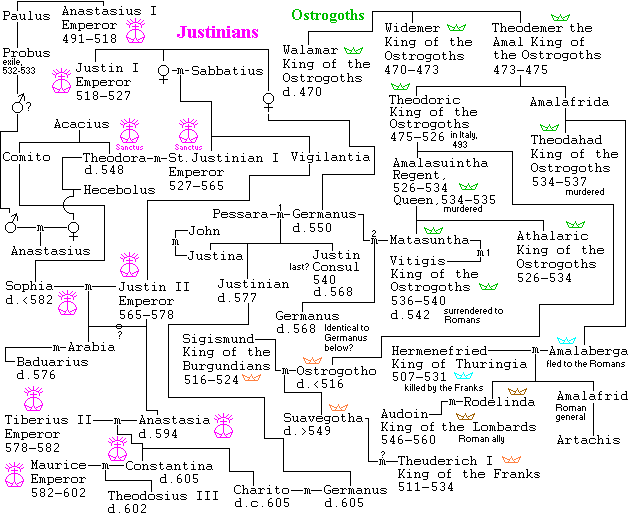
In the genealogy below, we can see some Kings of the Ostrogoths before Theodoric's descent into Italy. The actual dynasty ends in 540, when Belisarius conquered the country for the Emperor Justinian. When Ostrogothic resistance revived, the Kings were unrelated to the old dynasty. The heiress of the dynasty, Matasuntha, at first married the first extra-dynastic King but then, after the surrender of Vitiges, married into the house of Justinian. Her son, Germanus, would form the only actual link between the Justinian Emperors and their successors Tiberius II and Maurice.
The last days of the Ostrogoths were an exhausting campaign against the Romans. Belisarius, with thin forces, at first defeated them more by maneuver and strategem than by force, taking the surrender of Ravenna in 540. Ravenna would remain in Roman hands until temporarily occupied by the Lombards in 712 and then permanently in 751. However, undefeated Ostrogoths promptly elected new Kings, finding a competent, energetic, and effective one, Totila, in 541.
 |
|---|
| "Bathtub" Porphyry Sarcophagus of Theodoric, Ravenna, 2019 |
In the course of the War, Italy would suffer such damage as it had not had previously in the protracted earlier 5th century "Fall" of Rome. The principle city of the North, Milan, would be destroyed by the Ostrogoths; and Rome itself would be starved and depopulated, and its aqueducts broken, in the course of the struggle. The judgment of history about this is conflicted. If Honorius had fought for Italy as fiercely against the Visigoths, and won in the end, he certainly would be celebrated by historians as the Savior of the Empire, however much damage had been done. That Italy fell to Germans less with a bang than with a whimper is a truth actually little noted, and hardly present at all in popular consciousness. I expect most people imagine the Goths storming their way into Rome against futile Roman resistance.
There is little general awareness that nothing of the sort happened until the 6th century; and, when some attention is paid to it, the struggle of Justinian and Belisarius largely comes in for censure by historians. Italy, they seem to think, would have been better off without Justinian's Reconquest. Perhaps, with 20/20 hindsight; but it is hard to fault the sense of a Roman Emperor that it is his duty to recover Rome and expel the barbarians. That the success of the War would be undone by the Lombards, who inflicted further damage and prevented recovery, cannot be blamed on Justinian. It looks like there were innumerable Germans tribes lined up one after another to invade Romania. And after them would be countless steppe people, down to the Mongols.
Totila himself fell in battle against the Roman general Narses, who recovered Rome, for the last time, in 553. The City would not again fall to barbarians, although the Arabs looted Ostia and the Vatican (at least) in 846.
The Ostrogoths disappeared from history in 553. The Visigoths survived longer, until the Islamic Conquest of Spain in 711. In the Renaissance, however, what was seen as the revival of Classical learning also meant renewed esteem for Classical architecture; and this led to a disparagement, not just of Mediaeval culture, but of Mediaeval architecture also. Such a negative attitude then took the form of the association of Mediaeval civilization, and its products, with the Goths.
Giorgio Vasari (1511-1574), in his Lives of the Most Excellent Painters, Sculptors, and Architects [1550, 1568], not only introduced the term "Renaissance" itself but decided that the Goths were responsible for the end of Roman architecture, much of the destruction of Roman art, and the introduction of a "Gothic" style. Vasari was a contemporary of Hieronymus Wolf (1516-1580), who effected a similar distortion in history by deciding that the Mediaeval Romans were "Byzantines" and that the Mediaeval Roman Empire, Romania, was the "Byzantine Empire."
Vasari's move, of course, was totally ahistorical. The "Gothic" sytle of architecture did not begin until the 12th century. At the time, it was called the "French" or "Frankish" style, the opus Francigenum, with the earliest examples in the actual Île de France, the Royal domain of the Capetian Kings of France. The cathedral Notre Dame de Paris, recently damaged by fire, remains a supreme example of the style at its place of origin. Vasari himself, in his survey of the Mediaeval period, actually skips over the French churches and cites heavy Romanesque buildings in Italy, like the cathedral in Pisa. He dimisses churches such as San Vitale in Ravenna as "extremely clumsy in their architecture," without commenting, not just on what that is supposed to mean, but not even on the luminous mosiacs of the period [Lives of the Artists, Volume I, translated by George Bull, Penguin, 1965, 1987, p.40].
The French churches were actually a stunning achievement in aesthetics and in architectural technology. The height and spidery construction of the walls, held up with "flying buttresses," allowed for vast areas of windows, filled with extraordinary stained glass artwork, that made the "Gothic" churches places of light, space, and polychromatic beauty. Nothing like it had ever been seen before. It certainly had nothing to do with the Goths, who had all been gone for a good 400 years. If there is an actual Gothic architecure, we see it in the Arian Baptistry and the Basilica di Sant' Apollinaire Nuovo in Ravenna, which were built by Theodoric. But these are consistent with all Roman architecture of the period and are certainly handsome enough in their own terms.
At the same time, the supreme monument of Renaissance architecure may be St. Peter's Basilica, whose defining architectural feature is probably its great dome. This is an achievement itself, and it follows the tradition of Roman architecture from the Pantheon and Santa Sophia in Constantinople. Not everyone, however, thought that domes were "Classical" enough; and we can see hostility to "Byzantium" manifest as a disparagment of the uniquely Roman devices of arches and domes. This was as absurd, in its own way, as the condemnation of the "French" style as "Gothic."
But the negative meaning of "Gothic" did not persist. In the 18th century we get the introduction of "Gothic" novels, in which we begin to see a nostalgia for the Middle Ages. The first of these is thought to be The Castle of Otranto [1764] by Horace Walpole (1717-1797). This is a fictionalization and "reimagining" built around the actual person of Manfred of Sicily, the illegitimate son of the Emperor Frederick II Hohenstaufen, with supernatural elements.
Walpole's book led to a vast "Gothic" literature, parodied by Jane Austen in Northanger Abby [1803, 1817], which itself mentions one of the most popular works of the genre, The Mysteries of Udolpho [1794], by Ann Radcliffe (1764-1823). Since many of the authors, like Radcliffe, were women, the phenomenon has come to be of interest to feminists. Remembered as perhaps better literature, however, were novels such as Ivanhoe [1819], by Sir Walter Scott (1771-1832), from whom we also get Count Robert of Paris [1832], which combines the "Gothic" nostalgia with the "Byzantine" Court of Emperor Alexius Comnenus and the Englishmen in his Varangian Guard. Such Englishmen are soon forgotten in historiography, even as the disparagement of "Byzantium" continued.
But the "Gothic" element grew in popularity. The Hunchback of Notre Dame [1831], by Victor Hugo (1802-1885), not only continued the nostalgia but it inspired a renewed affection for the eponymous cathedral that led to its extensive repair and restoration, after the wear and tear of the centuries and the damage deliberately inflicted during the French Revolution. By Hugo's day, "Gothic" romance had grown into a whole movement of "Romanticism," which was a reaction against the Rationalism of the Enlightenment -- itself rather discredited by the excesses of the Revolution and the Napoleonic Era.
The Later Meanings of "Gothic"
 |
|---|
| The Royal Courts of Justice, the Strand, London, 2005 |
This was not without a Romantic revival of actual, new "Gothic" architecture, begun in part by Horace Walpole himself. At right are the Royal Courts of Justice in London, completed in 1882, in a "Gothic revival" from. This is an entirely secular building, but much of it has the look of a cathedral. This is across the street from the Middle and Inner Temple Inns of Court, where the Temple Church, from 1185, is of an original "Gothic" style.
But the supernatural element of Walpole's novel also led to something else -- an element of horror. "Gothic" novels began in part to mean stories of horror and supernatural horror. Thus, Frankenstein [1818], by Mary Shelley (1797-1851), although having nothing to do with the Middle Ages or nostalgia and, if anything, counting as a cautionary critique of modern science, gets classisified as "Gothic" just for its element of (non-supernatural) horror. But then the equally famous, and much later Dracula [1897], by Bram Stoker (1847-1912), a fictionalized and "remimagined" treatment of the historical 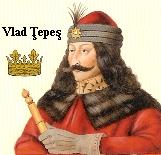 Vlad the Impaler of România, encompasses Mediaeval supernatural horror, perhaps without the nostalgia, brought down to a threatening, modern reemergence. Frankenstein and Dracula have, of course, created their own extensive horror genres in the movies.
While I'm at it, we have the remarkable circumstance that the President of the California Medical Association was a one time (2007-2008) no less than Richard S. Frankenstein, M.D., a pulmonologist in Riverside California, who also practices at the Hollywood Presbyterian Medical Center, the hospital where I was actually born.
Not only are the original negative connotations of "Gothic" for architecture completely forgotten, but even "Gothic" stories of supernatural horror have taken a respectable place in literature. The actual Goths, and the ideology of the Renaissance, are left far behind. So much so, that the modern counter-culture movement of "Goths," who tend to be defined by black clothing and makeup and a preference for painful music, derives its identity, tenuously, from the horror fiction. Theodoric the Ostrogoth would find it all very perplexing.
The recovery of Italy by the Romans from the Ostrogoths turned out to be a devastating event for the country. Between 536 and 553 the war surged back and forth, probably doing more damage than all the previous fighting since the invasion of Italy by the Visigoths in 410.
| LOMBARDS | |
|---|---|
| Wacho | d.539 |
| Walthari | 539-546 |
| Auboin | 546-560 |
| Roman foederatus, 541 | |
| Alboin | 560/5-573 |
| Occupation of Lombardy, 569-572 | |
| Celph | 573-575 |
| Autharis | 584-590 |
| Theodelinda | 590-591 |
| Agilulf | 591-615 |
| Adaloald | 615-625 |
| Arioald | 625-636 |
| Rotharis | 636-652 |
| Aribert I | 652-661 |
| Grimoald | Duke of Benevento 647-662 |
| 662-671 | |
| Garibald | 671-674 |
| Bertharit | 674-688 |
| Cunibert | 688-700 |
| Aribert II | 701-712 |
| Liutprand | 712-744 |
| Rachis of Friuli | 744-749 |
| Duke of Spoleto 756-757 | |
| Aistulf of Friuli | 749-756 |
| Duke of Spoleto 751-756 | |
| Desiderius | 756-774 |
| Duke of Spoleto 758-759 | |
| Overthrown by Franks | |
| Kings of Thuringia | |
|---|---|
| Widephus | 4th century |
| occupied by the Huns, c.450-c.455 | |
| Bisin | 5th century |
| Baderich | 5th century |
| Berthachar | 5th century |
| Hermenefried | c.500- 531 |
| defeated by the Franks, Battle of Unstrut, killed after safe conduct; Thuringia annexed; wife Amalaberga flees to Ostrogoths, removed by Romans to Constantinople | |
The Rome-Ravenna corridor is later "donated" to the Pope by the Franks and becomes the Papal States, enduring as such, in whole or in part, until 1870, when the unified Kingdom of Italy finally occupies Rome. The Lombards themselves slowly waxed in power as the Romans suffered the devastating blows dealt by the rise of Islâm. Finding himself at the mercy of the advancing Lombards, the Pope began to appeal to the Franks. The Lombard kingdom was finally wholly defeated and annexed by Charlemagne in 774. The "Iron Crown of Lombardy" then was mostly at the mercy of political events beyond the Alps.
The list of the Kings of the Thuringians is something I have only seen at one source, a historical website. The dates are pretty early. The line ends with Frankish conquest, but a Duchy of Thuringia is later briefly revived, as seen below.
| Kings of the Bavarians, Bavarii | |
|---|---|
| Theodo I | 508-512 |
| Theodo II | 512-537 |
| Theodo III | 537-565 |
| control by Franks, after 553 | |
| Theodobald I | 537-567 |
| Garibald I | 550-590 |
| Grimwald I | 590-595 |
| Tassilo I | 591-609 |
| Garibald II | 609-640 |
| Agilolf | 609-630 |
| Theodo IV | 640-680 |
| Theodo V | 680-702 |
| Theodobert | 702-725 |
| Grimwald II | 702-723 |
| Theodobald II | 702-715 |
| Tassilo II | 702-730 |
| Hubert | 725-737 |
| Odilo | 737-748 |
| Tassilo III | 748-788 |
| annexed by Franks | |
The Alemanni ("all men") were a confederation of German tribes, an old adversary of Rome, from the 3rd century. While they occupied the left bank of the Rhine during the collapse of the Western Empire, they otherwise were not particularly active in the "fall" of Rome. Then they became targets of Clovis, first Christian King of the Franks, who defeated them in 496 and 505. Henceforth, until annexation by Charlemagne in 806, they were dependents of the Franks. Their domain, revived as the Duchy of Swabia,
| Kings of the Alemanni; control by Franks, 496, 505 | |
|---|---|
| Leuthari | c.536-554 |
| Butilin | c.536-554 |
| Haming | d.c.539 |
| Leutfred I | c.570-587 |
| Uncilen | 588-613 |
| Gunzo | d.613 |
| Chrodebert | c.615-639 |
| Leutfred II | c.640-673/95 |
| Godefred | c.700-709 |
| Huocin | d.c.712 |
| Willehari | d.c.712 |
| Lanfred I | c.720-730 |
| Nebi | d.746 |
| Theodobald | c.737-744 |
| Lanfred II | 746-749 |
| Gerold | 791-799 |
| Isenbard | 799-806 |
| annexed by the Franks | |
| Saxons | |
|---|---|
| Vegdegg Odinson | 1st century AD |
| Gelder | ? |
| Freawine | 4th century |
| Guictglis | 5th century |
| Hulderic | 6th century |
 Alof Alofthe Great | 6th century |
| Boddic | 7th century |
| Berthold | ? |
| Sighard | ? |
| Dietrich | ? |
| Wernicke | 8th century |
| Withukund the Great | ?-777, 778-785 |
| Frankish conquest, 777-778, 785-790, rebellion, 790-804 | |
The Saxons were a tough fight for the Franks, just about the worst. It took Charlemagne 27 years (777-804) to effectively reduce the country -- longer than the 12 years that the Southern Sung resisted the Mongols. The fighting, by all accounts, was brutal, with little restraint or humanity shown by either side. Saxon paganism, toughness, and ruthlessness perhaps foreshadows the future ferocity of the Vikings. Saxons, of course, had previously colonized Britain. The Saxon chiefs Aelle and Cissa are said to have established themselves in Sussex (the "Southern Saxons"), apparently some time between 449 and 491. As uncertain as these dates are, they are more than we have to go on for Saxony itself.
 |
|---|
| St. Boniface of Crediton chopping down the "blood oak" of Thor at Geismar, Thuringia, in 720, where the pagan chief Gundhar was about to sacrifice his child, Asulf. Thor didn't stop Boniface, and the tree fell, so the Thuringians converted. |
Part of Charlemagne's campaign was to destroy the Saxon religion. Indeed, the campaign followed on the martyrdom of St. Boniface of Crediton in 754/5. Boniface, from England, had been preaching across Germany since 718, accompanied by St. Walpurga. He seems to have introduced the English "w" to use in writing German languages.
Charlemagne's conquest included burning down the Saxon "Sacred Groves," where human sacrifices were performed. This might remind us of the similar campaign, much earlier, by the Romans in Gaul, for similar reasons. Sacred groves were general among the Celts, and evidently, from what we now hear, among the Germans -- as they would be later in pagan Lithuania. The human sacrifices by the Lithuanians now are curiously confused by the apologetics of Polish nationalism and polemics against the Crusades. Sacred German trees, however, were remembered, and they now survive, after a fashion, as "Christmas Trees" (and "Hanukkah Bushes"), since the custom was taken to Britain when Prince Albert married Queen Victoria. Considerable irony is involved.
| Dukes of Thuringia | |
|---|---|
| Radulf | c.634-642 |
| independent, 639 | |
| Hetan I | c.642-687 |
| Gozbert | c.687-689 |
| Hetan II | c.689-719 |
| annexed by the Franks | |
A telling sign of a bit of Merovingian decline is that Thuringia, after a brutal conquest in 531, should drift into independence for 80 years. We can imagine that Frankish control of the Bavarians and Alemanni during the same period was likely to have been pretty slack. Significantly, Thuringian independence ends in the days of Charles Martel. The Bavarians and Alemanni must have been more entrenched. It was only Charlemagne, waxing in power, who eliminated the native lines.
Anglo-Saxon England
Kings of Sussex, Bernicia, Deira,
Northumbria, Essex, Mercia, and East Anglia
| Kings of Sussex Saxons | |
|---|---|
| Aelle & Cissa | 491- c.499/516 |
| killed at Battle of Badon? | |
| rule by Mercia, c.516-c.660 | |
| Athelwalh | c.660-c.685 |
| Berthun | 685-686 |
| Nothhelm or Nunna | c.692-c.725 |
| Wattus | c.692 |
| Athelstan | c.714 |
| Athelbert | c.725-c.750 |
| Osmund | c.758-c.772 |
| Dukes of Sussex under Mercia | |
| Oswald | c.772 |
| Oslac | c.772 |
| Ealdwulf | 765-c.791 |
| Elfwald | c.772-? |
| Kings of Bernicia Angles | |
|---|---|
| Ida | 547-559 |
| Glappa | 559-560 |
| Adda | 560-568 |
| Aethelric | 568-572 |
| Theoderic | 572-579 |
| Frithuwald | 579-585 |
| Hussa | 585-592 |
| Kings of Deira Angles | |
| Aelle | 560-599 |
| Aetheiric | 599-604 |
| Kings of Northumbria, Angles | |
| Aethelfrith | Bernicia, 593-616; Deira, 604-616 |
| annexed Bernicia, and Deira, 604 | |
| Edwin | 616-633 |
| Osric | Deira, 633-634 |
| Eanfrith | Bernicia, 633-634 |
| St. Oswald | 634-642 |
| Oswiu | 642-670 |
| St. Oswine | Deira, 644-651 |
| Aethciwaid | Deira, 651-655 |
| Ecgfrith | 670-685 |
| defeated and killed by the Picts and Britons under Brude III mac Bili at Nechtansmere or Dun Nechtain, 685 | |
| Aldfrith | 686-705 |
| Eadwulf I | 705-706 |
| Osred I | 706-716 |
| Cenred | 716-718 |
| Osric | 718-729 |
| Ceotwulf | 720-737, d.760 |
| Eadberht | 737-758, d.768 |
| after surrender of Dumbarton, killed (?) by King Angus (Oengus, Onuist) of the Picts, 756 | |
| Oswulf | 758-759 |
| Aethelwald | 759-765 |
| Alhred | 765-774 |
| Aethelred I | 774-779, 790-796 |
| Aelfwald I | 779-788 |
| Osred II | 788-790, d.792 |
| Vikings sack Lindisfarne Monastery, 793, Jarrow Monastery, 794 | |
| Osbald | 796, d.709 |
| Eardwulf | 796-808 |
| Aelfwald II | 808 |
| Eardwulf | 808-809 |
| Eanred | 809-841 |
| Aethelred II | 841-844, 844-848 |
| Redwulf | 844 |
| Osbert | 848-866, d.867 |
| Aelle | 866-867 |
| Danish "Great Army" conquers Deira, 867 | |
| Egbert I | 867-873 |
| Ricsige | 873-876 |
| Egbert II | 876-878 |
| Eadwulf II | 878-913 |
| Aldred | 913-927 |
| Wessex annexes Bernicia, 927 | |
At first what this meant for the local Britons was just trying to repel Frisian and Saxon pirates. This had long been a problem for the Romans, and we notice that in the Notitia Dignitatum the only commander of Limitanei, frontier troops, with the rank of Comes ("Count," i.e. companion of the Emperor) was the "Count of the Saxon Coast," whose job was to police priates in the English Channel and North Sea.
Around 455, then, Hengest from Jutland, the land of the Jutes, established himself in what would then become the Kingdom of Kent. Because of its priority, the Kings of Kent are listed on the Periphery of Francia page for the British Isles. The Primate of England, the Archbishop of Canterbury, is still seated in Kent.
After Honorius, Roman Britain essentially disappeared from history. Nevertheless, we get a look at what was happening from St. Gildas "the Wise," whose De Excitio et Conquestu Britanniae, "The Ruin and Conquest of Britain," is the only contemporary account of the Gemanic invasion of Britain. Since Gildas was one of the Britons who fled to Brittany, he may be more an illustration, rather than an exception, to the loss of literacy and history in Britain. His history is arguably part of the literature of Brittany. Later the History of the English Church and People by the Venerable Bede (673-735) is where history pops up again, three hundred years later, in Britain. But for the Germanic conquest period, Bede repeats Gildas, sometimes word for word.
| Kings of Essex Saxons | |
|---|---|
| Sledda | 580's-c.600 |
| Saebert | c.600-c.616 |
| Sexred, Saeward, & Saexbald | c.616-623 |
| killed in battle against Wessex, 623 | |
| Sigebert I Parvus | 623-c.650 |
| Sigebert II Sanctus | c.650-c.653 |
| Swithhelm | c.653-663 |
| Sigehere | 663-688 |
| Kent, 687-688 | |
| Sebbi | 663-c.693 |
| Sigeheard | 693-c.707 |
| Swaefred or Swaefheard | Kent, 689-692 |
| 693-c.707 | |
| Offa | 707-709 |
| Saelred | 709?-746 |
| Swebert | 709-738 |
| Swithred | 746-759 |
| Sigeric | 759-798 |
| Sigered | 798-825 |
| annexed by Wessex, 825 | |
What events filled that time, and the vague years between 410 and Gildas, became strongly mythologized, especially around the figure of King Arthur. The first Life of Gildas was written in the 9th century, even later than Bede. Neither source mentions a King Arthur. We still just have Ambrosius Aurelius, whom Bede says won the battle of Badon Hill, although Gildas actually does not say so. The Life does says, interestingly, that Gildas was born in the Kingdom of Strathclyde to the royal family, a son of King Caunus. This does not clearly match any name I have for Strathclyde, although "Cinuit" is close, in the right time frame. But the brother of Gildas, "Cuillum," the next King, doesn't match at all. Gildas is even supposed to have sojourned in Ireland, working for the High King Ainmere macSátnai O'Néill (566-569), before going to Rome, Ravenna, and back to Brittany.
Eventually, the story of Ambrosius is assimilated into the Arthurian legends, as examined elsewhere, and the victory at Badon Hill is supposed to have gained a respite. Before long, however, the Celtic  Britons were pushed back into the west, into Wales, Strathclyde, and Cornwall. From the latter some, like Gildas, escaped to what would become Brittany. The Germans became organized into several Kingdoms. In the south the Jutes, who would soon disappear from their homeland with Danish conquest (leaving the name "Jutland" behind), established themselves in Kent and the Isle of Wight. In the north, Angles, who would similarly disappear from the southern part of Jutland but then would give their name to the whole of England (Anglia), established Mercia, East Anglia, Bernicia and Deira, which united to form Northumbria, and several smaller, subsidiary Kingdoms. Finally, in the south the Saxons, who would remain an important power on the continent, established the Kingdoms of the South Saxons, Sussex, of the East Saxons, Essex, and of the West Saxons, Wessex. Since Wessex eventually absorbs all the others and creates the united Kingdom of England, its Kings are given with Kent on the Periphery of Francia page.
I was long under the impression that the term "Anglo-Saxons" was a coinage of modern historians. This combined the names of the Angles, after whom, we have seen, the whole of England came to be named, and the Saxons, whose southern Kingdom of Wessex ended up uniting the whole. However, the expression can already be found in the 12th century historian Ordericus Vitalis, as Saxones Angli. This was in relation to the people who fled to Constantinople after the Norman Conquest of 1066. It would be both Angles and Saxons who joined the Varangian Guard, or who were settled in "New England," Nova Anglia, on the Black Sea, and continued to fight Normans (the ones from Italy) in the Roman Army. In all of this, the Jutes seem to have been forgotten, despite the priority of Kent among the Germanic kingdoms. Since the only Jute settlements were in Kent and on the Isle of Wright, perhaps there were just too few of them to maintain their identity. The Welsh name for the area of England, Lloegr, of course antedates the Germanic conquest. We see it Latinized as "Logres," "Logris," or "Loegria." Celtic Britain as a whole was Prydain. Note that Celtic place names and the surnames of Celtic peoples remaining within England often use the Walh element from Old English.
A bizarre theory is floating around that Britain was better off under the Germans than it had been under the Romans. This is recounted by Bryan Ward-Perkins in The Fall of Rome, and the End of Civilization [Oxford University Press, 2005, 2006]. The view is advanced, of course, by clueless Marxists. Ward-Perkins describes their theory and its problems thus:
The Roman period is sometimes seen as enriching only the elite, rather than enhancing the standard of living of the population at large. Indeed, some scholars claim that the wealthiest and most powerful members of society were enriched specifically at the expense, and to the detriment, of the less privileged. For instance, a recent book on Roman Britain [N. Faulkner, The Decline and Fall of Roman Britain, Stroud, 2000] depicts its economy as an instrument of oppression, and explicitly compares Rome's impact on the island to the worst effects of modern imperialism and capitalism. The end of Roman power is celebrated as the end of exploitation: 'The mass of British people could then enjoy a short golden age free from landlords and tax collectors.' Roman economic sophistication had benefited only the property-owners and the state; and the 'Dark Ages' that followed its demise were in reality a 'golden age'.I think this, and similar views, are mistaken. For me, what is most striking about the Roman economy is precisely the fact that is was not solely an elite phenomenon, but one that made basic good-quality items available right down the social scale. As we have seen, good-quality pottery was widely available, and in regions like Italy even the comfort of tiled roofs. I would also seriously question the romantic assumption that economic simplicity necessarily meant a freer and more equal society. There is no reason to believe that, because post-Roman Britain had no coinage, no wheel-turning pottery, and no mortared buildings, it was an egalitarian haven, spared the oppression of landlords and political masters. Tax, admittedly, could no longer be collected in coin; but its less sophisticated equivalent, 'tribute', could perfectly well be extorted in the form of sheaves of corn, pigs, and indeed slaves. [p.146]
| Kings of Mercia Angles | |
|---|---|
| Creoda or Crida | c.585-c.593 |
| Pybba | c.593-c.606 |
| Ceorl | c.606-c.626 |
| Penda | 633-655 |
| Northumbrian rule, 655-658 | |
| Wulfliere | 658-675 |
| Aetheired I | 675-704, d.716 |
| Cenred | 704-700 |
| Ceolred | 700-716 |
| Aethelbald | 716-757 |
| Beomred | 757, d.769 |
| Offa | 757-796 |
| Ecgfrith | 796 |
| Cenwulf | 796-821 |
| Ceolwulf I | 821-823 |
| Beornwulf | 823-825 |
| Ludeca | 825-827 |
| Wiglaf | 827-929, 830-840 |
| Wessex rule, 829-830 | |
| Berhtwulf | 840-852 |
| Burgred | 852-874 |
| Ceolwulf II | 874-879 |
| subsequent control by Wessex | |
| Aetheired II | c.883-911 |
| Aethelflaed | 911-918 |
| Aelfwyn | 918-919 |
| annexed by Wessex, 919 | |
Since Marxist regimes were never very good at production, the modern sophisticate believes in virtuous poverty, like Cuba. The problem is no longer the exploitation of the workers, but the exploitation of the planet. Such products as are available, once real production has been crushed, go to the political elite, whose luxury and privileges are merited by their political correctness and loyalty. The evil of these ideas now infects American politics, where the elite, comfortable at the pig trough of government, shamelessly accuse the abundant consumer economy of "inequality."
The future unifier of England, Wessex, was not at first able to absorb the whole country; for as it began to do this, the Vikings arrived. This started with the sacking of the Monastery at Lindisfarne, in Bernicia, Bede's own home, in 793. Eventually, Northumbria, East Anglia, Essex, and about the north-eastern half of Mercia were overrun and became part of the Danelaw. At first the Vikings raided, sacked, and carried off slaves, or were bought off with "protection" money -- "Danegelt" -- but then Danes and Norwegians, like the Jutes, Saxons, and Angles earlier, after similar behavior, began to establish their own Kingdoms. They also passed around to Ireland and the Isle of Man and began encroaching from the west on Wales and England. This finally led to the outright annexation of England to Denmark by King Canute in 1016, though the Danish Kings only lasted until 1042.
| Kings of East Anglia Angles | |
|---|---|
| Uffa | 571-c.578 |
| Tytila | c.578-c.599 |
| Redwald | c.599-c.625 |
| Eorpwald | c.625-c.632 |
| Ricbert | c.632-c.634 |
| Sigebert | c.634-c.638, d.c.641 |
| Egric | c.638-c.641 |
| Anna | c.641-c.653 |
| Athelhere | c.653-c.655 |
| Athelwold | 655-c.663 |
| Ealdwulf | c.663-c.713 |
| Alfwald | c.713-c.749 |
| Beonna | c.749-c.761 |
| Athelred | c.761-790 |
| Athelbert | 790-794 |
| overrun by Mercia, c.794-796 | |
| Eadwald | c.796-c.799 |
| overrun by Mercia, c.799-823 | |
| Athelstan | c.823-837 |
| subject to Wessex, 829 | |
| Athelweard | 837-850? |
| Beorhtric | 852-854 |
| St. Edmund the Martyr | 854/6-869/70 |
| Original Patron Saint of England, martyred by the Vikings | |
| Oswald | c.870 |
| overrun by the Danish "Great Army", 869 | |
If a contemporary was betting on which English Kingdom would have dominated the others, Mercia might long have seemed the one poised to do so, as it was larger and bordered on most of the others. With King Offa (757-796), this promise might have seemed on the verge of being fulfilled. Offa not only dominated several neighbors and treated with the new Frankish King Charlemagne, but he settled a permanent border with the Welsh. This was defined with a fortification, "Offa's Dike," that ran almost 150 miles from north to south. It remains the largest artifact of Saxon England, evidence of England emerging from the Dark Ages and becoming part of cosmopolitan Francia. After Offa, however, Mercia began to lose its grip and the advantage passed to Wessex.
If Offa begins to represent the European political coming of age of England, we could say this had already happened intellectually earlier in the century. With Bede we have, according to Thomas Fuller, "the profoundest scholar of his age for Latin, Greek, musick and what not" [cf. Bede, Historical Works, on the title page and spine, Ecclesiastical History on the dust jacket, Books I-III, Loeb Classical Library, Harvard U. Press, 1930, 1999, p.xiii]. Bede is the first historian of Britain since Gildas, and perhaps the most thorough one since Tactitus, and the proper beginning of English history comes with his A History of the English Church and People [op.cit.]. It is noteworthy that this is included in the Loeb Classical Library, when few would think of Anglo-Saxon England as part of the Classical World. It is probably included just because it is a classic in Latin -- though the absence of Anna Comnena from the series, as a classic in Greek (or of many of Mediaeval works in Latin, like Isidore of Seville, St. Thomas Aquinas, etc.), is then awkward. Although perhaps not often appreciated, Bede does provide some important perspectives on Roman history and participates in the development of Roman Catholic religion.
Today, some of the names of the early Kingdoms survive as Counties, like Kent and Essex. The County of Middlesex, occupied by the City of London, tended to be part of Essex, but this was the area where three Kingdoms came together and the border moved around a good bit. Some of the names have even passed to the New World, as with Middlesex and Sussex Counties, New Jersey.
These tables are mainly based on The Mammoth Book of British Kings and Queens, by Mike Ashley [Carroll & Graf Publishers, Inc., New York, 1998, 1999, pp.208-321] but with the lists for Bernicia, Deira, Northumbria, and Mercia intially drawn up from the Oxford Dynasties of the World, by John E. Morby [Oxford University Press, 1989, 2002, pp.64-66].
The Stain of Sin in the Venerable Bede
This page supplements The Kings of Denmark, Norway, and Sweden, 588 AD-Present with diagrams of the earliest kings, with some of their legendary and mythic progenitors. When that link is used, a new browser window will open for the page. If one of the windows is reduced in size and positioned conveniently, the diagrams here can be compared with the tables there.
The information here is derived from the Royal Families of Medieval Scandinavia, Flanders, and Kiev by Rupert Alen and Anna Marie Dahlquist [Kings River Publications, Kingsburg, California, 1997], The Mammoth Book of British Kings and Queens by Mike Ashley [Carroll & Graf Publishers, Inc., New York, 1998, 1999], the large genealogical chart, Kings & Queens of Europe, compiled by Anne Tauté [University of North Carolina Press, 1989], and Kingdoms of Europe, by Gene Gurney [Crown Publishers, New York, 1982]. These sources are not consistent, and choices and compromises have been made, especially to simply get a coherent picture of some things, which is actually not always possible. Thus, neither of the two sets of dates for Ragnar Lodbrok (750-794 or 860-865), King of Denmark and Sweden, works if he is the Viking chief who sacked Paris in 845 and treated with Charles the Bald. If he was, then, actually, all we have to do is split the difference, more or less!
Royal Families of Medieval Scandinavia, Flanders, and Kiev does not begin very early in the chronology and so avoids some of the issues with the legendary kings. The Mammoth Book of British Kings and Queens gives a bare genealogy that goes from Halfdan to Helgi to Yrsa to Eystein. (The original, bare genealogy is shown in the table for the Kings of Dublin.) This skips over information such as that Yrsa was both the daughter and the wife of Helgi (or even a woman), conceiving with him the hero Hrolf Kraki, who is not listed in the genealogy at all. This is perhaps the high point of a legendary period that we may be perceiving through the most distorted of lenses, and there are many versions of the story, and of the names, from different, and of course much later, sources. The dates are entirely conjectural and inconsistent between the sources. We suspect that where there is smoke there must be fire, but we are nevertheless very far from a real historical picture of these people.
The descent of the earliest kings is reckoned all the way back to Odin (Wotan, Woden -- hence "Wednesday"). This may be a dimly remembered historical person, but the fact that other Germans, like the Saxons who invaded Britain, also reckoned their descent Norway may have begun as a colony of Sweden, represented by the legendary founder, Olaf Tretelgia. This simplifies things, since there may have not been the large number of rival kingdoms as may actually have existed in Sweden and Denmark, and which serve to confuse the account. As with Sweden above, branch An interesting career is that of Harald III Hårdråde. When his brother St. Olof II died in battle against Canute II the Great of Denmark in 1030, Harald flees into exile in Kiev. He makes his way as a mercenary all the way down to Sicily and eventually back home to Norway in 1047, where the Danes were gone and Olof's son, Magnus I the Good, ruled Norway and Denmark. Harald joins Magnus in rule, but the nephew doesn't last long. After Harald's long quest, then follow years of successful rule. In 1066, however, Harald's ambitions overwhelm him. He lands in England, intending to follow Canute in the rule of that country. He is unexpectedly defeated and killed, however, by Harold II. This is often regarded as the end of the Furor Normannicus, the Viking Terror. Harold, unfortunately, rode from victory over Harald to defeat and death at the hands of William of Normandy, who thus effects the conquest of England by Northmen, somewhat removed from their Viking past, after all.
After the succession jumps around a bit, we get a couple of major uncertainties. Harald IV may not really have been a son of Magnus III. And then Sverre almost certainly was not a son of Sigurd II, but he claimed to be -- probably just a convenient pretext upon which a usurper could fight for the Throne. Since his fight was successful, subsequent kings of Norway were descended from him. After this, as above, the genealogy of Norway is continued on The Kings of Denmark, Norway, and Sweden page.
The Kings of Denmark, Norway, and Sweden
Legendary and Early
Kings of Scandinavia
"From the fury of the Northmen deliver us, O Lord."While writing exists in the Scandinavian countries for the entire period covered below (and eventually across a broad swath of Europe from Britain all the way to the Ukraine), namely the system of Runes, as shown at left, it ends up being of limited value for historical information. Objects and small monuments are inscribed with names and some references to events and transactions, but we do not find great monumental historical inscriptions like that of Ramesses II about the battle of Qadesh or like that of Darius at Behistun about his rise to power,  much less texts on practical media that tell us much about ongoing developments. As Christianity crept into the region, bringing the Latin alphabet with it, full texts began to be written, preserving Sagas and instituting chronicles. One gets the impression that Runes were regarded as somewhat more magical than utilitarian, which is pretty much the way they were later remembered. Or the more practical media of utilitarian inscriptions may simply have decayed in the damp climates. Nevertheless, Runic inscriptions continue throughout the Middle Ages in Scandinavia for the traditional epigraphic and magical purposes.
 from Odin may indicate that this is a mythic device and that Odin indeed is understood as the Odin, the king of the gods. That full genealogy is not shown here (it is in Ashley, p.209). Instead, I pick it up where the Danish line divides, with one branch picking up kings of Sweden, who otherwise seem to have a separate descent from Odin for earlier kings. These early, mythic kings are the Ynglings, which end in Sweden with Ingjald Illrade. Ingjald is succeeded either by Ivar Vidfamne or Olaf Tretelgia (or Tretelia), who is also said to have fled Sweden and founded the royal line of Norway. Ivar is also reckoned as a king of Denmark, but the coordination between the two lines is not always clear. Much the same can be said for subsequent kings down to Ragnar Lodbrok. Fortunately, the sons of Ragnar are supposed to have divided his inheritance, and this begins to get us on more secure historical ground (which means that the 9th century rather than the 8th century dates for Ragnar are probably more like it). Especially noteworthy is the line of descent that involves rulers of York (Saxon Northumbria; Eboracum in Latin, Eoforwic in Old English, and Jórvik in Norse), the Isle of Man, and Dublin -- note that the genealogy shown here is a bit different from that presented in the separate treatment of Dublin. Thus we are well into the period when Viking raiders are spread all over Western Europe, and Eastern as well (Randver Radbartsson is supposed to have been fathered by a Russian, i.e. a Norseman in Russia, a Varangian). This diagram continues with the Swedish kings, who, however, as described by Alen and Dahlquist, do not necessarily continue the same line of descent. This is a little more organized than we get with Denmark, but it may well indicate that kings are ruling simultaneously and that the legendary genealogy is in fact a mythic construction. Erik I thus may indeed precede Erik II, even though the dates here have him later in the 9th century. With Erik VI, however, we get into more historically secured material, which is where Tauté begins her diagram.
 With the continuation of Swedish kings, there are just a few uncertainties. We are missing the name of Stenkil's wife, the daughter of King Edmund III. After Stenkil's death, there is some trouble, and two usurpers became sufficiently established, or remembered, that they get numbered as Erik VII and Erik VIII. One of these may be a king listed in other places as "Erik Arsaell," but there is no discussion of this name where I might expect it, in Alen and Dahlquist. Another uncertainty is whether King Blot-Sven was or was not married to a daughter of Stenkil. And then there is the question whether Sverker I was or was not descended from Blot-Sven. Alen and Dahlquist show that he was; Tauté does not show it. Some sources show rather different dates for Halsten and Inge I, and Inge II may also have been reigning simultaneously with Filip. Tauté does not list Magnus Nielsson at all, and Alen and Dahlquist have Inge II dying in 1125 on one page and living until 1130 on another. After they are all out of the way, we get rival lines, the "Sverkerska" and "Erikska" dynasties, between whom the Throne swaps back and forth, often violently, for a century. The execution of a number of heirs prepared the way for both male lines to die out, and the Throne passes to the sons of Birger Jarl, beginning the "Folkung" dynasty. From there, the genealogy of Sweden is continued on The Kings of Denmark, Norway, and Sweden page.
 The diagram for the kings of Denmark begins with some of the same figures given for Sweden above. Here we get another phenomenon. From various sources we known of several kings who do not fit into the legendary succession or genealogy. While these figures can be found given authentic looking dates and listed in succession, the impression persists that most of them were in fact ruling simultaneously. If sufficient time had elapsed, they all either would have been dropped from memory or worked up into a seamless legendary picture. As it happened, history was fast approaching and a jumble is what we get. Denmark was not a unified kingdom, much as we get that sense from the earlier legendary material. It was probably much like contemporary and adjacent Saxony, which consisted of three major tribes (Westphalians, Angarii, and Eastphalians) and two minor ones (Wihmuodi and Nordalbingi). The chief of the Westphalians, Widukind, surrendered to Charlemagne in 785. Widukind is supposed to have been related to some Danish kings and spent some time there in refuge. The first properly historical king of Denmark was Gorm the Old, who is said to have been a son of Hardeknut (Canute I), but is shown by Ashley descended through Canute, Frodo, and Harald II. Harald is completely ignored by Alen and Dahlquist. This confusion gives us a fitting end to the legendary period -- though Gorm is more than a little legendary himself. We are then quickly into the fully history period, for which there don't seem to be major uncertainties, except for some overlapping reigns that result in some kings being dropped from some accounts. Again, from here, the genealogy of Denmark is continued on The Kings of Denmark, Norway, and Sweden page.
 lines lead to interesting colonial acquisitions of the Vikings. For instance, the line of Thorstein the Red intermarries with the Earls of Orkney -- the Orkneys are the group of islands off the north end of Scotland. Similarly, the line of Olaf Geirstade leads directly (according to Ashley) to Rolf (or Rollo) who became the first Duke of Normandy. For subsequent Norman influence on European history, this was one of the most fateful events.
Copyright (c) 2002, 2004, 2007, 2010, 2013 Kelley L. Ross, Ph.D. All Rights Reserved
| Kings and Lords of the Isles | |
|---|---|
| Llywarch Hen | King of the Isles and Man, c.560-595 |
| Man conquered by Báetán mac Cairill of Ireland, 577, by Aedán mac Gabhrán of Dál Riata, 582 | |
| Diwg | c.600 |
| Man conquered by Edwin of Northumbria, 620 | |
| Gwyar | 630's |
| Tegid | 670's |
| Algwn | c.700 |
| Sandde | 730's |
| Elidr | 760's |
| Gwriad | c.800 |
| Iona Monastery attacked by Vikings, 795, 802, 806 | |
| Godred mac Fergus | Lord of the Hebrides, c.836-853 |
| Kentil Flatnose, or Caitill Find | c.853-c.866 |
| Vassal of Olaf the White of Dublin | |
| Tryggvi | 870's |
| Asbjorn Skerjablesi | 880's |
| disputed between Dublin & York | |
| Ragnall of York | c.914-c.921 |
| King of York, 910-c.921 | |
| Gebeachan or Gibhleachán | ?-937 |
| Mac Ragnall | 937?-942 |
| Olaf Sitricson | c.942-972 |
| King of Dublin, 945-980 | |
| Magnus Haraldsson | c.972-977 |
| Godred Haraldsson | 977-989 |
| Ragnald Godredson | c.1000 |
| Kenneth Godredson | 1005-? |
| Swein | ?-1034 |
| Vassal of Orkney, 989-1014, of Dublin, 1014-1035 | |
| Thorfinn the Mighty | c.1038-1052 |
| Earl of Orkney, c.1018-c.1060 | |
| Margad Ragnallson of Dublin | 1052-c.1061 |
| Murchaid mac Diarmait of Dublin | 1061-1070 |
| King of Dublin, 1052-1070 | |
| Fingal Godredsson | 1070-1079 |
| Godred I Crovan | 1079-1095 |
| King of Man, 1079-1095 | |
| King of Dublin, c.1091-1094 | |
| Lagman | 1095-1099, d.1111? |
| King of Man, 1095-1099 | |
| Sigurd III, the Crusader, I of Norway | 1099-1103, d.1130 |
| Earl of Orkney, 1099-1105 | |
| King of Norway, 1103-1130 | |
| King of Man, 1099-1103 | |
| Dmnall mac Teige | King of the Isles & Man, 1103-1114?, d.1115 |
| Olaf I the Red | Isles & Man, 1114?-1153 |
| Godred II the Black | Isles & Man, 1153-1158, 1164-1187 |
| Somerled | 1156-1164 |
| King of Man, 1158-1164 | |
| Ragnald | usurper, 1164 |
| Ragnald of Islay | King of the Isles, 1164-c.1210 |
| Dugald | Lord of Lorne & Argyll, 1164-c.1192 |
| Donald I | c.1210-1230 |
| Duncan mac Dougall | c.1210-c.1247 |
| Dugald Screech | c.1210-1235? |
| Uspak or Gillespie | 1230 |
| Ewen mac Dougall | c.1248-1266 |
| Dugald mac Ruari (MacRory) | 1249-1266 |
| Annexed to Scotland, 1266 | |
| Angus Mór (the Great) MacDonald | King of the Isles, c.1266-1296 |
| Alexander I | 1296-1299, deposed, d.1308? |
| Angus II Og (the Younger) | 1299-1330 |
| John I | 1st Lord of the Isles, 1330-1387 |
| Donald II | 2nd Lord of the Isles, 1387-1423 |
| Married to Mariota, Margaret Leslie, Countess of Ross, 1424-1436, d.1440 | |
| Alexander II | 3rd Lord of the Isles, 1423-1449 |
| Earl of Ross, 1436-1449 | |
| John II | 4th Lord of the Isles, 1449-1493 |
| Earl of Ross, 1449-1475 | |
| Angus III | usurper, 1480-1490 |
| Isles Revert to Scottish Crown, 1493 | |
| Donald Dubh, the Black | claimant, 1545 |
The rule of the Isles often included that of more distant islands, like the Isle of Man and even the Orkney Islands. Here Man is give a separate treatment beginning with Godred Crovan in 1079. The Orkneys also have their own page, beginning with Ragnald the Wise around 874. But the history of the Isles goes back rather earlier, beginning with legendary or poorly documented British and Irish Kings. The first ruler here, Llywarch, has a name that even looks Welsh, and indeed he had a connection to the Kings of Gwynedd. The Isles, of course, were far beyond the control of Roman Britain, so it is interesting that the presence of the British themselves, which we also see with the Kingdom of Strathclyde, extends well beyond what we understand as Roman boundaries. Llywarch already had to contend with the Scots coming over from Ireland and from their Kingdom of Dál Riata, based in Argyll. Despite the obscurity of the period, the /gw/ element in names of the such rulers of the Isles as we have over the next couple of centuries still looks Welsh.
This picture begins to change radically with the arrival of the Vikings. The first Viking raids on the East and the West side of Britain seem to be almost simultaneous. Thus, the Saxon monastery of Lindisfarne, not far south of the present Scottish border at the River Tweed, was sacked in 793. In 795 a series of attacks began on the Scottish monastery on the island of Iona, off Mull. In short order, the Vikings had overrun the islands and were raiding well down into Ireland. The Norse Kingdom of Dublin was founded in 853. Meanwhile, in 841 Vikings had even appeared in the Seine, and Paris was sacked in 845.

The Vikings were not the sort to grab some land and then settle down to tend their gardens. Who was ruling what was thus often a very fluid business, and we find the Isles in the middle of a tug-of-war between Norse rulers of Dublin, York, and Orkney. In the background, of course, is the King of Norway; and when the Norwegian state gets organized in some kind of disciplined form, the ultimately sovereignty of Orkney, the Isles, and sometimes Man is assumed there.  With Orkney also went the Shetland Islands to the north.
Perhaps the last sort of classic combination of the territories came with Somerled, King of Man and of the Isles. Somerled began with the Southern Hebrides (in purple on the map) and eventually spread to the rest of the Hebrides, part of Galloway (in yellow), and Man. With his death, things begin to permanently break up, not the least because of divisions and disputes between his sons. As Norway settles into being an ordinary sort of European state, Scotland begins to assume a more organized and modern form. Although Norway was probably still able to defeat the Scots in pitched battle, King Alexander III of Scotland maneuvered Scottish forces into control over the Isles and Man. In 1266, the Norwegians accepted a payment and annual tribute to surrender sovereignty to Scotland. By then, we begin to mostly have Celtic names in the Isles anyway. Although Man would not long remain with Scotland, the Isles were now secure, except for the threat of the locally autonomous nobility.
The local nobility became the MacDonalds. In the fight over the Scottish Throne between the Balliols, the English, and the Bruces (1290-1306), the MacDonalds sometimes picked the wrong side (Balliols) and were deposed (Alexander I and Angus II). With the rule of the Bruce and the Stuarts, things settled down, but the Kings became unhappy with the power and independence of the Lords of the Isles. Alexander II was captured by King James I of Scotland, as was John II by James III. After futher rebellions, James IV annexed the Isles to the Crown in 1493, shortly after the Orkneys and Shetlands were obtained from Norway (1472).
Today the MacDonalds are still the prominent nobility of the Isles. Not long ago, the MacDonald's hamburger chain tried suing Lord MacDonald over the use of the MacDonald name. British courts, of course, dismissed anything so absurd as a foreign claim on the name of the real and original MacDonalds.
The list here is entirely from The Mammoth Book of British Kings and Queens by Mike Ashley [Carroll & Graf Publishers, Inc., New York, 1998, 1999].
The Kings of Denmark, Norway, and Sweden
Earls of Orkney
and Kings of York
| Earls of Orkney | |
|---|---|
| Ragnald I the Wise | c.874-c.875, d.894 |
| Sigurd I the Mighty | c.875-892 |
| Thorstein the Red | c.875-900 |
| Guthorm | c.892-893 |
| Hallard | c.893-894 |
| Einar I | 894-920? |
| Arnkel | 920?-954 |
| Erlend I | 920?-954 |
| Erik Bloodaxe | c.937-954 |
| King of Norway, 933-934 | |
| Gunnhildr, Ragnfred, & Godred | 954-955, 976-977 |
| Thorfinn I Skullsplitter | c.947-977 |
| Arfinn | 977-979? |
| Havard | 979?-981? |
| Liot | 981?-984? |
| Hlodvir | 984?-987? |
| Sigurd II | 987?-1014 |
| Somerled | 1014-1015 |
| Einar II | 1014-1020 |
| Brúsi | 1014-c.1030 |
| Thorfinn II the Mighty | c.1018-c.1060 |
| Ragnald II | 1038-1046 |
| Paul I | c.1060-1098 |
| Erlend II | c.1060-1098 |
| Sigurd III the Crusader, I of Norway | 1099-1105, d.1130 |
| King of the Isles, 1099-1103 | |
| King of Man, 1099-1103 | |
| King of Norway, 1103-1130 | |
| Haakon | 1105-1126 |
| Magnus I | 1108-1117 |
| Paul II the Silent | 1126-1137 |
| Harald I Smoothtalker | 1126-1131 |
| Ragnald III | 1137-1158 |
| Harald II the Old | 1139-1206 |
| Erlend III | 1154-1156 |
| Harald III | 1195?-1198 |
| David | 1206-1214 |
| John I | 1206-1231 |
| Magnus II of Angus | 1231-1239 |
| Gilbert | 1239-1256 |
| Magnus III | 1256-1273 |
| Magnus IV | 1276-1284 |
| John II | 1284-1311 |
| Magnus V | 1311-c.1329 |
| Malise | c.1329-1353? |
| Erengisl | 1353-1357/60, d.1392 |
| Henry I of St. Clair | 1363/1379-1400 |
| Henry II | 1400-1420 |
| William | 1420-1471, d.1480 |
| Scottish sovereignty, 1469; resigned to Scottish crown, 1472 | |
 whose inhabitants are "Orcadians," lie off the northern tip of Scotland. They were a fief of Norway founded in the ninth century by King Harald I Fairhair. The Lords, called Earls in English fashion, thus with equal or better justice could be called "Jarls," with the Norwegian cognate. Over time, Scottish influence increased, with even intermarriage into the Scottish Royal Family. Scottish control was initiated in 1469. The Islands had become collateral, with the Shetland Islands, for the dowry of Margaret of Oldenburg, daughter of Christian I, King of Denmark, Norway, and Sweden, in her marriage to King James III of Scotland. Since Christian wasn't able to come up with money for the dowry, in 1471 the rule of the Islands was taken directly by James III and by 1472 they were formally annexed to Scotland.
The Orkneys were one set of North Atlantic Islands, including the Shetlands, Faeroes, and Hebrides, that were natural stepping stones and staging areas for Viking raids on Britain, Ireland, and elsewhere. Until the King of Norway asserted authority, the Islands were more or less nests of pirates. The way in which things became more organized we can see in one stunning connection: A son -- Hrólfur, Rolf, or Rollo -- of the first Earl, Ragnald, went on to become the first Duke of Normandy. The consequences of this for European history, from England to Sicily and beyond, are beyond calculation; yet this connection to the Orkneys is rarely noted.
The rulers of the Orkneys often tangled with those of the Hebrides and further islands. Sigurd III, installed by his father, King Magnus III of Norway, in Orkney, ended up ruling all the way down to the Isle of Man, before returning home to assume the throne of Norway.
The Orkneys retreat from the spotlight of history for many centuries. They suddenly acquire great significance, however, in World War I. A large sound south of the main island (Pomona), Scapa Flow, became the main base for the Grand Fleet of the British Royal Navy. This might seem to be rather far from anything, but it put the fleet in a position, at the entrance to the North Sea, to intercept the German High Seas Fleet whatever it might do. As it happened, the German fleet was thus intercepted in 1916, resulting in the Battle of Jutland. When the War ended, the German fleet was then interned in Scapa Flow. Rather than have the ships turned over to Britain or her allies in a post-war settlement, in June 1919 the Germans scuttled their ships in a dramatic, surprise action. There the ships still lie, long after most of their British rivals, however victorious, have been broken up and sold for scrap.
| Kings of York -- Latin Eboracum, Old English Eoforwic, and Norse Jórvik | |
|---|---|
| Ivarr the Boneless | 866-873 |
| King of Dublin, 856-873 | |
| Halfdan Ragnarson | 873-877 |
| King of Dublin, 873/5-877 | |
| Gothfrith | 883-895 |
| Sigfrid | 895-c.899 |
| Canute | c.899-c.900 |
| Athelwold | 899-902 |
| Halfdan II | 902?-910 |
| Eowils | 902?-910 |
| Ragnall | 910-c.921 |
| King of the Isles, c.914-c.921 | |
| Sitric Caech | King of Dublin, 917-921 |
| 921-927 | |
| Godfrid (Guthfrith) | King of Dublin, 921-934 |
| 927 | |
| York held by Æthelstan of England, 927-939 | |
| Godfrid, Olaf Guthfrithsson | King of Dublin, 934-941 |
| 940-941 | |
| Sitric? | King of Dublin, 941-943 |
| 941-943 | |
| Ragnall II Gothfrithson | 943-945 |
| Held by Edmund I and Eadred of England, 944-948 | |
| Erik Bloodaxe | 948-954 |
| killed, Battle of Stainmore, York annexed by Eadred of England, 954 | |

The Norse Kingdom of York, or Jórvik to them (Eboracum in Latin, Eoforwic in Old English), represented one of the major and most permanent holdings of the Vikings on the mainland of Great Britain -- part of the "Danelaw," whose conquest began with the landing of the "Great Army" in 865. The Army landed in East Anglia, and Northumbria was invaded in 866. The Northumbrian Kingdom of Deira was overthrown (867) and than East Anglia (869). Eventually, conquest extended all the way down to London (held by Danes 871-885). York was the principal Roman city of northern Britain (Erboracum) and was the ecclesiastical center of the area, one of the Archbishoprics of England, from then until now. That the city should then have been taken by the Vikings was of great significance. Norse holdings also extended into Cumbria and Galloway, with Danes in the south shading over into Norwegian barons in the north of Cumbria and Galloway. In the early days of the kingdom, we see the involvement of the kings with other Norse domains, like Dublin and the Isles, where leaders hold more than one simultaneously, or move around from one to another. There is not much time for this to settle down before the English begin to return. After about thirty years of conflict and confusion (927-954), York returns to England, until, of course, the Danes conquer all of England, 1013-1014 & 1016-1042.
The lists and genealogy here is entirely from The Mammoth Book of British Kings and Queens by Mike Ashley [Carroll & Graf Publishers, Inc., New York, 1998, 1999].

The Kings of Denmark, Norway, and Sweden
While one might think of the Danes coming directly across the North Sea from Denmark, which Ragnar may have done himself, and which is now often said about this invasion, Ivar and Halfdan were operating from their advanced base in Ireland. Thus, their invasion of England may have been from the North, into York (867), and then down into East Anglia (869). However, they are also said to have landed in East Anglia first, passed on to Northumbria, and then returned to overthrow the King of East Anglia. Either way, they went on to capture London (871). Mercia was largely under Danish control, and a vast area of it in the north-east was appropriated by Danish barons of the "five castles" or "five boroughs."
The invasion began in 865, and the Viking forces were called, in The Anglo-Saxon Chronicle, the "Great Army," or the "Great Heathen Army." The virtue of the story about Ivar and Halfdan is that it gives a reason for the invasion, while we don't have that if the Army came directly across the North Sea from Denmark. Perhaps the Vikings needed no pretext for a massive invasion, but it does seem reasonable that something occasioned the project. And revenge for the death of a relative, who had already been looting, murdering, and raping, sounds like something Vikings could get indignant about: "How dare you murder our beloved murderer!"
Wessex, which since Egbert (802-839) we could consider the proto-kingdom of England (829), inflicted some defeats on the Danes but seemed ready to lose the war and be overrun.
The Danelaw
 The "Danelaw" is the area of England that was occupied and ruled by Danish Vikings between 866 and about 917. Viking raids were nothing new, but the leaders of the virtual invasion of the period, Ivar the Boneless and his brother Halfdan, had set out from Dublin to avenge the killing of their father, Ragnar Lodbrok, by Aelle, King of Northumbria.
| Kings of East Anglia | |
|---|---|
| Guthrum or Athelstan | 879-890 |
| lands in England, 871; defeated by Alfred the Great, 878, enfeoffed with East Anglia | |
| Eohric or Yorrik | 890-902 |
| Guthrum II | 902-916 |
| East Anglia joined to England, 917 | |
The new arrangements also allowed Alfred to subordinate Mercia, the last remaining Anglo-Saxon state, to his supervision. Alfred is supposed to have introduced the Carolingian penny coinage, of 24 sterling silver grains, to Britain. When the Norse Kings of York were subdued in 959, the Danish invasion had finally been defeated, with the result also of a unified England from the English Channel to the Firth of Forth. The Great Army therefore ironically resulted in the unification of England. Edgar (959-975) may have been the first King crowned and anointed in a Christian ceremony by the Archbishop of Canterbury -- in this case, St. Dunstan.
Unfortunately, the Danes would keep coming, and indeed would occupy all of England in 1013-1014 and 1016-1042. In 991, King Æðedred introduced the "Danegeld" tax, to have money to pay off the Danes. By the time of the later conquest, however, Denmark had become a Christian state, much more organized and "normal" in the ways of the Mediaeval world. King Canute was a ruler aspiring to Christian piety, which we see in the story of his demonstration of his inability to control the tide.
The list here is entirely from The Mammoth Book of British Kings and Queens by Mike Ashley [Carroll & Graf Publishers, Inc., New York, 1998, 1999]. The map is based on The Mammoth Book and also on The Anchor Atlas of World History, Volume I [Hermann Kinder, Werner Hilgemann, Ernest A. Menze, and Harald and Ruth Bukor, 1974, p.128], and The New Penguin Atlas of Medieval History [Colin McEvedy, 1992, pp.46-47].
The Kings of Denmark, Norway, and Sweden
| Kings of Dublin | |
|---|---|
| 1a. Olaf the White (Amlaíb) | 853-871/3, or d.872 |
| captures Dumbarton in Strathclyde, 870/871 | |
| 1b. Ivar I (Ímar) the Boneless | 856-873 |
| 1c. Ausile (Hásli) | 863-867 |
| 2. Eystein | 873-875 |
| 3. Halfdan? (Alband) | 873/5-877 |
| 4. Barid/Barith (Bard) | 875/7-881 |
| 5. Son of Auisle | 881-883 |
| Eoloir?, son of Jarnkne | ? |
| 6. Sichfrith (Sigfrid) | 883?-888 |
| 7a. Sitric I (Sigtryggr) | 888-893, 894-896 |
| 7b. Sichfrith Járl | 893-894 |
| 8. Ivar II | 896-902, d.904 |
| Interregnum, Dublin abandoned by Norse, 902-917 | |
| 9. Sitric II (Sigtryggr Gale) | 917-921 |
| King of York, 921-927 | |
| 10. Godfrid (Guthfrith) | 921-934 |
| King of York, 927 | |
| 11. Olaf (III) Godfridsson, Guthfrithsson (Anlaf) | 934-941 |
| King of York, 940-941 | |
| defeated invading England, Battle of Brunanburh, 937 | |
| 12. Sitric? III | 941-943 |
| King of York, 941-943 | |
| 13. Blacair mac Gofraid (Blákkr Godfridsson) | 943-945, d.948 |
| 14. Olaf Cuarán (Anlaf, Óláfr Sigtryggsson Kváran) | 945-980, d.981 |
| 15. Glúniarainn (Járnkné Óláfsson) | 980-989 |
| 16. Sitric IV (Sitric mac Amlaíb), Sihtric Silkbeard | 989-1036, d.1042 |
| 17. Echmarcach mac Ragnaill | 1036-1038, 1046-1052, d.1064/5 |
| King of Man & Galloway, 1052-1064 | |
| 18. Ivar III Haraldsson (Ímar mac Arailt) | 1038-1046, d.1054 |
| Diarmait mac Máel | King of Leinster, 1042-1072 |
| High King (?) of Ireland, 1042-1072 | |
| 19. Murchad mac Diarmata | 1052-1070, Vassal of Leinster |
| King of the Isles, 1061-1070 | |
| 20a. Gofraid mac Amlaíb | 1070/72?-1074, d.1075 |
| 20b. Domnall mac Murchada | 1070-1072, 1074-1075 |
| King of Leinster, 1072-1075 | |
| Toirrdelbach Ua Briain | King of Munster, 1063-1086 |
| 1072? | |
| 21. Muirchertach mac Toirrdelbaig Ua Briain | 1074-1086 |
| King of Munster, 1086-1119 | |
| 22a. Donnchad mac Domnaill | 1086-1089? |
| King of Leinster, 1075-1089 | |
| 22b. Énna mac Diarmata | 1086-1089? |
| King of Leinster, 1089-1092 | |
| 23. Gofraid Meranach (Godred Crovan?) | King of Man, 1079-1095 |
| c.1091-1094, 1095 | |
| Domnall mac Muirchertaig Ua Briain | 1094?-1118, d.1135 |
| Donnchad mac Murchada | ?-1115? |
| King of Leinster, 1098-1115 | |
| Diarmait mac Énna | 1115-1117? |
| King of Leinster, 1115-1117 | |
| Énna mac Donnchada | King of Leinster, 1117-1126 |
| 1118-1126 | |
| Conchobar mac Toirrdelbaig | 1126-1127, d.1144 |
| King of Mide, 1142-1144 | |
| Thorkell | c.1133 |
| Conchobar Ua Briain | 1141-1142 |
| Ottar | 1142-1148 |
| Ragnall mac Torcaill (Thorkellsson) | ?-1146 |
| Brótar mac Torcaill | 1146-1160 |
| Asculf (Ascall mac Torcaill) | 1160-1162?, 1166-1170, d.1171 |
| Diarmait mac Donnchada | King of Leinster, 1126-1171 |
| 1162-1166, 1170-1171 | |
| English conquest, 1171 | |
The table and genealogy here are based on A New History of Ireland, Volume IX, Maps, Genealogies, Lists -- a Companion to Irish History, Part II [Oxford University
Press, 1984, 2002, pp.134, 139, 208-210]. This information has been combined with parts of the tables for Sweden and Norway above; but A New History of Ireland does not always agree with my Norse sources, and precedence is given to it in this section. Thus the New History shows unknown antecedents for Olaf, the co-King of Ivar. My Norse sources identified him as Olaf the White, four generations removed from Halfdan I, King of Norway, and father of Thorstein the Red -- whose descendants figure among the Earls of Orkney. Perhaps Olaf of Dublin was not Olaf the White, so this identification may be taken with some caution. Another issue is over the grandsons of Ivar I. My Norse sources showed them as sons of Sitric I, but the New History expresses no commitment at all about which, or any, known sons of Ivar are their fathers. The subsequent generations are represented above only with two further Ivars. Which these are supposed to be cannot even be recognized in terms of the New History genealogy. Of course, there is no great certainty for any of the early Scandinavian information. Danish Kings are not fully historical until Gorm the Old (d.950). So conflicting information should not be too surprising. The uncertainties about the succession and identity of the Kings of Dublin are evident enough in the missing dates and many the question marks -- and the multiple lines of dots leading to King Echmarcach. The numbering of the Kings is that of the New History. It ends with the 23rd King, Gofraid Meranach. This may or may not be Godred Crovan, who founded a durable dynasty of the Kings of Man. The last days of the Kingdom, from 1126 to 1171, were a free-for-all of obscure Kings, though the entire period corresponds to the reign of a single King of Leinster, Diarmait mac Donnchada, whom we find asserting his influence in Dublin just in time to meet the arrival of the English.

The Kings of Denmark, Norway, and Sweden