

 , the "Three Kingdoms,"
 India and China are the sources of the greatest civilizations in Eastern and Southern Asia. Their rulers saw themselves as universal monarchs, thereby matching the pretensions of the Roman Emperors in the West.
The only drawbacks to their historical priority were that India suffered a setback, when the Indus Valley Civilization collapsed (for disputed reasons), and China got started later than the Middle Eastern civilizations. By the time India recovered, it was a contemporary of Greece, rather than Sumeria, with many parallel cultural developments, like philosophy. And, curiously, China reached a philosophical stage of development in the same era, the "axial age," 800 to 400 BC.
Later, when the West, India, and China all had contact with each other, it was at first India that had the most influence on China, through the introduction of Buddhism. Indian influence on the West, though likely through the skepticism of Pyrrho, and possibly evident in the halos of Christian saints (borrowed from Buddhist iconography), did not extend to anything more substantial -- unless the whole world-denying character of Christianity was due, as Schopenhauer might have thought, to Indian influence. While China then made Buddhism its own, India later endured the advent of Islām, which introduced deep cultural and then violent political divisions into the Subcontinent, which persist until today. The only comparable development as disruptive in China was the application of Marxism by the Communist government that came to power in 1949, whose violence has been largely inflicted on both ethnic minorities and the majority population of Han, 漢, Chinese. Mao Zedong was one of the great mass murderers of the Twentieth Century.
While China instituted a liberal economic vision and has outgrown India, which was larger and more developed under the British, it retains the political dictatorship of Communism, which now is again eating into its economic successes. India, with a successful history as a democracy, found its growth hampered by socialist expectations and regulations (the stifling "Licence Raj"), with some, but not enough, economic liberalization in the 1990's. India's federalism means that some states are more prosperous than others, while Bengal is run by actual Communists. So within India itself is an experiment in contrasting economic policies, with many escaping to prosperity elsewhere.
Recently, China has harmed itself with renewed state controls over the economy, a "one child" policy often involving forced abortions, which has led to a population shortfall, renewed police state measures which have discouraged and driven out foreign investment and foreign entrepreneurs, and, perhaps especially, political repression and terror tactics in Hong Kong, which violate the 1997 treaty with Britain and alarm the whole international business community.
Xi Jinping has sought to emulate the dictatorship and even personality cult of Mao, violating the system created by Deng Xiaoping, who mandated a revolving leadership. Xi had former President Hu Jintao arrested and removed from the 20th National Congress on 22 October 2022 in an apparent display of his power and domination -- nothing "offical," mind you. Meanwhile, India is set to surpass China in population, which, even with imperfect economic governance, is given India a renewed advantage in growth.
Since the 19th century, if not earlier, however, emigrants from China and India have distinguished themselves with their entrepreneurial spirit and economic success, sometimes dominating economies where they then have been resented, often with violence, by the local majority. This is a valuable lesson, rarely noticed, for those who think that economic power is a function of political power, or that minorities are necessarily poor because of their powerlessness. Successful Chinese or Indians may have been hated, or ignored, but never understood, in the blizzard of Leftist ethnic ideology. Yet this was all already obvious in the Russian Revolution, when Lenin realized that the "workers" did not know how to run factories. Management by bureaucrats, on the other hand, as a solution, never worked well. Instead, it was a formula for self-interest and stagnation, as was already understood by no less than Karl Marx and now developed as Public Choice economics.
Even in the United States, the success of "Asian" immigrants, from China, Korea, Vietnam, Japan, and especially from India has contradicted Leftist ideological claims that "racism" prevents economic and educational success. Immigrants from India are now, according to the U.S. Census, the most sucessful demographic group in the country. In revenge, "Asian" students, like Jewish students in the past, have been systematically discriminated against at elite colleges and universities, in violation of anti-discrimination laws -- practices ruled illegal by the Surpreme Court in Students for Fair Admissions v. Harvard (2023).
The response to Fair Admissions has often been open expressons of hatred against "Asians," who for some reason are expected to accept discrimination because they are too successful from "acting white," i.e. working and studying hard. At least there have been no race riots, as there were against Chinese people in the Philippines and Indonesia, although attacks on "Asian" persons, especially in New York City, have become frequent.
The Left wishes to assign such attacks to white "racism," but the majority of them are by other, especially Black, minorities. The experience of Chinese immigrant Ying Ma, growing up in Oakland with Black racism, is recounted in her book Chinese Girl in the Ghetto [2011]. This expodes most of the anti-American ideology currently infecting the Leftist political elite of the American Ruling Class. Democrats vote for crime, corruption, poverty, and urban decay, and that is what we all get, at least in "Blue" States and cities, as a result.
Nevertheless, Black voters mostly continue to support a party, the Democrats, fresh from a history of slavery and Segregation, who have betrayed them at very turn, especially in education. But now we get the idea that the ignorant and illiterate are simply owed advanced degrees, even as thieves and looters are thought to have a right to their stolen goods, while the targeted businesses disappear from cities. History attests to few examples of more irrational and self-destructive principles. It may be enough to persuade one of the reality of Freud's "Death Wish."
The 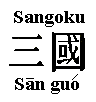 idea that there are "Three Kingdoms," Sangoku, 三國, is a Japanese conceit, placing those peripheral islands on equal standing with the great centers of civilization, India and China. Until the 20th century, there would not have been a shadow of justification for that, except perhaps in subjective judgments about the creativity or originality of Japanese culture, which I am sure would be disputed by Koreans and Vietnamese, especially when early Japan owed a lot to Korean influence.
However, in terms of the history of Buddhism, Japan can make some claims. Saichō (767-822) first used the term in relation to the transmission of the T'ien T'ai School, whose doctrine he brought directly from China. At the same time, in Korea the monarchy became fiercely anti-Buddhist, even forbidding Buddhist institutions or monks in the capital, while in contemporary Japan we see a flourishing of original Buddhist sects.
Buddhism was only freed in Korea because of the Japanese occupation, which itself motivated many Koreans to convert in protest to Christianity. In Vietnam, the principal development in Buddhism that I am aware of may have been that the conquest of Champa by Đại Việt in 1471 snuffed out the Theravāda culture of the South, including that of the Mekong Delta, subsequently taken from Cambodia.
Later, after a process of self-transformation sparked by American intervention, Japan leapt to the status of a Great Power by defeating Russia in 1905. This shocked and astounded the world, especially since the Russian fleet was not just defeated, but annihilated, leading to Teddy Roosevelt calling the Japanese the "Anglo-Saxons of the Orient." Many people in European colonies took heart from this, that European nations could be decisively defeated -- although the way the Koreans, Chinese, Filipinos, Burmese, and others were treated under Japanese occupation was quickly disillusioning.
The Japanese Empire, 大日本帝國, Dai Nippon Teikoku, then spent the next 40 years throwing its weight around, occupying Korea and invading China, ultimately taking on the United States in a disastrous bid for hegemony (1941-1945). Catastrophic defeat slowed Japan down a little, but by the 1980's, the country had vaulted to the highest per capita income in the world, with wealth and economic power that deeply frightened many, even in the United States. The ironic song, "Turning Japanese," by the Vapors [1980], began to seem prophetic.
Japan became the first and, for a long time, the only Great Power, in economic terms (as the Japanese military establishment remains low profile), not directly derived from European civilization. Even after a decade of economic stagnation in the 1990's, Japan remained the second largest economy in the world (about 40% the size of the United States, more than 1.7 times the size of Germany, and finally reviving a bit in 2004), although in per capita terms declining from 3rd in the world in 2003 to 11th in 2007 [The Economist Pocket World in Figures, 2007 Edition].
However, by 2010 the economy of China had surpassed Japan in absolute size, although, of course, far behind Japan in per capita terms. China is thus in the position that Russia was in 1914 -- underdeveloped in per capita comparisons but the fourth largest economy in the world (after the United States, Germany, and Britain) because of its relative development and absolute size.
The level of success of Japan, despite its relative decline, might still be thought to justify the Japanese view of themselves as having a unique, or at least special, "national essence," 國体, Kokutai, certainly of the first order of geopolitical importance, giving us some motivation for the inclusion of Japan in a "Sangoku" page. However, Japan has problems with an aging population and an economy that is still slowed by the drag of "zombie" companies, i.e. businesses that should have gone bankrupt but are unwisely protected. Japan has thus still not really shaken off the problems that developed in the 1990's.
At the same time, China has been aggressive against its neighbors, creating militarized islands, against international law, in the South China Sea, and trespassing in territorial waters claimed by Japan, Vietnam, the Philippines, and Indonesia. It regularly threatens Taiwan, despite the recognition of the "People's Republic" by the United States stipulating that the reunification of China only be done peacefully. This has motivated Japan to greatly increase its military budget. The obvious threat of China is alarming most of these countries in the area.
India has had less of a Bhāratavarṣa, भारतवर्ष, meant the "division of the world" (varṣa) of the Bhāratas -- the heroes of the great Mahābhārata epic. An independent India in 1947 decided to officially become Bhārat, भारत (the short final "a" not being pronounced in Hindi), with the earlier word emerging as Hindi Bhāratvarsh. Probably India did not have a clear local name earlier because, like China, it seemed to be the principal portion of the entire world, and so simply the world itself.
In 2023, it looks like the Indian government may be actively trying to replace international uses of "India" with "Bhārat." This follows a similar effort by Turkish dictator Erdoğan to replace "Turkey" with the Turkish version of the name, i.e. "Türkiye." Such moves always reflect increasing nationalism, often in response to internal opposition or international criticism. As in Burma, the international press and diplomacy often uncritically go along with this. A milder version of it is opposition to the usage in English of an article with the name of the Ukraine.
As essentially constituting the world, there was another early name for India, Jambudvīpa, जम्बुद्वीप, the "Island of the Jambu Tree." In Buddhist cosmology, this was the great Southern Continent in the sea around the cosmic Mt. Sumeru (or Meru), the only one inhabited with humans identical to us. Thus, despite the existence of the other continents, Jambudvīpa constituted our world for all practical purposes.
The only question was how much of it was taken up by India. Since the name often seems to be used interchangeably with India, there was early on not much sense that much existed beyond what we still call the "Subcontinent"; and since Jambudvīpa was thought to be triangular in shape, this was consistent with the form of India, which is roughly triangular. Indeed, India was once an island in the Mesozoic Ocean, but it moved north and collided with Asia. The use of Jambudvīpa for India may have declined as the size of Asia became more apparent from the reports of traders, travelers, and conquerors. Eventually, Buddhist cosmology was that Jambudvīpa consisted of "sixteen major countries, five hundred middle-sized countries, and a hundred thousand minor countries, as well as countless island countries scattered in the sea like 'millet grains or dust motes'." Since these numbers are vastly larger than the membership of the United Nations today, Jambudvīpa was ultimately conceived as larger than what we now know of the whole of Planet Earth.
In Chinese, we get various ways of referring to India. The modern form, When a unified state has occurred in Indian history, it has had varying religious, political, and even linguistic bases: e.g. Hindu, Buddhist, Islāmic, and foreign. The rule of the Sulṭāns of Delhi and the Moghul Emperors was at once Islāmic and foreign, since most of them were Turkish or Afghani, and the Moghul dynasty was founded directly by incursion from Afghanistan. The supremely foreign unification of India, of course, was from the British, under whom India achieved its greatest unity, although that was lost upon independence to the religious division between India and Pakistan. The Moghuls and British, of course, called India by its name in their own languages -- i.e. "Hindustān," हिन्दुस्तान, हिंदुस्तान (with "n" written as a nasalization, the anusvāra), or هِنْدُوسْتَان, and "India."
With a unified state in India a rare phenomenon, often under foreign influence, and with only a derivative indigenous name for the modern country as a whole, one might wonder if the term "Emperor," with its implications of unique and universal monarchy, is aptly applied to Indian rulers. However, from an early date there was a notion of such monarchy, which depended only on a conception of the world, particularly as Jambudvīpa, जम्बुद्वीप, whether India itself was clearly conceived or not, but with some actual examples, beginning with the Mauryas. The universal monarch Thus, the prophecy was that Siddhartha Gautama might have become the Buddha or a Cakravartin, a world ruler. The word was ambiguous, since the term can mean simply a sovereign, but its use is paralleled by the Latin word Imperator, which simply means "Commander" and grew, by usage, into a term for a unique and universal monarch. As it happened, many of the monarchs who began to claim ruler over all of India did usually use titles that were translations or importations of foreign words. Thus, the Kushans used titles like Rājatirājā, "King of Kings," and Mahārājā, "Great King," which appear to be translations from older Middle Eastern titles. While the original "Great King" long retained its uniqueness, thanks to the durability of the Persian monarchy, the title in India experienced a kind of grade inflation, so that eventually there were many, many Mahārājās. With Islām came a whole raft of new titles. One was Sulṭān, which originally was an Arabic title of universal rule itself but had already experienced its own grade inflation. Persian titles, like Pādeshāh, centuries after the Achaemenids, were now borrowed rather than translated. With the Moghuls, however, the names of the Emperors, more than their titles, reflected their pretensions: like Persian Jahāngir, "Seize (gir) the world (jahān)." The most remarkable title borrowed from the West is probably Kaisar, but the Latin title itself arrived with Queen Victoria, IND IMP, Indiae Imperatrix, in 1876. The last Indiae Imperator was King George VI, until 1947.
In addition to these complications, Indian history is also less well known and dated than that of China or Japan. Classical Indian literature displays little interest in history proper, which must be reconstructed from coins, monumental inscriptions, and foreign references. As Jan Nattier has said recently [A Few Good Men, The Bodhisattva Path According to the Inquiry of Ugra (Ugraparipṛcchā), University of Hawai'i Press, 2003]:
Because of this, even the dating of the Mauryas and the Guptas, the best known pre-Islāmic periods, displays small uncertainties. The rulers and dates for them here are from Stanley Wolpert's A New History of India [Oxford University Press, 1989], the Oxford Dynasties of the World by John E. Morby [Oxford University Press, 1989, 2002], and Bruce R. Gordon's Regnal Chronologies. Gordon had the only full lists I'd ever seen for the Mauryas, Kushans, and Guptas until I found the Oxford Dynasties, which has the Mauryas and Guptas but nothing else until the Sulṭanate of Delhi. Besides Wolpert, another concise recent history of India is A History of India by Peter Robb [Palgrave, 2002]. It is becoming annoying to me that scholarly histories like these are almost always but poorly supplemented with maps and lists of rulers, let alone genealogies (where these are known). Both Wolpert and Robb devote much more space to modern India than to the ancient or mediaeval country, and this preference seems to go beyond the paucity of sources for the earlier periods.
More satisfying than Wolpert and Robb is another recent history, A History of India by John Keay [Harper Perennial, 2000, 2004]. Keay has an apt comment for the phenomenon just noted in the other histories:
Keay thus does a better job of dealing with the eras (and their obscure events) that fall between the Mauryas, Guptas, and the Islamic states with their new, foreign traditions of historiography. One drawback of Keay's book is its total innocence of diacritics. Indeed, it is even innocent of any acknowledgement of this, which would leave the reader wondering why a word is given as "Vidisha" in one citation and "Vidisa" in another [cf. p.90]. Keay also exhibits the occasional ignorance of Indianists for the Persian and Arabic backgrounds of some words, where here I explain the difference between Ghazna and Ghaznī and between Moghul and Mughal. We also find Keay carelessly referring to the capital of the Caliph al-Walīd as Baghdad, a city that was not yet founded [p.185].
The "Saka Era," शककाल, as the Indian historical era, significantly starts rather late (79 AD) in relation to the antiquity of Indian civilization. Indeed, like Greece (c.1200-800 BC) and Britain (c.400-800 AD), India experienced a "Dark Ages" period, c.1500-800 BC, in which literacy was lost and the civilization vanished from history altogether. Such twilight periods may enhance the vividness of quasi-historical mythology like the Iliad, the Arthurian legends, and the Mahābhārata. The earliest history of India is covered separately at "The Earliest Civilizations" and "The Spread of Indo-European and Turkish Peoples off the Steppe." The affinities of Indian languages are also covered at "Greek, Sanskrit, and Closely Related Languages."
Readers should treat with caution some scholarship and a great deal of the material on the internet about the Indus Valley Civilization and its relationship to Classical Indian civilization, or all of civilization. The claims have progressed to the point now where not only are all of Indian civilization and all of its languages regarded as autochthonous (with Indo-European languages said to originate in India, and derived from Dravidian languages, rather than arriving from elsewhere and unrelated to Dravidian), but the civilization itself is said to extend back to the Pleistocene Epoch (before 10,000 BC), with any ruins or artifacts conveniently covered by rising sea levels. The urge towards inflated nationalistic claims is familiar. Particular claims about India are treated here in several places but especially in "Strange Claims about the Greeks, and about India."
Index
Copyright (c) 1998, 1999, 2000, 2001, 2002, 2003, 2004, 2005, 2006, 2007, 2008, 2009, 2012, 2018, 2020, 2023, 2025 Kelley L. Ross, Ph.D. All Rights Reserved

Emperors of India
 tradition of political unity than China or Japan. Indeed, most of the names for India ("India," "Hind," "Hindustān") are not even Indian. As Yule & Burnell say in their classic A Glossary of Colloquial Anglo-Indian Words and Phrases ["Hobson-Jobson," Curzon Press, 1886, 1985, p. 433]:
It is not easy, if it be possible, to find a truly native (i.e. Hindu) name for the whole country which we call India; but the conception certainly existed from an early date. Bhāratavarsha is used apparently in the Purānas with something like this conception.
 , renders the name phonetically with characters of no particular semantic significance ("print, stamp, or seal" and "a rule, law, measure, degree"). This rendering, of course, is based on a name from Greek, Ἰνδία, or Arabic, أَلْهِنْد (ʾal-Hind; هِنْدِي, Hindī, "Indian," हिन्दी in Devanagari), that would have been unknown in China until modern times. The older practice, however, was dedicated characters that might have a larger meaning. Thus, we get
 or
or  , in which can be a kind of bamboo but otherwise is just used for India. Semantically stronger is
  , where is primarily used for the Indian god Brahmā (
 ) and then for compounds involving India or Buddhism. Thus we get expressions like
  , "Sanskrit,"
  , "Sanskrit writing," and
  , "Sanskrit characters." In Japan, India was sometimes called the Yüehchih,
 , the "Moon Tribe." This appealed because of the contrast with Japan, the
  , "Sun Source." The Japanese knew from Chinese histories that the Yüehchih were in the West, and since they were a bit vague about what was in the West, but they knew that India was also, the connection got made. They might not have known that the Yüehchih actually did enter India as the Kushans
 was the Cakravartin, चक्रवर्तिन्, "Who Turns the Wheel of Dominion." He could also be called the "One Umbrella Sovereign," after the parasol carried to mark the location of royalty. The Cakravartin rules, or at least has authority, over all of Jambudvīpa. In Chinese, Cakravartin could be rendered as
  , "Wheel [i.e. Cakra] King,"
  , "Wheel Turning King," or
  , "Wheel Turning Sacred King." The first Chinese Emperor who thought of his universal dominion in these Buddhist terms was Yang Chien, founder of the Sui Dynasty.
...the writing of history in the strict sense does not begin in India until the 12th century, with the composition of Kalhaṇa's Rājataraṅgiṇī. [p.68]
In contriving maximum resolution for the present, there is also a danger of losing focus on the past. A history which reserves half its narrative for the nineteenth and twentieth centuries may seem more relevant, but it can scarcely do justice to India's extraordinary antiquity. [p.xxi]
| THE NANDAS, c.450?-c.321 | |
|---|---|
| Mahapadma Nanda | c.450?-c.362? |
| Pandhuka | c.362-? |
| Panghupati | |
| Bhutapala | |
| Rashtrapala | |
| Govishanaka | |
| Dashasidkhaka | |
| Kaivarta | |
| Dhana Nanda (Argames) | ? c.321 BC |
The First Buddhist Council, soon after the death of the Buddha, was held at the Magadha capital, Rajagriha, and so would have been under the patronage of a Nanda King. However, traditionally it was King Bimbisara of Magadha (of the Hariyanka Dynasty) who was supposed to have sponsored the Buddha, and Bimbisara's patricide son and successor, Ajatashatru, who sponsored the First Council. The reckoning of their dates goes with the earlier traditional dating, with Bimbisara ruling c.545-493 BC. Since the reconstruction of the early Kings of Magadha is based on legendary material in the much later Puraṇas, it is difficult to have much confidence in them as history. And the whole structure of the dates hangs on how long before Aśoka the Buddha lived. If a short chronology is preferable, some serious rethinking will be necessary about the relationlship of Bimbisara to the Nandas, whose own chronology of course, such as it is, is speculative.
THE MAURYAS,  , ,c.322-184 BC | |
|---|---|
 Chandragupta; Greek, Sandrákottos,  | c.322-301 |
 Bindusāra | 301-269 |
 Aśoka, Asoka | 269-232 |
| Kunala ? | 232-225 |
| Dasharatha | 232-225 |
| Samprati | 225-215 |
| Shālishuka | 215-202 |
| Devadharma/ Devavarman | 202-195 |
| Shatamdhanu/ Shatadhanvan | 195-187 |
| Br.hadratha | 187-185 |
The lion capital of the pillar at Sārnāth is now used as the official crest of the modern Republic of India, with the Wheel of the Law (Dharmachakra, धर्मचक्र) on it (as at right) featured the flag of India.
Indeed, Aśoka is the most famous for converting to Buddhism (or something, his references are to the dharma but are otherwise vague) and sending missionaries abroad. But his name, अशोक, "Without Sorrow," is a good Buddhist name. It was also easily translated into Chinese, as Wu-yu, 
 . We also get the ideology of the Cakravartin, चक्रवर्तिन्, the "Wheel Turning" universal monarch, i.e. the legitimate sovereign over all of Jambudvīpa, जम्बुद्वीप. But Aśoka was not the first Maurya to get religion late in life. Chadragupta himself is supposed to have renounced the throne, become a Jain monk, and eventually starved himself to death, in Jain fashion, in Bhadrabahu Cave in Karnataka.
Below we have a sculpted image of Aśoka from the extraordinarily well preserved Buddhist Stupa complex he built at Sanchi. He is surrounded by court women, whom we clearly see are lacking underwear, with the pudendal cleft (rima pudendi) not only shown, but conspicuous in a way that is contrary to human anatomy. This is a vivid example of how the Indian tradition of dress (and art) initially had no problem displaying female genitals. I know of no other example of this in world history.
The Egyptians and the Greeks, for all their comfort with various kinds of undress and nudity, nevertheless drew the line at female genitals. Greek and Rome sculpture typically doesn't even allow space between the legs for female genitals. Otherwise, the hips and breasts of the female figures here are familiar from all later Indian art. There is also the curious feature of this image that Aśoka seems to have an oversized head, and he also seems to be positively supported by two of the women, as though he is weak or stumbling. Is this some evidence of illness or deformity? We have no other information or indication of such things, so it will likely remain mysterious. The sensuality of a court with only all-but-naked female attendants in evidence may not be surprising in the nation of the Kama Sutra, but it may now seem a little incongruous at a sacred Buddhist site.

Aśoka can be rather well dated because he sent missionaries or letters to the contemporary Hellenistic monarchs, Antiochus II Theos (Antiyoka) of the Seleucid Kingdom, Ptolemy II Philadelphus (Turamaya) of Egypt, Antigonus II Gonatas (Antikini) of Macedonia , Magas (Maga) of Cyrene, and Alexander II (Alikasudara) of Eprius, urging them to convert to Buddhism themselves and apparently receiving the impession, one way or another, that they had. Greek history contains no record of these efforts. There is also an attested eclipse in 249 dated with a regal year date. Aśoka's reign is used to date the life of the Buddha, since tradition in Sri Lanka (Ceylon) is that the Buddha died 218 years before Aśoka came to the throne. That would put his death in 487 BC, which is close to the generally used date. The Ceylonese chronology is now often questioned, with alternative reckonings placing the Buddha's death about a century later. John Keay's history inclines in this direction [cf. op. cit. p.62].
In 1971 K.M. Srivastava excavated further at the site and discovered more relics, at a deeper layer, which findings were not formally published until 1991. The actual bones and ashes of the Peppe discovery had been donated by the British Government of India to the Buddhist King of Siam; but the inclusions of hundreds of small jewels, including gold leaf flowers and other treasures, had been divided between the Peppe family and the Government, with the family only keeping things that were duplicates.
It is worth recalling the Buddhist belief that cremation itself produces jewels as part of the ashes of saints, including the Buddha himself. The speculation now is that the Piprahwa relics consisted of the original 1/8th share of the Buddha's relics that had been given to the Śākyas, and that Piprahwa can be identified with the site of Kapilavastu that had been recorded as where the Śakyas kept the relics. The lower layer of excavation was from the original burial, while the stupa excavated by William Peppe was a later work, with reburial, of Aśoka himself.
Nepal believes that Kapilavastu is a site in that country, but nothing like the Piprahwa relics has ever been discovered anywhere else. That the stupa itself was built by Aśoka is a determination that relies on its date, since there are no inscriptions on site, except for the short text on the reliquary -- which itself is of the language and alphabet (the Brahmi) of Aśoka's age.
While the Mauryas are the beginning of historical India, a great deal had already been going on (like the life of the Buddha) that in a Greek or Chinese context we would expect to be within historical time. In traditional Indian terms, such events were already covered by the "Fifth Veda," the historical Epics of the Mahābhārata and the Rāmāyaṇa. One reason for the lack of interest in history in Indian secular literature may have been the feeling that, as only eternity is significant and all other time is cyclical and repetitive, the Epics thus represent everything that can possibly happen in history. There is even a saying, "Everything is in the Mahābhārata." Our lack of knowledge of individual Indian philosophers from this early period, even though we possess much of an undoubted early date in the Upaniṣads, may also be due to the idea that such texts, as parts of the Vedas, were actually part of eternal revelation and were not originated by their authors.
 Among Aśoka's many works for Buddhism, one has come in for recent prominence. In 1898, an amateur archaeologist, William Claxton Peppe, excavated a stupa at Piprahwa on his land near Birdpore -- itself near one of Aśoka's pillars. This was in Uttar Pradesh, in the ancient lands of the Śākya Clan of the Gautama Buddha. Relics, identified as those of the Buddha on one reliquary, were recovered by Peppe.
| MACEDONIAN KINGS OF BACTRIA 256-c.55 BC |
|---|
| THE SAKAS, c.130 BC | |
|---|---|
| Maues | 97-58 BC |
| Vonones | |
| Spalyris | |
| Spalagademes | |
| Spalirises | |
| Azes I | c.30 BC |
| Azilises | |
| Azes II | |
| THE PARTHIANS/SUREN | |
| Pakores | |
| Orthagnes | |
| Gudnaphar (Gondophernes) | c.19-45 AD |
| Abdagases | |
| Sasas | |
| Arsaces Theos | |
| Nahapa | 119-124 AD |
| THE SAKA ERA, THE INDIAN HISTORICAL ERA | 79 AD |
|---|---|
| 2000 AD - 78 = 1922 Annō Sakidae | |

Simultaneously with the descent of Sakas into India, Parthians (Pahlavas) or Suren appear from the west, and some of them become established in India independent (or not) of the Parthian King. The Parthians spoke a "North-Western" Iranian language, though its origin was far south of the Scythians. The sources are sometimes confused about which Indian rulers are Sakas and which are Parthians, since they are never attested as which. Gudnaphar (Greek Gondophernes), who traditionally is supposed to have welcomed the Apostle Thomas to India, seems to have been Parthian. The legend of the mission of Thomas to India is now of renewed interest because of the discovery of the text of the Gospel of Thomas, one of the Gnostic Gospels, in Egypt in 1945.
| THE KUSHANS | |
|---|---|
| Kujula Kadphises | c.20 BC-c.30/64 AD |
| Wima/Welma Taktu | c.30-c.80 |
| Welma Kadphises | c.80-c.103 |
| Kanishka I | c.103-c.127 AD |
| Vasishka I | c.127-c.131 |
| Huvishka I | c.130-c.162 |
| Vasudeva I | c.162-c.200 |
| Kanishka II | c.200-c.220 |
| Vasishka II | c.220-c.230 |
| Kanishka III | c.230-c.240 |
| Vasudeva II | c.240-c.260 |
| Vasu | late 3rd century |
| Chhu | late 3rd century |
| Shaka | 3-4th century |
| Kipanada | 4th century |
, the "Moon Tribe." They seem to have been a group who moved far east on the steppe very early, speaking a language with many archaic features.
The Hsiung-nu, 
 , probably the later Huns, drove the Yuèzhi back into the Tarim Basin (170 BC). These were the "Lesser" Yüeh-chih,
  . Some continued on into Transoxania, where they become the "Greater" Yüeh-chih,
  ). They dominated these areas c.100 BC-300 AD. The language of the Lesser Yüeh-chih is attested in Buddhist texts in two dialects of Tocharian (A and B).
The Greater Yüeh-chih, as the Kushans, followed other steppe people down into India. Some small uncertainty perisisted over the identification of the Yüeh-chih with the Kushans and the writers of Tocharian, but the debate over Tocharian seems to have been resolved with a positive identification. The recent discovery of well-preserved, European-looking mummies along the Silk Road serves to affirm the European and so Indo-European bona fides of the still illiterate (from a period long before Tocharian) local culture. Unfortunately, the Tocharian texts do not include historical works, which might have removed uncertainties and added an invaluable framework for understanding the area.
Although the dates are still very uncertain, historical information in India is rather better than for the preceding period. Of special importance is King Kanishka, under whom the Fourth Great Buddhist Council is supposed to have been held, as the Third was under Aśoka. Kanishka is said to have been converted to Buddhism by the playwright Ashvaghosha. The earliest actual images of Buddhas and Boddhisattvas date from his reign. Also of interest are the Kushan royal titles, Maharaja Rajatiraja Devaputra Kushāṇa. Rajatiraja, "King of Kings," is very familiar from Middle Eastern history, since monarchs from the Assyrians to the Parthians had used it. Maharaja, "Great King," is very familiar from later India but at this early date betrays its Middle Eastern inspiration, since it was originally used by the Persian Kings. Devaputra, "Son of God," sounds like the Kushans claiming some sort of Christ-like status, which is always possible,  but it may actually just be an Sanskrit version of a title of the Chinese Emperor, "Son of Heaven."
The Roman trading posts in Kushan India bespeak a great deal of trade and contact, about which we get the occasional notice in Greek and Roman writers, but which do not become a source of any extensive knowledge of India or its history recorded by either. Something else overlooked by Classical historians nevertheless turns up in Chinese history. That is, a Roman Embassy made its way by way of India by sea to the China of the Later Han Dynasty. It is recorded that in the year 166 AD (in the time of King Vasudeva I) an embassy arrived in Lo-Yang from a ruler of  , "Great Ch'in," named Andun, which looks like a rendering of Antoninus. The year 166 was in the early days of Marcus Aurelius (Antoninus). Since we know, besides the presence of Romans in India, that there were well traveled sea routes to China (see the voyage of Fa-hsien below), this Roman Embassy easily passes the test of credibility. It is a shame that such a project, like the letters written by Aśoka to Hellenistic monarchs, escaped the notice of Greek and Roman historians.
While the imperial maps here until 1701 are based on Stanley Wolpert's A New History of India [Oxford University Press, 1989], the map for the Kushans is based on the The Anchor Atlas of World History, Volume I [1974, Hermann Kinder, Werner Hilgemann, Ernest A. Menze, and Harald and Ruth Bukor, p.42], which now has been reissued in identical form as The Penguin Atlas of World History, Volume I [Penguin Books, 1978, 2003].
 The rule of the Guptas was one of the classic ages of Indian history, for whose culture we have a rather full description by the Chinese Buddhist pilgrim Fa-hsien (Fǎxiǎn, d.c.422), who was in India between 399 and 414 (see map below), in the time of Chandra Gupta II. This was the last time that the North of India would be united by a culturally indigenous power. The Guptas patronized the Hindu, Buddhist, and Jain religions equally. Consequently, they now become celebrated, like Aśoka and Akbar, as examplifying a modern liberal ideal of tolerance and enlightenment.
  This is anachronistic but not inappropriate as long as we realize the limitations of such an identification. The Indian monarchs, however relatively enlightened, were autocrats, and thus comparable less to liberal democracy than to "Enlightened Despots" like Frederick the Great of Prussia. Thus, their magnanimous patronage of religions certainly did not extend to the toleration of political opposition.
THE GUPTAS,  , ,c.320-551 AD | |
|---|---|
| Gupta | 275-300 |
 Ghaṭotkaca | 300-320 |
| Chandra Gupta I | 320-335 |
 Samudra Gupta | 335-370 |
| Rama Gupta ? | 370-375 |
 Chandra Gupta II | 375-415 |
 Kumāra Gupta I | 415-455 |
 Skanda Gupta | 455-467 |
| Kumāra Gupta II | 467-477 |
 Budha Gupta | 477-496 |
| Chandra Gupta III ? | 496-500 |
 Vainya Gupta | 500-515 |
 Narasimha Gupta | 510-530 |
| Kumāra Gupta III | 530-540 |
 Vishṇu Gupta | 540-551 |
While the name of Chandragupta, the founder of the Mauryas, is usually given as one word, the "Gupta," गुप्त ("guarded, protected"), element in names of the Gupta dynasty is usually, but not always, written as a separate word. The Oxford Dynasties writes them together. Classical Sanskrit, of course, like Greek and Latin, ordinarily did not separate words at all.
One of the unique monuments of the Gupta dynasty is the Iron Pillar of Delhi, seen at right. This is a solid piece of wrought iron more than 22 feet tall. Delhi may not have been its original location, but exactly where that would have been and when or why the pillar was brought to Delhi is a matter of conjecture. The pillar is dedicated to Vishnu, but any other Hindu structures around it were demolished by the Sulṭāns of Delhi, who built the nearby Qutub Minar tower and the Quwwat-ul-Islam mosque. Dating the pillar is also a matter of some uncertainty, since its inscription merely mentions a King named "Chandra." This is generally taken to mean Chandra Gupta II, reinforced by the evidence of the style and language of the pillar, in comparison to known art of the Guptas, like the coins of Chandra Gupta II. It is also sometimes said that the pillar was erected to commemorate Chandra Gupta by his successor Kumāra Gupta I. The Pillar, however, is such an extraordinary artifact that some people reject the mundane historical explanations and prefer that the object is much, much older, or even the work of extra-terrestrials. The Pillar does testify, however, to the sophistication of Indian iron work, of which there is much other evidence. The steel of the famous Damascus steel swords of the Middle Ages was actually manufactured and exported from India, with techniques that had been used for centuries. The Pillar, although not itself steel, does exhibit the technique that leaves it appearing to be a single piece of iron -- forge welding, where hot iron is hammered and fused together. This is the technique that produced the bars of steel that were exported.
The pilgrimage of Fa-hsien is noteworthy for many things, but one feature in particular evident from the map is that the entire homeward leg of the journey was by sea.  This reminds us of the sea routes that had been busy since the Greeks and extended all the way from Egypt to China. We have frustratingly little in the way of historical documents about this business, but when we do get an account, as with Fa-hsien, we realize how routine the communication was (with understandable hazards and misadventures).
Towards the end of the period, the Guptas began to experience inroads from the Huns (Huna), the next steppe people, whose appearance in Europe (it is supposed that these are the same people), of course, pressured German tribes to move into the Roman Empire. By 500, Huns controlled the Punjab and in short order extended their rule down the Ganges. They don't seem to have founded any sort of durable state and eventually suffered defeats. The Huns were the last non-Islamic steppe people to invade India.
| Vardhanas of Thanesar | |
|---|---|
| Naravardhana? | c. 500-? |
| Rajyavardhana I? | |
| Pushyabhūti | |
| Adityasena Vardhana | c.555-580 |
| Prabhakaravardhana | c.580-c.605 |
| nephew of Mahāsenagupta | |
| Rajyavardhana (II) | c.605-606 |
| Harsha Vardhana | 606-647 |
| The Later Guptas, of Magadha, c.550-700 AD | |
|---|---|
| Kumāragupta | c.550-560 |
| Dāmodaragupta | c.560-562 |
| Mahāsenagupta | c.562-601 |
| vassals of Kālachuris, 595/6-c.601 | |
| Mādhavagupta | c.601-655 |
| Ādityasena | c.655-680 |
| Devagupta | c.680-700 |
| overthrown by Yashovarman of Kanauj, 725-730 | |
Harsha Vardhana, from Thanesar, north of Delhi, was one ruler who for a while united most of the North of India again, and, as luck would have it, we have the account of Hsüan-tsang (Xuanzang, 600-664), another Chinese Buddhist pilgrim, who went to India between 629 and 645, during his time. In his A History of China [Basic Books, 2009], John Keay says, "Indeed, most of what is known of Harsha and his empire, and of India in the seventh century, derives from Xuanzang's Record of the Western Regions" [p.241]. There is a remarkable sequel to this:
In the mid-nineteenth century, armed with a French translation of Xuanzang's itinerary (the first to appear in any European language), Alexander Cunningham, a Scots general in British India, devoted his retirement to rediscovering the long-forgotten sites associated with the Buddha's life and early Buddhism; from this exercise there grew the Archaeological Survey of India, whose responsibilities now probably exceed those of any other heritage body and of which Cunningham was both founder and director. [ibid., p.241]
Thus, the ancient Chinese pilgrim allows the modern British general to initiate the modern archaeology of Indian Buddhism, and then that of all India.
Hsüan-tsang's account follows a story we have from the other direction, that of a Greek sailor, Cosmas Indicopleustes, Κοσμᾶς ὁ Ἰνδικοπλεύστης, who visited India, Ceylon, and even Axumite Ethiopia some time before 550 AD, during the reign of the Roman Emperor Justinian. Unfortunately, Cosmas was a bit of a crackpot who seemed just as concerned with proving, despite widely accepted evidence (recounted in detail by Aristotle), that the Earth was flat rather than spherical. Thus, we can imagine that Cosmas, whose book was the Christian Topography, was hostile to a round earth for much the same (religious) reasons that contemporary anti-Darwinians are hostile to Evolution.
Harsha enjoyed a long reign but, when he attempted to expand south into the Deccan, he was defeated by Pulakeshin II of Vātāpi (or Badami). Subsequently, we get dynasties whose power occasionally spans the country, but none are able to secure hegemony for long.
Indian Buddhism, although patronized by Harsha, already seemed to be in decline to Hsüan-tsang, and some important Buddhist sites were already neglected or abandoned. John Keay cites the Pala Dynasty of Bengal (8th-9th centuries AD) as the "last major Indian dynasty to espouse Buddhism" [India, op.cit. pp.192-193]. Indeed, I think the contemporary development of Tantrism was obscuring the differences between Hinduism and Buddhism -- Keay agrees with this [p.194, in a comment marred by the rationalism he attributes to the pure original Buddhism of the Buddha]. It was also during this period that we begin to get identifiable individual Indian philosophers, like Shankara (c.780-820), from whom we have a classic formulation of the doctrine of the Vedanta School. With the period of the Classical Empires over, it is striking that only now do individuals appear in the light of history in Indian philosophy. There is speculation that Shankara already represents a reaction to the arrival of Islām on the borders of India.
| the Deccan, the Carnatic, & Mahārāṣṭra | |
|---|---|
| Chālukyas of Vātāpi | |
| Pulakeshin I | c.543-566 |
| Kīrtivarman I | c.567-597 |
| Mangalesha | c.597-609 |
| Pulakeshin II | c.609-642 |
| overthrows Kālachuris, c.620; killed in battle by Narasimha Varman I of Pallava, 642; interregnum, 642-655; Arab attacks, 644 | |
| Vikramāditya I | 654/5-681 |
| Arab attacks, 677 | |
| Vinayāditya | c.680-696 |
| defeats Later Gupta Devagupta, 695 | |
| Vijayāditya | c.696-733/4 |
| Vikramāditya II | c.733-744/5 |
| defeat and explusion of Arabs from India, 737 | |
| Kirtivarman II | 744/5-753 |
| Rāṣṭrakūṭas of Ellora & Malkhed | |
| Dantidurga | c.735-744 |
| Krishna I | c.755-772 |
| Dhruva Dhārāvarsha | c.780-793 |
| defeats Gangetic powers but abandons North | |
| Govinda III | c.793-814 |
| occupies North again, height of Rāṣṭrakūṭa power | |
| Amoghavarsha | c.814-880 |
| Krishna II | c.878-914 |
| Indra III | c.914-928 |
| Amoghavarsha II | c.928-929 |
| Govinda IV | c.930-935 |
| Amoghavarsha III | c.936-939 |
| Krishna III | c.939-967 |
| Khoṭṭiga | c.967-972 |
| Karkka II (Amoghhavarsha IV) | c.972-973 |
| Chālukyas of Kalyāṇī | |
| Taila II Ahavamalla | 973-997 |
| Satyasraya Irivabedanga | 997-1008 |
| invasions of Mahmud of Ghaza, 1001-1024 | |
| Vikramaditya I | 1008-1014 |
| Ayyana | 1014-1015 |
| Jayasimha | 1015-1042 |
| Somesvara I | 1042-1068 |
| Somesvara II | 1068-1076 |
| Vikramaditya II | 1076-1127 |
| Somesvara III | 1127-1138 |
| Jagadekamalla | 1138-1151 |
| Tailapa | 1151-1156 |
| Kālachuris | |
| Bijjala | 1156-1168 |
| Somesvara | 1168-1177 |
| Sankama | 1177-1180 |
| Ahavamalla | 1180-1183 |
| Singhana | 1183-1184 |
| Chālukyas | |
| Somesvara IV | 1184-1200 |
| Yādavas | |
| Singhana | 1200-1247 |
| Krishna | 1247-1261 |
| Mahadeva | 1261-1271 |
| Amana | 1271 |
| Ramachandra | 1271-1311 |
| Sankaradeva | 1311-1313 |
| Harapaladeva | 1313-1317 |
| To Delhi, 1317-1336; then Vijayanagar, 1336 | |
Initial invasions by the Arab Omayyad Caliphs, starting in 644, were repulsed by 737, after episodes of the Arabs slaughtering local populations or deporting them as slaves. Curiously, these Muslims were at first called "Greeks," i.e. Yavana, यवन. This is rather like the way the Chinese called the Portuguese "Hui,"  , i.e. Muslims, when they first arrived in China.
The following period, then, is the calm before the full force of Islām burst on the country with the invasions of Maḥmūd of Ghazna, from 1001 to 1024. While Shankara's views were later criticized as too influenced by Buddhism, they are more faithful to the Upanishads than the theism of the critics, who themselves seem increasingly influenced by the monotheism of Islām.

The period of the Arab invasions of India (644-737) corresponded to the residence of an important Chinese pilgrim in India, I-ching (635-713), from 673 to 687. While previously pilgrims, and Indian missionaries, had traversed Central Asia for at least one leg of their journey, I-ching went entirely by sea. We also might notice that his travels in India did not extend to the Western part of the country, as had those of previous pilgrims. We therefore might harbor the suspicion that he avoided an area where warfare that attended the invasions was raging. This is at least a portent of the later Islamic Conquest, which will help eliminate Buddhism from India. Also, I-ching spends several years at a Buddhist center in Indonesia, whose Buddhism, still flourishing, will also be eliminated by the advent of Islām there.
While it is not difficult to find bare breasts in Classical Indian art, after a while one begins to notice something rather more shocking. This minimal dress varies with other representations where the narrow band of a loincloth (a dhoti) may extend down to the feet, front and back, both on goddesses and others, without our having any clue on the reason for this variation. When the vulva is shown, there does not seem to be any effort to portray pubic hair, which actually would be comparable to the Egyptian practice, which survives even in the modern Middle East, of shaving pubic hair.
In Western art, female nudes became common from the Mediaeval period on, and Modern art contains female nudes in abundance, often as Neo-Classical references to Greek and Roman nudes. Nowever, the rima pudendi is all but never visible in the whole expanse of this art. Nor is there ever the sort of "thigh gap" at the top of the legs that would render the labia and rima more conspicuous. There is something about all these structures that has made Western artists, from the Greeks on, very nervous. As far as I know, this is a unique object. Portraying the rima pudendi obviously did not catch on in Greek or Roman art, and if there were other such imports from India around, they must have been destroyed in the Christian moralization of artworks. But we also might note in this example of sculpture that the placing of the vulva is more exaggerated and unnatural than in the other examples here: the rima pudendi is really not going to be evident, from the front, in natural anatomy; and all Indian art, but especially this statue, takes increasing liberties to make it explicit.
To see how unnatural this is, click for a popup image of a front view of the female pelvis. This is an anatomically explicit image, so do not click on the link if one is liable to be offended by such an image. It will be obvious that the vulva is not visible from the front, with only a hint of the labia and the beginning of the rima. In those terms, the image is less explicit that all of the Indian sculpture shown.
Japanese manga figures, amid their various bodily exaggerations, are generally anatomically accurate and do not misplace the vulva like this, even as it is generally present.
Equally curious is the treatment of Indian dress in history and scholarship on India. For instance, the Indian Art volume of the "Oxford History of Art" [Partha Mitter, 2001] has only a single large image of a Classical figure with both breasts and vulva bare [p.18], but the breasts are actually broken off and the genital area is photographed in shadow, with the pudendal cleft invisible. Since the caption speaks of the "'full-moon' face" of the figure, where the head is simply missing from the sculpture shown, This reminds me of the problem when John Ruskin (1819-1900) married Euphemia "Effie" Gray (1828-1897) in 1848. The marriage was never consumed, and it was finally annulled in 1854. From the comments in Effie's letter to her father, we may gather that Ruskin wasn't familiar with female anatomy and found Effie's body alarming. While we generally expect that Victorian women were more ignorant of male anatomy than the opposite, that is what seems to have happened here. We should be reminded of the rarely quoted aside by Nietzsche that "we easily conceive a hatred for nature on account of all the repulsive natural functions to which every woman is subject," ...so haben wir leicht einen Haß auf die Natur, aller der widerlichen Natürlichkeiten gedenkend, denen jedes Weib ausgesetzt ist. This may explain the reaction of Ruskin to his bride -- if not Partha Mitter's presentation of Indian art.
A clue about an intermediate stage in the evolution of female dress in India may be in the Mahābhārata. When Duḥshāsana tries to humiliate Draupadī by pulling off her clothes, we might wonder exactly what is going to be exposed. In terms of the modern sārī, it will not be her breasts; for these are covered by a separate garment, the bodice or choli, which may not antedate the 10th century AD. Duḥshāsana is clearly pulling off a long piece of cloth, the sārī proper, which is miraculously extended to protect Draupadī's modesty. This is what would cover her genitals and buttocks, which in modern India, or even China and Europe, would be considered something to be concealed. If the Mahābhārata was completed by about 300 AD, then we might imagine that the custom of female genital exposure must have largely disappeared by the time of the Guptas.
My source for the list of the rulers from the fall of the Guptas (551) to the dominance of the Sulṭanate of Delhi (1211), beginning with the line of the Chālukyas, was originally from Bruce R. Gordon's Regnal Chronologies. I took details of the period from Stanley Wolpert's A New History of India [Oxford, 2000, pp.95-103]. There was clearly uncertainty about the dates, since Wolpert has Krishna I Rāṣṭrakūṭa, patron of the remarkable Kailasanatha temple to Shiva, reigning 756-775, while Gordon has 768-783. This is, of course, not too surprising, given the problems with Indian historiography. Later, however, I found a much more thorough treatment of the period in Ronald M. Davidson's Indian Esoteric Buddhism, A Social History of the Tantric Movement [Columbia University Press, 2002], which has an extensive summary of the whole period [pp.25-62], with maps and lists of many of the rulers. Here we find Krishna I with the dates c.755-772, in much closer agreement with Wolpert, but still, of course, residual uncertainties. John Keay's A History of India [Harper Perennial, 2000, 2004] covers the period with similar thoroughness.
 Later there appears to be a decisive influence from Islām on Indian dress. While in Classical India women are typically shown bare breasted, as at left, the rigors of the Middle Eastern nudity taboo came into full force in modern India, at least for women. I am not aware just when this transition occurs. John Keay cites several references from the 13th to the 15th century on the nudity of the Indians, including a Russian traveler, Athanasius Nikitin, who around 1470 described Indians going about all but naked, with "their breasts bare" [op.cit. p.277]. By the 19th century Krishna's lover Radha is shown in a full shoulder to floor woven dress or sari. Someone could easily chronicle the transition by cataloguing such sculpture and portraiture.
 Female figures appear wearing little more than a belt around their hips, with the labia majora and pudendal cleft (rima pudendi) plainly visible. While this is now mainly preserved in the figures of goddesses and spirits, such as the yakshini spirit at right, who may represent hightened sexuality, it also appears among the women of the Court of Aśoka, and so for a while seems to have been acceptable in ordinary costume. The name of the semi-divine Sītā, the wife of the Avatar Rāma, of the epic Rāmayāna, सीता, Sītā, actually has the basic meaning "furrow." This is explained by the story of her miraculous birth from the furrow of a plowed field, but it is not hard to see it as a reference to the actual rima pudendi. Metaphors of sexual intercourse as plowing, and of female genitals as furrows, are common in all agricultural societies.
 This exposure of female genitals seems to me very unusual in world history. Even in cultures that today tolerate little or no dress, the female genitals usually seem to be the first thing covered, or the last thing uncovered, sometimes with folk beliefs that unwary males looking directly at the vulva might be blinded. Egyptian hieroglyphics, which when dealing with sexual organs at first seem quite explicit, nevertheless appear to shy away from representing the structures of the vulva.
 We know that the Romans, at least, were aware of the explicitness of Indian art because a statue of the goddess Lakshmi was found at Pompeii, in what is actually called "the House of the Indian Statuette," between 1930 and 1935, and held at the Museo Archeologico Nazionale de Napoli. The description of the statue is that it is "naked," but we know from our other examples that it is not, as this was reckoned in India. This Lakshmi is wearing as much as the women of Aśoka's Court, even if that mostly consists of jewelry.
 I am left with the impression that the example was not chosen with particular care that it illustrate the attributes, like "rounded breasts," that are described. And it is as close as we get in the whole book to the level of exposure that is evident in so much of the early art. Otherwise, although we do see occasional comment about the bare torsos of Classical Indian dress, I have never seen actual discussion of the bare female pudenda. This all would seem to make people uneasy.
 However, we get perhaps a contrary, but ambiguous, indication from the sculpture at left, from the Rani ki Vav step well at Patan in Gujarat. This dates from the 11th century. The goddesses in the well wear the ancient belt, and all that seems to cover the pudenda is a long tassle, one of several around the belt. In the figure shown, although not on the others, the belt seems merely rope-like, and it has come down, perhaps pulled by the monkey. We get the faintest hint of the rima pudendi here; and one wonders, at this late date, if there is a sense of naughty humor in this, like the dog pulling down the girl's bathing suit in the
  old Coppertone tanning lotion ads. If so, it may mean that the old level of exposure is no longer quite acceptable -- but still not positively banned. This is the era, indeed, when Islām is beginning to make its inroads. The monkey still represents a bit more erotic fun than Islām will tolerate.
| Kārkoṭas of Kashmir | |
|---|---|
| Candrāpīḍa | c.711-720 |
| asks for alliance with China, 713 | |
| Tārāpīḍa | c.720-725 |
| Lalitāditya Muktāpīḍa | c.725-756 |
| overthrows Yashovarman of Kanauj, 733; secures Ganges Valley, 747; dies in Tarim Basin | |
| Kuvalayāpīḍa | ? |
| Vajrāditya | ? |
| Prthivyāpīḍa | ? |
| Samgrāmāpīḍa | ? |
| Jayāpīḍa Vinayādirya | c.779-810 |
| The Gurjara-Pratīhāras of Ujjain & Dantidurga | |
|---|---|
| Nāgabhaṭa I | c.725-760 |
| helps defeat Arabs, 725 | |
| Devarāja | c.750-? |
| Vatsarāja | ?-c.790 |
| Nāgabhaṭa II | c.790-833 |
| occupies Kanauj and middle Ganges, 815 | |
| Rāmabhadra | c.833-836 |
| Mihira Bhoja | c.836-885 |
| Mahendrapāla I | c.890-910 |
| Mahīpāla | c.910-? |
| Bhoja II | ?-914 |
| Vināyakapāla I | c.930-945 |
| Mahendrapāla II | c.945-950 |
| Vināyakapāla II | c.950-959 |
| Vijayapāla | c.960-1018 |
| invasions of Mahmud of Ghaza, 1001-1024 | |
| Rājyapāla | c.1018-1019 |
| Trilocanapāla | c.1019-1017 |
| Mahendrapāla III | ? |
More importantly, the history of India in this period is not the national history of linguistic communities. It is dynastic history, and dynasties like the Chālukya were much more interested in territory, anywhere, than in national origins, homelands, or languages. Thus, Chālukyas ruled elsewhere, without much regard for the local language, with branches of the dynasty in what is now Andhra Pradesh (Telugu speakers) and Gujarat (Gujarati). When the Vātāpi Chālukyas were overthrown by their vassals, the Rāṣṭrakūṭas of Ellora, this was a dynasty definitely seated in a Marāṭhī speaking area of Mahārāṣṭra, though they subsequently moved their capital to Malkhed, virtually at the border between Karnataka and Andhra Pradesh. The Rāṣṭrakūṭas were in time displaced by a branch of the Chālukyas again, who in turn fell to the Kālachuris, a dynasty from a region in modern Madhya Pradesh that now speaks Hindi. Thus, the language of their domain was not nearly as important to all these rulers as the possession of dominion.
As the Chālukyas moved, they could also take a geographical name with them. The British rendering of "Karnataka" was as the "Carnatic" (much like the word in Hindi, where a short final "a" would not be pronounced). The name "Carnatic" migrated south and south-east, with the movements of the Chālukya dynasts. On the Bay of Bengal, the Eastern Chālukyas became established, and we also find the name "Carnatic" applied there. That eastern "Carnatic" then also came to be associated with the large Vijayanagara realm, which straddled the modern states of Karnataka, Tamil Nādu (the language is Tamil), and Andhra Pradesh. Thus, on old maps of India, the name "Carnatic" can sometimes be found adjacent to the west coast, and on others along the south-eastern coast. The name disappeared altogether for a while between Mahārāṣṭra to the north and the later state of Mysore to the south. The modern Indian state of Karantaka was originally itself called "Mysore," but this was changed in 1973 to "Karnātaka" to reflect its linguistic character.
Pulakeshin II declared himself "Lord of the Eastern and Western Waters." Although the Chālukyas never united the north or dominated the country like the Guptas or Harsha, they would appear there, and I have focused on them and their successors as the best sequence to span the period down to the Sulṭāns of Delhi. There were many other states of similar size and power during this era, several often called "Empires." Now I include lists for Kashmir and for the Gurjara-Pratīhāras, whose realm centered on Ujjain in the western part of the modern Madhya Pradesh. All of these states contended at one time or another for the Ganges Valley and thus were candidates for achieving a North Indian hegemony. Their successes proved only temporary, often because of rebellions in their rear.
The Chālukya dynasty suffered a severe reverse when Pulakeshin II was killed in battle by Narasimha Varman I of Pallava, and Vātāpi occupied. After reestablishing themselves, they most importantly planted cadet lines in the East and in Gujarat, which would eventually provide for the restoration of the dynasty.
| Chola Kingdom | |
|---|---|
| Vijayalaya | c. 846-c. 871 |
| Asitya I | c. 871-907 |
| Parantaka | 907-947 |
| Rajaditya I | 947-949 |
| Gandaraditya | 949-956 |
| Arinjaya | 956 |
| Parantaka II | 956 |
| Aditya II | 956-969 |
| Madhurantaka Uttama | 969-985 |
| Rajaraja I Deva the Great | 985-1012 |
| Conquest of Ceylon, 993 | |
| Rajendra I Choladeva | 1012-1044 |
| Rajadhiraja I | 1044-1052 |
| Rajendra II Deva | 1052-1060 |
| Ramamahendra | 1060-1063 |
| Virarajendra | 1063-1067 |
| Adhirajendra | 1067-1070 |
| Rajendra III | 1070-1122 |
| Diplomatic mission to China, 1077 | |
| Vikrama Chola | 1122-1135 |
| Kulottunga II Chola | 1135-1150 |
| Rajraja II | 1150-1173 |
| Rajadhiraja II | 1173-1179 |
| Kulottunga III | 1179-1218 |
| Rajaraja III | 1218-1246 |
| Rajendra IV | 1246-1279 |
| Overthrown by Delhi, 1279 | |
One of the "Empires" of the period was the Kingdom of Chola. As it happens, this is a realm in origin and history with a decidedly linguistic basis, in the Tamil language of modern Tamil Nādu. The Chola Kings cultivated Tamil literature and are remembered as heroic patrons of Tamil power, learning, and religion. Chola is in the competition as an "Empire" because of it spread north, briefly all the way to the mouths of the Ganges, and, most strikingly, by its projection beyond the sea, initiated by King Rajaraja I Deva, whose name has the decidedly Imperial ring of "King of Kings, god." With grave portent for future history, the first such projection of Chola power was into Ceylon. Tamils had settled in Ceylon and briefly ruled there already, and even the Chola occupation was relatively short lived, but it all contributed to a durable Tamil ethnic presence that, in the modern day, exploded into a vicious and protracted civil war, whose appalling course and sobering lessons are examined elsewhere.
Of dramatic course and great portent in its own way is the other projection of Chola power, which was across the sea of the Bay of Bengal, through isolated land such as the Andaman Islands, all the way to Sumatra, Malaya, and the trade route of the Straits between those Indonesian islands. It is hard to know how much of the area was actually occupied and ruled. Some maps (optimisticly or nationalisticly) show a Chola domain over entire islands like Sumatra and over the entire peninsula of Malaya. Other maps (more realistically) show a Chola presence along the coastlines. In whichever form, this is the first example we know of an incursion that will be significantly mirrored in later history. Four hundred years after the Chola presence, the Chinese would arrive in the Straits from the opposite direction and initiate what was probably much the same kind of process, finally arriving themselves at Ceylon and the coast of Tamil Nādu. As we will see below, this did not last long. Not long after the Chinese left, however, the Portuguese arrived from across the Indian Ocean, themselves occupied Ceylon and areas on the mainland of India, and then followed in the wake of the Chola voyagers into Indonesia. This produces occupations of considerable extent and duration, though mostly consumated by the Dutch and the British who replaced the Portuguese. The Chola "Empire" thus pioneers the colonial history of Indonesia -- though the hiatus between the Chola presence and the arrival of the Chinese will see a heavy Islamicization, by influence of trade alone, of the area.
Chola was finally broken up by the Sulṭanate of Delhi, which, however, was unable to retain a dominant position in the south. Thus, the small kingdom of Madura became the successor state at the southern tip of India, while the larger kingdom of Vijayanagar came to dominate much of the South, including the old metropolis Chola, Gangaikondacolapuram.
 The map shows the aggressive powers of the 11th century in India. In the South, Chola looks on its way to making the Bay of Bengal into a Cholan lake, but apparently it never does have much success on the coast of Burma, where Pagan has grown into a powerful kingdom with its own brilliant civilization. The darker green in the image shows the conquests of Rajendra I, the son of Rajaraja I.
Otherwise, what we see is the domain of the conqueror Maḥmūd of Ghazna. He began raiding into India in the year 1001 (enough to warm the heart of any ordinalist). Eventually he established a presence in the Punjab, but he also continued raiding deeper into India, usually with the aim of plunder, to be sure, but practiced with particular relish in the sacking of Hindu and Jain temples. This allowed for the particuarly Islamic diversion of smashing idols -- where in most Islamic conquests, in Christian and Persian lands, there had actually been few to smash.
This set a poor precedent in the area, since in recent years the savage vandals of the Tālibān regime in Afghanistan determined to smash all the Buddhist art in the Kabul Museum and that present around the country on cliff-face sculpture, including two great cliff carved Buddhas in Bamian province, 175 and 120 feet tall. Subsequently, Jihadist forces have destroyed monuments in Palmyra, in Syria, and even Muslim tombs and libraries in Mali. These atrocities and vandalism, along with human carnage, certainly represent the worst of Islamic Fascism. Given the fury of his own attacks, Maḥmud's treatment of the Hindu population was actually more conciliatory than one might expect, and it laid the groundwork, once the smashing was finished, for durable Islamic regimes in India.
A curious linguistic issue arises when we deal with Maḥmud. The name of the city of Ghazna, غَزْنَى, is written in the Arabic alphabet with the letter "y" at the end. Ordinarily, this would indicate the long vowel "ī"; but sometimes in Arabic, and originally in this case, the "y" is pronounced as the vowel "a." This is called alif maqṣura and occurs in some very common words in Arabic. Thus, sources that one might expect to be intimate with Arabic, like The New Islamic Dynasties,
| Rājās of Mysore | |
|---|---|
| Ballala I | 1100-1110 |
| Vishnuvardhana | 1110-1152 |
| Narasimha I | 1152-1173 |
| Ballala II | 1173-1220 |
| Narasimha II | 1220-1238 |
| Somesvara | 1233-1267 |
| Narasimha III | 1254-1292 |
| Ballala III | 1291-1342 |
| Vijayanagara rule after 1336 | |
| Virupaksha Ballala IV | 1342-1346 |
| Vacant, 1346-1399 | |
| Wadiyar, Wodeyar Dynasty | |
| Yadu Raya | 1399-1423 |
| Hiriya Bettada Chamaraja I | 1423-1459 |
| Timmaraja I | 1459-1478 |
| Hiriya Chamaraja II | 1478-1513 |
| Hiriya Bettada Chamaraja III | 1513-1553 |
| Timmaraja II | 1553-1572 |
| Vijayanagara broken up by Moghuls, 1565 | |
| Bola Chamaraja IV | 1572-1576 |
| Bettada Devaraja | 1576-1578 |
| Raja Wadiyar | 1578-1617 |
| Chamaraja V | 1617-1637 |
| Immadi Raja | 1637-1638 |
| effective independence, 1637 | |
| Kanthirava Narasaraja I | 1638-1659 |
| Kempa Devaraja | 1659-1673 |
| Chikkadevaraja | 1673-1704 |
| Kanthirava Narasaraja II | 1704-1714 |
| Krishnaraja I | 1714-1732 |
| Chamaraja VI | 1732-1734 |
| Krishnaraja II | 1734-1766 |
| Muslim Ḥaydarids | |
| Ḥaydar 'Alī Khān Bahādur | 1762-1782 |
| First Anglo-Mysore War, 1766-1769; Second Anglo-Mysore War, 1780-1784 | |
| Wodeyar figureheads for Ḥaydarids | |
| Nanjaraja | 1766-1770 |
| Bettada Chamaraja VII | 1770-1776 |
| Khasa Chamaraja VIII | 1776-1796 |
| Tīpū Sulṭān | 1782-1799 |
| Third Anglo-Mysore War, 1789-1792; Fourth Anglo-Mysore War, 1798-1799 | |
| restoration of the Wodeyars | |
| Krishnaraja III | 1799-1831, d.1868 |
| British rule, 1831-1881 | |
| Chamaraja IX | regency, 1868-1881 |
| 1881-1894 | |
| Krishnaraja IV | 1894-1940 |
| Jayachama- rajendra Bahadur | 1940-1949 |
| Annexation to India, 1947 | |
In Arabic, where "y" indicates the long vowel "ī," we get two dots under the letter. However, in Persian, the dots are not used (and vowels rarely indicated), the word is written غَزْنَى, and, consequently, alif maqṣura tends to end up getting read in the more obvious way, as a long "ī."
Eventually this happened with Ghazna, which today is locally pronounced "Ghaznī," which would have been written غَزْنِي in Arabic. Thus, sources, including modern news sources, whose focus is more on India and less on Islam or on Arabic,
| SULṬĀNS OF DELHI (DILHÎ) | |
|---|---|
| Muʿizzī or Shamsī Slave Kings | |
| ʾAybak Quṭb ad-Dīn | Commander in India for the Ghūrids, 1192-1206 |
| Malik in Lahore, 1206-1210 | |
| destroys Buddhist library and monastery at Nalanda, 1193/4 | |
| ʾĀrām Shāh | 1210-1211 |
| ʾIltutmish Shams ad-Dīn | Sulṭān in Delhi, 1211-1236 |
| Fīrūz Shāh I | 1236 |
| Raḍiyya Begum | Sulṭāna, 1236-1240 |
| Bahrām Shāh | 1240-1242 |
| Mas'ūd Shāh | 1242-1246 |
| Maḥmud Shāh I | 1246-1266 |
| Balban ʾUlugh Khān | viceroy since 1246 |
| 1266-1287 | |
| Kay Qubādh | 1287-1290 |
| Kayūmarth | 1290 |
| Khaljīs | |
| Fīrūz Shāh ʾII Khaljī | 1290-1296 |
| ʾIbrāhīm Shāh I Qadır Khān | 1296 |
| Muḥammad Shāh I ʿAlī Garshāsp | 1296-1316 |
| ʿUmar Shāh | 1316 |
| Mubārak Shāh | 1316-1320 |
| Khusraw Khān Barwārī | 1320 |
| Tughluqids | |
| Tughluq Shāh I | 1320-1325 |
| Muḥammad Shāh II | 1325-1351 |
| Fīrūz Shāh III | 1351-1388 |
| Tughluq Shāh II | 1388-1389 |
| ʾAbū Bakr Shāh | 1389-1391 |
| Muḥammad Shāh III | 1389-1394 |
| Sikandar Shāh I | 1394 |
| Maḥmūd Shāh II | 1394-1395, 1401-1412 |
| Nuṣrat Shāh | 1395-1399 |
| Tamerlane sacks Delhi, 1398 | |
| Dawlat Khān Lôdī | 1412-1414 |
| Sayyids | |
| Khiḍr Khān | 1414-1421 |
| Mubārak Shāh II | 1421-1434 |
| Muḥammad Shāh IV | 1434-1443 |
| ʿĀlam Shāh | 1443-1451 |
| Lôdīs | |
| Bahlūl | 1451-1489 |
| Sikandar II Niẓām Khān | 1489-1517 |
| ʾIbrāhīm II | 1517-1526 |
| Moghul Rule, 1526-1540 | |
| Sūrīs | |
| Shīr Shāh Sūr | 1540-1545 |
| ʾIslām Shāh Sūr | 1545-1554 |
| Muḥammad V Mubāriz Khān | 1554 |
| ʾIbrāhīm III Khān | 1554-1555 |
| ʾAḥmad Khān Sikandar Shāh III | 1555 |
While, Islām came to India in great measure in the person of Maḥmūd of Ghazna, this progressed to permanent occupation under his successors, the Ghūrids. Their viceroys in India, originally from slave troops like the Mamlūks in Egypt, drifted into independence at the beginning of the 13th century. These "Slave Kings" thus founded the Sulṭānate of Delhi. This began an Islāmic domination of India, especially the North of India and the Ganges Valley, that lasted until the advent of the British.
The consequences of the Islāmic conquest of India can hardly be underestimated. Up to a quarter of all Indians ended up converting to Islām. Buddhism disappeared. Some of the greatest monuments of Indian architecture, like the Taj Mahal, really reflect Persian and Central Asian civilization rather than Indian. Indian Moslems became accustomed, as was their right under Islāmic Law, to be ruled by a Moslem power. In practical terms, that meant that they did not want to be ruled by Hindus, when and if India should become independent. Today, the separation of Pakistan and Bangladesh from the Republic of India, with ongoing strife between them, and the occasional riot between Hindus and Moslems in India itself, are all the result of this.
Mysore (Mahisur, Maysūr, Mahishūru, Mysuru) began as a dependancy of the rulers of the Deccan to the North. In 1100, in the days of the Chālukyas of Kalyāṇī, Mysore became independent under the dynasty that had been in place since the 6th or 7th century. However, after the passage of the Sulṭāns of Delhi, Mysore then became a dependency of the Vijayanagara kingdom that was established in 1336. The Wodeyar Dynasty was a cadet line of Vijayanagara. The subordination of Mysore was broken up after Vijayanagara was defeated by the Moghuls in 1565. Moghul rule, such as it was, seems to have ebbed and flowed in presence and affectiveness. The domination by Aurangzeb was certainly a brief one, after which Mysore was independent.
Mysore lost its traditional Hindu rule and became a center of conflict when its own general, Ḥaydar Alī, who had defeated the Marathans, seized power in his own right. The Rājās were retained as figureheads until deposed in 1796 by Ḥaydar's son, the celebrated Tīpū. The rule of these Muslim warriors quickly led to repeated conflict with the British. Ḥaydar Alī became an active ally of the French in the War of American Independence, 1778-1783 (the Second Anglo-Mysore War, 1780-1784), but his invasion of Madras, with some French troops, was defeated. However, after his death (1782), Tīpū crushed a British force of 2000, killing 500 and taking the rest prisoner. This made him the "Tiger of Mysore." Tīpū amused himself with a six-foot long mechanical figure of a tiger gnawing at the throat of an Englishman and snarling at the turn of a crank.
Continuing with the enemies of his enemy, Tīpū entered into relations with Revolutionary France, whose rationalists, deists, and atheists curiously found a kindred spirit in a fanatical and tyrannical Muslim -- a dynamic we may see today in the affinity of the Left for Islamic Fascism. When Napoleon landed in Egypt in 1798, it looked like help might be on the way; but there really wasn't much that the French Republic could do for "Citizen Tipu." The British whittled away at Tīpū's realm until he was killed in 1799. The Wodeyar Rājās were restored, doubtless with some relief to Hindus who had undergone forced conversion and circumcision by Tīpū.
The first map below is based on Stanley Wolpert [op.cit.]; but the following map, and those of Harsha and of Chola above, are based on maps in The Harper Atlas of World History [Pierre Vidal-Naquet, Editor, Jacques Bertin, Cartographer, Harper & Row, New York, 1986, p.117]. In assembly information for the maps on this page, this is the only source I have that shows Chola or the Sulṭānate at its high water mark.

On the map of India in 1236, the Sulṭānate of Delhi has completed its conquest of the North of India, all the way down the Ganges to the Bay of Bengal. Although the fortunes of the state will vary, this area will generally be preserved until the coming of the Moghuls.
 On the map for 1335, we see the Sulṭānate of Delhi astride the whole Sub-Continent. This is the largest Indian state in a long time, if not the largest ever. But it will not last long.
The following map below, for 1350, indicates the kingdoms in the South that are the result of the earlier states (like Mahārāṣṭra and Chola) being broken up by Delhi, which, then unable to remain dominant in the area, was driven out.
We also see the routes travelled by Zhèng Hé, the Chinese admiral who led seven great voyages of exploration, trade, and military intervention during the early days of the Ming Dynasty, from 1405 to 1433. The military intervention became less a factor the further West we get. It was intense in Indonesia, where considerable battles were fought and kings were made -- or sent back to China for execution. A Chinese base was established and fortified at Malacca. In Ceylon, we still get some intervention, with King Vira Alakeshvara of Raigama (1397-1411) captured and sent back to China. But the Emperor apologized for this, and returned the King to Ceylon (though not, apparently, to his throne). Further West, trade and embassies seem to have been the rule. All this stopped abruptly in 1433, as China withdrew from foreign contact. When the Portuguese arrived in 1498, the Chinese were long gone.

| Vijayanagar | |
|---|---|
| SANGAMA | |
| Harihara I | 1336-1356 |
| Bukka I | 1356-1377 |
| Harihara II | 1377-1404 |
| Virupaksha I | 1404-1405 |
| Bukka II | 1405-1406 |
| Devaraya I | 1406-1422 |
| Rama- chandra | 1422-1430 |
| Vira Vijaya I Bukka Raya | 1422-1424 |
| Devaraya II | 1424-1446 |
| Vijaya II | 1446-1447 |
| Mallikarjuna | 1446-1465 |
| Virupaksha II | 1465-1485 |
| Praudha Raya | 1485 |
| SALUVA | |
| Narasimha- devaraya | 1485-1490 |
| Thimma Bhupala | 1490-1491 |
| Immadi Narasimha | 1491-1505 |
| TULUVA | |
| Vira Narasimha | 1505-1509 |
| Krishna- devaraya | 1509-1529/30 |
| Achyota- devaraya | 1529/30-1542 |
| Venkata | 1542 |
| Sadashi- varaya | 1542-1565 |
| disrupted by Moghuls, 1565 | |
| ARAVIDU | |
| Tirumala Devaraya | 1565-1572 |
| Sriranga I Devaraya | 1572-1586 |
| Venkatapati I Devaraya | 1586-1614 |
| Sriranga II Raya | 1614 |
| vacant | |
| Rama- devaraya | 1617-1632 |
| Venkatapati Raya | 1632-1642 |
| Sriranga III Raya | 1642-1646 |
| Venkatapati II Raya | 1646-c.1660 |
The kingdom of Vijayanagar, based in the area of Kannada speakers again (stretching East in Telugu speaking country), originates in revolt against the Sulṭānate of Delhi, which only briefly dominated the South, but nevertheless broke up the older powers in the area. Vijayanagar reestablishes local independence. It will continue dominant until the arrival of the Moghuls. We do not, however, see a simple conquest any cleaner than what Delhi had managed to accomplish in the same area. In 1565, Akbar defeated and disrupted the power of the state, but the result was not Moghul occupation. Instead, a cadet line of Vijayanagar at Mysore begins to overshadow its parent state, as recounted above and shown on the maps below. By the time Aurangzeb returned to briefly conquer the area, Vijayanagar had faded away. In 1646 the capital itself was seized by the Sulṭāns of Bijapur and Golkonda. The last king, Venkatapati II, was thus himself an exile in some small fragment of the former kingdom.
Sikhism, from Pāli
| Sikh Gurūs | ||
|---|---|---|
| 1 | Nānak | 1469-1539 |
| 2 | Aṅgad | 1539-1552 |
| 3 | Amar Dās | 1552-1574 |
| 4 | Rām Dās Soḍhi | 1574-1581 |
| 5 | Arjun Mal | 1581-1606 |
| 6 | Hargobind | 1606-1644 |
| 7 | Har Rāi | 1644-1661 |
| 8 | Hari Krishen | 1661-1664 |
| 9 | Tegh Bahādur | 1664-1675 |
| 10 | Gobind Rāi Singh | 1675-1708 |
| Khālsā, 1699 | ||
| Bandā Singh Bahādur | 1708-1716 | |
| Moghul campaign of extermination, 1716-1733 | ||
| Nawab Kapur Singh | Nawwāb, 1733-1753 | |
| recognized by Moghuls, 1733; attack on Nādir Shāh, 1739; Sikh Confederacy, 1745; 11 Misls, 1748; Khālsā Rāj, Punjab, 1761 | ||
| Ranjīt Singh | Mahārāja, 1801-1839 | |
| Sikh column attacked by Wahhābīs, "Hindustani fanatics," who are massacred, 1827; Sikhs defeated by Wahhābīs, 1828; Peshawar occupied by Wahhābīs, Pathans massacre Wahhābīs, 1830; Sikhs annhilhate Wahhābīs, Battle of Balakot, 1831 | ||
| Kharak Singh | 1839-1840 | |
| Nao Nehal Singh | 1840 | |
Chand Kaur  | 1840-1841 | |
| Sher Singh | 1841-1843 | |
| Duleep Singh | 1843-1849, d. 1893 | |
| First Sikh War, 1845-1846; Second Sikh War, 1848-1849; annexed by British, 1849 | ||
| Victor Duleep Singh | Heir of Punjab, 1893-1918 | |
| Frederick Duleep Singh | 1918-1926 | |
Actually, I am curious about कौर , which is said to mean "princess" in both Punjabi and Hindi. But the word of that spelling in the Oxford Hindi-English Dictionary [edited by R.S. McGregor, Oxford, 1993] only has the meaning "a mouthful (of food)" [p.219]. This is glossed as possibly being a Dravidian word, and indeed it does not occur in my Sanskrit lexicon [Practical Sanskrit Dictionary, by Arthur Anthony MacDonnell, Oxford, 1929, 1971, p.75]. I am surprised that there is this obscurity about it.
At first this transformation did not seem to improve things much. Gobind Singh and his temporal successor, Bandā Singh Bahādur, both died violent deaths, and the community fragmented. But with the decline of Moghul power, opportunity knocked. The Khālsā was soon again unified and installed in Lahore, under Ranjīt Singh, who became Mahārāja of the Punjab. Henceforth the Sikhs, although never more than a minority, were the greatest military power in northern India. The death of Ranjīt, however, led to a chaotic succession and conflict among his heirs. Two sharp wars with the British led to the annexation of the Punjab, after which Sikh warlike ambitions could be directed through membership in the British Indian Army, where the Sikhs stood out with their characteristic turbans and beards.
In the Punjab, we have a major crossroads of history. The name, "Five Rivers," we find in Persian, پَنْجَاب, Pænjab (i.e. پَنْج, pænj, "five," and آب, āb, "water, river"). The "u" in the English name probably is the result of the "a" being a reduced vowel, as "schwa" [ə], in Hindi-Urdu, पंजाब, Pañjāb. Just what rivers these are is a matter of some small uncertainty. In Sanskrit, the area was the "Seven Rivers," सप्तसिन्धु, Saptasindhu; and there are enough rivers, indeed, that these could be multiplied. However, the general idea is that the Indus, Ἰνδός, सिन्धु, Sindhu, and its five major tributaries constitute the Punjab.
The tributaries considered for this are (1) the Jhelum, (2) the Chenab, (3) the Ravi, (4) the Beas, and (5) the Sutlej.  If the Indus itself is counted as one of the "Five," then the Sutlej might be dropped. This seems a little odd, since the Beas is a tributary of the Sutlej, which is a lot longer, flowing into the Indus. The answer may be that the road to the Ganges, such as followed by Alexander the Great, reaches the Beas before the Sutlej. All of these rivers have different names in multiple languages. What are shown on the map are the names, of course, in English, in Greek, and in both Hindi and Urdu (in the Arabic alphabet).
A curious case is the Beas (or Bëas, or Bias) River, whose name in Hindu or Urdu I had some difficulty finding. Wikipedia didn't have either on its "Beas" page.
What is shown on the map is Sanskrit, विपाश, Vipāśa, and Arabic, بِيَاة, Biyāh. For the Arabic, I only had a clue from "Hobson-Jobson," A Glossary of Colloquial Anglo-Indian Words and Phrases, by Henry Yule & A.C. Burnell [1886, 1985, Curzon Press, 1995, p.742]. Yule & Burnell quote al-Birūnī using "Biah" [c.1020] and, apparently, Tamerlane using "Biyāh" [c.1400], which I have used to produce the likely rendering, albeit speculative, in Arabic.
An actual Hindi name I could only find on pages in Hindi about the Beas, fortunately with the name in the title and first line, which did not prevent my ignorance of Hindi from interfering with the identification. Thus, the basic Hindi name seems to be ब्यास, Byās. A variant of this is व्यास, Vyāsa, where we have a "v" instead of a "b." As it happens, this is often what we see in Sanksrit for a "b" in Hindi, and with a "v" this word looks like the name of the author of the Mahābhārata. Thus, we seem to find a tradition that the river was actually named after him.
The Greek names of the rivers are discussed in the relation to the campaign here of Alexander the Great, with relevant sites in purple. The cities in red are either ancient (Harappa) or modern (Delhi, Lahore, and Amritsar).
In modern India a movement began for Sikh independence from India, with the Indian Punjab becoming Khālistān. Led by Sant Jarnail Singh Bhindrānwale, this led to a catastrophic showdown in 1984 when the Golden Temple in Armitsar, the fortified center of the Sikh Faith, was stormed by the Indian Army, and Bhindrānwale killed. When Prime Minister Indria Gandhi was assassinated later the same year by Sikh bodyguards, few doubted that this was an act of revenge. Sikh nationalism continues to trouble India, although the historic Sikh kingdom lies equally in Pakistan.
 MOGHUL EMPERORS | |
|---|---|
| Great Moghuls | |
Bābur,  | 1498-1500, 1500-1501 in Transoxania |
| 1526-1530 | |
Humāyūn,  | 1530-1540, 1555-1556 |
ʾAkbar I,  | 1556-1605 |
Jahāngīr,  | 1605-1627 |
| Dāwar Bakhsh | 1627-1628 |
Shāh Jahān I,  , ,Khusraw,  | 1628-1657, d. 1666 |
ʾAurangzeb/ʾAwrangzīb, , ,ʿĀlamgīr I,  | 1658-1707 |
Shāh ʿĀlam I,  , ,Bahādur,  | 1707-1712 |
| Jahāndār Muʿizz ad-Dīn | 1712-1713 |
| Farrukh-siyar | 1713-1719 |
| Shams ad-Dīn Rāfiʿ ad-Darajāt | 1719 |
| Shāh Jahān II Rāfiʿ ad-Dawla | 1719 |
| Nīkū-siyar Muḥammad | 1719 |
Muḥammad Shāh,  , Nāṣir ad-Dīn, , Nāṣir ad-Dīn,  | 1719-1748 |
| Looting of Delhi by Nādir Shāh, 1739 | |
| Aḥmad Bahādur Shāh I | 1748-1754 |
| ʿAzīz ad-Dīn ʿĀlamgīr II | 1754-1759 |
| Shāh Jahān III | 1759 |
| Shāh ʿĀlam II | 1759-1788, 1788-1806 |
| Diwani of Bengal granted to East India Company, 1765; Marathans eject Afghans from Delhi, 1770 | |
| Bīdār-bakht | 1788 |
| Muʿīn ad-Dīn ʾAkbar II | 1806-1837 |
| Moghul authority replaced by Britain, 1827; English replaces Persian, 1828; Suttee illegal, 1829; suppression of Thugee launched, 1836 | |
| Sirāj ad-Dīn Bahādur Shāh II, | 1837-1858, d.1862 |
| Great Sepoy Mutiny, 1857-1858; British Rule, 1858-1947 | |
There the /gh/ is ordinarily pronounced as a /g/, but otherwise meaning the Arabo-Persian fricative /γ/ (indicated by the diacritic underdot in Devanāgarī), not the proper voiced aspirate stop /gh/ of Sanskrit.
The Hindi-Urdu name Mughal now tends to be used by historians, on the principle that it is an "endonym," the name used by the people to whom it refers. However, although Mughal is used in Modern India and Pakistan, it was not used by the people to whom it refers. On the other hand, it is the English word "Mogul," which we find in dictionary entries and is used for Hollywood movie executives, that looks to be based directly on the Persian. Its use was standardized in the 18th century.
Many names were used for the Mongols, long before the advent of the Moghuls in India. In Marco Polo we see Mungul. In the 14th century there is Moccol in Portuguese and even Μουγουλίος, Mougoulíos, in Greek. Portuguese is still using Mogor in the 18th century.
Persian was the Court language of the Moghuls themselves. "Mughal" would have been strange to them. Although Arabic and Persian have variant writings that seem to have have included this, the short "u" would have been pronounced "o" in proper Persian. The dominant language today, Hindi-Urdu or Hindustani, was simply the language that ended up adopted as the language of the Moghul army -- as it remained the language of command in the British Indian Army, which meant British officers had to learn to speak it, as did Indian recruits, like Punjabis, whose first language was something else. Thus, when William Slim, later the victorious commander in Burma, found himself about to be discharged from the British Army after World War I, he continued his career by moving to the Indian Army and, of course, learning Hindi.
Hindi has gone on, in turn, to be the principal language of India, although it is used as a first language mainly in the North. Hindi is also the national language of India, along with English. The original idea to replace English with Hindi has been stopped by States where Hindi is not an official language. The defining text of Indian law is still the one in English, and deliberations of the Indian Supreme Court are in English.
Some States, like Mahārāṣṭra, have neither Hindi nor English as official languages, which has resulted in phenomena such as official replacement of English "Bombay" with Marāṭhī "Mumbai" as the name of that city. This reflects Indian politics, not anti-colonialism. Marāṭhī is the only official language of Mahārāṣṭra, despite a reported 38 other languages spoken there. The replacement of "Bombay" with "Mumbai" even in English is the result of politically correct confusion, i.e. asinine "virtue signaling," about place names.
As a center of the Indian movie industry, Bombay continues to be called "Bollywood," and its movies are mostly filmed in Hindi. A South Indian movie industry, with movies shot in Tamil or Telugu, has come to be called "Tollywood." One of its movies, the marvelous two part Bāhubali [2017], became an international sensation, in Tamil, Telugu, and Hindi versions; but the internationally available DVD is only the film dubbed in Hindi. The name, बाहुबलि, Bāhubali, "Strong Arm," is, of course, Sanskrit -- the equivalent name in European history, used for Baldwin I of Flanders and William de Hauteville, would be Bras de Fer, "Iron Arm."
We should reflect that the current preference among academics for Mughal is in part the result of a modern ideological preference for a "national" language, along with the political principle that we should use the name for a people that they use for themselves, the purported "endonym," in their own language. This is something that the Moghuls would have found alien and perplexing, both in principle and in result. They certainly weren't speaking Hindi-Urdu. It thus verges on the anachronistic and may seem biased in a distractive, deceptive, and politically correct way. It is not a practice and does not reflect an attitude that is proper to a historian. And, ironically, this means that calling a Hollywood studio executive a "Mogul" may reflect a pronunciation that is more faithful to the Moghuls than the current "best practice" of historians -- the expression "Bollywood Mogul" might be the nicest taunt to the language police. We find similar political quibbles over the transcription of Greek [note].

Pretensions to universal rule, which figure in Indian mythology, in Persian imperial tradition, and in the titles of earlier Indian rulers,
|
Feudal Hierarchy
Monarchical Acclamations |
Almost from the first, Moghul policy was to tolerate and win the cooperation of Hindus, especially the warriors of Rajasthan. With ʾAkbar, this approached a policy of positive toleration and religious syncretism, which earned Akbar the disfavor of Moslem clerics but,  like Aśoka, the esteem of modern liberal opinion. Akbar even toyed with the idea of a universal syncretistic religion, to be called the Din-e Allāh, the "Religion of God." This was rather like what the Sikhs originally tried to do. But while Hinduism was open, more or less, to various kinds of syncretism (like adopting the Buddha as an Avatar of Vishnu), Islām certainly was not.
The maps of Moghul India begin to feature European colonial possessions. Portugal is first, and for a good while they have the scene to themselves. Goa is the center of the operation, which then would extend all the way to China and Japan. St. Francis Xavier (d.1552) entered Japan and learned Japanese, and his reportedly incorrupt body is now still enshrined at Goa. Although nearly lost among the billion people of India, a fair number of Catholics survive from Portuguese missionary activity, often with Portuguese names, like D'Souza. Famous Portuguese missionaries in China, like Matteo Ricci (d.1610), also passed through Goa. The Kingdom of Kandy in Ceylon came to be in a rebellion against the Portuguese (1590) and then would survive in the mountains all through the Dutch tenure on the island, until the British took over (1815).
Until this point the maps of Imperial domains in India are based on Stanley Wolpert's A New History of India [Oxford University Press, 1989]. Now, however,  they are largely based on the The Anchor Atlas of World History, Volume I [1974, Hermann Kinder, Werner Hilgemann, Ernest A. Menze, and Harald and Ruth Bukor] and Volume II [1978], and the Historical Atlas of the World [Barnes & Noble, 1972].
Even the most basic elements of Moghul policy were reversed by the fanatical ʾAwrangzīb, أَوْرَنْگْزِيب (or ʾAurangzeb), who briefly brought the Empire to its greatest extent but whose measures against Hindus and Sikhs (the execution of the ninth Sikh Gurū) fatally weakened the state. Non-Moslems no longer had any reason to support the Moghuls, and in short order the Empire was only a shell of its former strength and vigor, with the Persians sacking Delhi itself (1739), under the Emperor, Muḥammad Shāh, who had otherwise done somewhat well at maintaining things.
A century after ʾAkbar, with the death of ʾAurangzeb, as the Moghul Empire totters at maximum extent a moment before fatally shrinking, things are getting a bit crowded, with Britain, the Dutch, the French, and even the Danes piling on. One of the earliest British toeholds was Bombay, which was actually a gift from Portugal in the dowry of Catherine of Braganza when she married Charles II of England in 1664. In 1701, it looks like the Dutch have the strongest hold, but as the 18th century progressed, and the Moghul domain crumbled, France and Britain would become the principal rivals for hegemony.
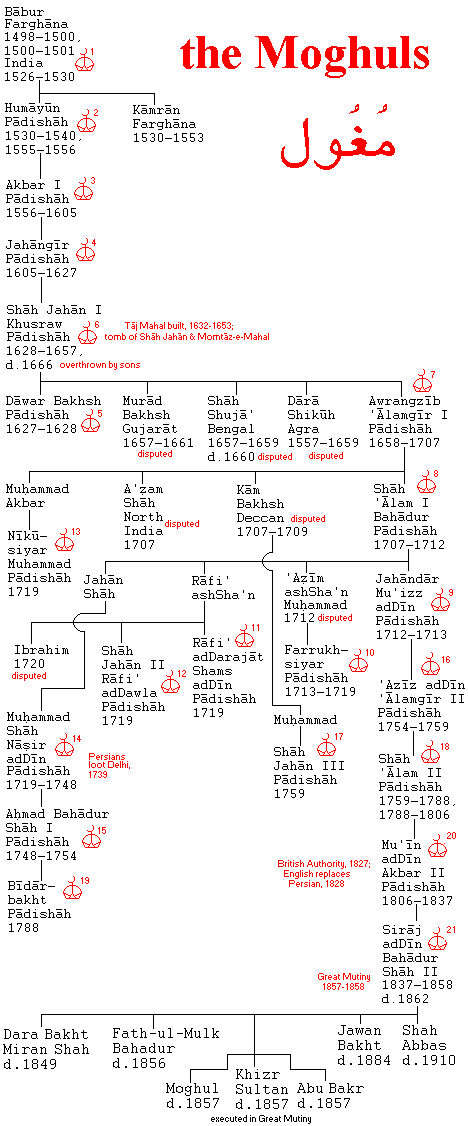 Henceforth, the shell of Moghul authority would stand just until a new conquering power would appear. After a surge of French influence under their brilliant governor Joseph Dupleix (d.1763), that turned out to be the British, who, however, only gradually conceived the notion of actually replacing nominal Moghul authority with an explicit British Dominion in India. Although the last Moghul was deposed in 1858, after the Great Mutiny, the full process was not complete until Queen Victoria was proclaimed Empress of Indian in 1876. The British Rāj would then last exactly 71 more years -- testimony to the rapidity of modern events after the 332 years of the Moghuls.
How durable the British heritage will be is a good question. The form of government in India, which has in general remained democratic, is far more British than that of other former British possessions. And English, with its own distinctive Indian accent and vocabulary, remains the only official language of the country that does not provoke communal conflict. To many, the experience of British rule is a bitter memory, but it is only Hindus who may maintain the same kind of animus against the Moghuls. The removal of British monuments -- I've notice a statue of Edward VII transported to Toronto -- then dangerously suggests the removal of Moghul or Muslim monuments, which is now not unheard of.
The genealogy of the Moghuls is entirely from The New Islamic Dynasties, by Clifford Edmund Bosworth [Edinburgh University Press, 1996]. Some brief reigns given by Bosworth, which are so ephemeral as not to figure in most lists of the Moghuls, including the table above, are marked as "disputed." Otherwise, the title, Pādishāh, پَادِشَاه, "Emperor," and an imperial crown are given.
The most memorable monument of the Moghuls is the Tāj Mǝhǝl, تَاج مَهَل, ताजमहल, "Crown Palace." Shāh Jahān built this mausoleum in tribute to his favorite wife, Mumtāz-i-Mahal, مُمْتَازِ مَهَل, "Select of the Palace" (in Persian, this would be pronounced Momtāz-e-Mahal -- mumtāz is Arabic [root myz] and can mean "distinguished," "exquisite," "select," "excellent," etc.), the mother of Aurangzeb. Shāh Jahān lies there now with her, but his reign did not end well. He became ill and his sons then fell out among themselves, until Aurangzeb, the last of the Great Moghuls, gained control -- and imprisoned Shāh Jahān for the rest of his life.
One might say that Aurangzeb ruled with such force, breaking, among other things, with the Rajputs, who earlier Moghuls had co-opted to the regime, that the Empire shattered in his hands. For a good while, as the realm broke up, the Throne was passed between brothers and cousins. Some stability was achieved when it no longer made much difference.
The last, aging Moghul, Bahādur Shāh II, threw his lot with the Mutineers and was deposed by the British.  He was then exiled in Rangoon for the rest of his life. The image is of his arrest -- the old man with the white beard -- after he fled Delhi ahead of the British. Three sons are with him, Moghul, Khizr Sulṭan, and Abu Bakr.
A British officer, Captain William Hodson, summarily executed -- i.e. murdered -- all or two of these -- some accounts place the execution of Abu Bakr a month later. This may have been to prevent their ever becoming a focus of resistance; but in the long run, of course, it made them martyrs, not to mention being a despicable way to treat defeated royalty -- especially the Emperor to whom the British, after a fashion, still owed some loyalty.
Bahādur Shāh was still the nominal sovereign of India, and none of his family owed the British any loyalty. Other sons nevertheless survived, with modern descendants -- some still litigating for Moghul property. But it is clear from world history, the victors only tend to be magnaminous when they don't still feel threatened by those they defeat. Thus, the Romans spitefully pursued Hannibal, and Caesar treated Vercingetorix shamefully; but Justinian pensioned off the defeated Kings of the Vandals and the Ostrogoths. The British, in turn, defeated the Zulus, but the British public received with jubilation and celebrated the defeated King Cetshwayo. The murdered and then surviving Moghul sons may represent the intensity, and then fading, of British fears, respectively.
| Maratha (Mahratta) Confederacy/Empire | |||
|---|---|---|---|
| Chattrapatis, Kings | |||
| Sivaji I the Great | 1674-1680 | ||
| Shambhuji I | 1680-1689 | ||
| Rajaram I | 1689-1700 | defeat and occupation by the Moghuls, 1700 | |
| Tara Bai | regent, 1700-1708 | ||
| Chattrapatis, Kings | Peshwas, Ministers | ||
| Shahu I | 1708-1749 | Balaji Vishvanath | 1713-1720 |
| Baji Rao I | 1720-1740 | ||
| Balaji Baji Rao | 1740-1761 | ||
| Ramaraja II | 1749-1777 | Madhava Rao Ballal | 1761-1772 |
| defeated by Afghans, battle of Panipat, 1761, occupation of Delhi, 1770 | |||
| Narayan Rao | 1772-1773 | ||
| Raghunath Rao | 1773-1774 | ||
| Madhava Rao Narayan | 1774-1796 | ||
| Shahu II | 1777-1808 | Chimnaji Appa | 1796 |
| Baji Rao II | 1796-1818 | ||
| Pratap Singh | 1808-1839 | ||
| Shahji Raja | 1839-1848 | ||
The Marathans were already in revolt under Sivaji I the Great, and Aurangzeb was only able to put them down with difficulty. Shambhuji I was tortured and killed in 1689. After furious resistance and battles, Aurangzeb could claim victory; but after his death and the release from captivity of Shahu I, Marathan power recovered quickly and a large part of central India was lost to the Moghuls forever.
Although the Marathan domain is often called an "Empire," we also see it called merely a "Confederacy." This may indicate some difficulties in holding the domain together, which ultimately rendered it less powerful than its extent might indicate. We also get the curious circumstance that Shahu I began to leave the responsibilities of government to his minister, Balaji Vishvanath. The line of ministers, the Peshwas, come to exercise the rule of the Marathan domain, which is sometimes then said to simply be the realm "of the Peshwas."
In three wars between 1776 and 1818, the British defeated the Marathans and annexed a good part of their territory. The Western part of Maratha is now the State of Mahārāṣṭra, whose capital is Bombay, बम्बई, now officially styled Mumbai, मुंबई, in Marāṭhī. Observing political correctness, Bombay is now generally referred to in international discourse as "Mumbai."

| Nawwābs of the Carnatic, at Arcot | |
|---|---|
| Zū-l-Fiqār ʿAli Khan | c.1690-1703 |
| Dāʾūd Khān | 1703-1710 |
| Muhammad Saʿādat-Allah Khan I | 1710-1732 |
| Dost ʿAli Khan | 1732-1740 |
| Safdar ʿAli Khan | 1740-1742 |
| Saʿādat-Allah Khan II | 1742-1744 |
| ʾAnwar ud-Din Muhammad | 1744-1749 |
| defeated by the French, 1744; defeated by the French & killed, 1749 | |
| Chanda Sahib | 1749-1752 |
| installed by the French under Dupleix, 1749; defeated by the British, surrendered, executed, 1752 | |
| Wala Jah Muhammad 'Ali | 1749-1795 |
| installed & supported by the British | |
| ʿUmdut ul-Umara | 1795-1801 |
| ʿAzim ud-Dawlah | 1801-1819 |
| ʿAzim Jah | 1819-1825 |
| Annexed to British India, 1825 | |
Both the Nawwāb Anwar ud-Din of the Carnatic and the Ṣūbadār Nāṣir Jang of Hyderabad were killed in battle with the French allied to pretenders to their positions. French forces were sent with Muẓaffar Jang to support his government in Hyderabad. However, in 1752 their candidate for the Carnatic, Chanda Sahib, was defeated in battle, surrendered, and then was executed by the British candidate, Muhammad 'Ali, who would then rule under British protection for many years.
By 1756, Dupleix had been recalled (in 1754), and his policies repudiated. His job, after all, was to make money, not to make war on the English or take over Indian states. He had done this with some justification during the War of the Austrian Succession (1740-1748) but his aggressive actions had continued after the Peace. This was a problem, and, indeed, the adventure in Hyderabad never did make any money for the French.
In retrospect, Dupleix's recall looks ill considered, as the Seven Years War (1756-1763) was about to begin; the local French forces would need to make war on the English; and France would need as strong a position as possible to do that. She wasn't going to have it, and the British would be just as victorious in the war in India as in the Americas. But that is in hindsight. Back in France in 1754, it would not have been appreciated that Dupleix had created a whole new dynamic in Indian history. Formerly, Moghul authority continued to external appearances and Europeans approached local officials deferentially with nothing but trade privileges in mind. Now, with some exceptions and setbacks, the European traders could make and unmake local authorities at will. This was at first discovered and exploited by the French, but the British would prove far better and more successful at the game.
| Nawwābs of Bengal, 1704-1765 | |
|---|---|
| Murshid Qulī Khān ʿAlāʾ ad-Dawla | 1704-1725 |
| Shujāʿ Khān Shujāʾ ad-Dawla | 1725-1739 |
| Sarfarāz Khān ʿAlāʾ ad-Dawla | 1739-1740 |
| ʿAlīwirdī Khān Hāshim ad-Dawla | 1740-1756 |
| Mīrzā Maḥmūd Sirāj ad-Dawla | 1756-1757 |
| Defeated & dethroned by Robert Clive, Battle of Plassey, 1757 | |
| Mīr Jaʿfar Muḥammad Khān Hāshim ad-Dawla | 1757-1760 1763-1765 |
| Mīr Qāsim ʿAlī | 1760-1763 |
| Najm ud-Dawlah | 1765-1766 |
| Saif ud-Dawlah | 1766-1770 |
| British East India Company Rule, 1765-1858, Presidency of Calcutta; Nawwābs continue as pensioners | |
| Robert Clive | Governor, 1755-1760, 1764-1767 |
| Henry Vansittart | 1760-1764 |
| First Anglo-Mysore War, 1766-1769 | |
| Henry Verelst | 1767-1769 |
| John Cartier | 1769-1772 |
In 1765, Clive obtained from the Moghul Emperor Shāh 'Ālam II, who was a fugitive in British care, a grant of the Diwani, or revenue responsiblity for the province of Bengal. This made the British East India Company, as the Diwan of Bengal, part of the consitutional order of the Moghul Empire, and it is often considered the beginning of British Rule, the "Rāj," राज, in India. However, Clive had no intention of replacing the Nawwābs, and the Company intended to leave local officials in place to collect the actual revenues of Bengal. This was consistent with Clive's previous policy of supporting local rule, when he installed Mīr Qāsim as Nawwāb in 1760. Mīr Qāsim was a competent ruler, but, after Clive left, he was essentially doubled-crossed by the enemies of both himself and Clive, manueuvered into a war, and then driven from Bengal. The incompetent Mīr Ja'far was restored, evidently with the intention of employing him only as a puppet. Clive, on his return, could not undo this coup, but he did try to retain the Nawwāb as a real factor in the governance of Bengal, with the East India Company as Dīwān.
The Nawwāb at least remained so in name until 1880, when Mansur Ali Khan, the last Nawwāb of Bengal, was deposed. His son, however, Hassan Ali Mirza Khan Bahadur, succeeded with the title Nawwāb of Murshidabad. The titular line of Nawwābs actually continued until 1969, when the main line died out and the succession was left in dispute.
Bengal became one of the three "Presidencies" through which direct British rule in India was effected (with different arrangements for the Princely States, which remained nominally under local rule). The others were Bombay and Madras. However, Bengal was also the seat of general British authority; and when the Governor of Bengal became the actual Governor-General of India, his seat continued to be in Calcutta. The capital of India was not moved to Delhi until rather late in British rule, in 1912. New Delhi became the capital in 1931.
The British conquest of India was the first that progressed up rather than down the Ganges. Previous invasions had all come from Central Asia over the Hindu Kush and the Khyber Pass. This had happened so often, beginning with the Arya in the 2nd millennium BC, that is rather difficult to say just how many such invasions were there. The British, however, like all the European powers, had come by sea. Where the Persians or the Afghans, most recently, would head straight for Delhi, the British were coming up all the way from Calcutta. They wouldn't get to Delhi until 1803.
  British Governors- British Governors-General of India |
|
|---|---|
| Warren Hastings | Governor-General 1772-1785 |
| First Anglo-Maratha War, 1776-1782; Second Anglo-Mysore War, 1780-1784 | |
| John MacPherson | 1785-1786 |
| Lord Cornwallis | 1786-1793 & 1805 |
| Third Anglo-Mysore War, 1789-1792 | |
| Sir John Shore | 1793-1798 |
| Lord Mornington | 1798-1805 |
| Fourth Anglo-Mysore War, 1798 1799; Second Anglo-Maratha War, 1803-1805 | |
| Sir G. Barlow | 1805-1807 |
| Lord Minto | 1807-1813 |
| Lord Moira (Lord Hastings) | 1813-1823 |
| Gurkha War, 1814-1816; Third Anglo-Maratha War, 1817-1818 | |
| Lord Amherst | 1823-1828 |
| First Burmese War, 1824-1826; Moghul authority replaced by Britain, 1827 | |
| Lord Bentinick | 1828-1835 |
| English replaces Persian, 1828; Suttee illegal, 1829; name of Moghul Emperor removed from coinage, 1835 | |
| Lord Metcalfe | 1835-1836 |
| Lord Auckland | 1836-1842 |
| suppression of Thugee launched, 1836; famine, 1837; First Afghan War, 1839-1842 | |
| Earl of Ellenborough | 1842-1844 |
| Lord Hardinge | 1844-1848 |
| First Sikh War, 1845-1846 | |
| Earl of Dalhousie | 1848-1856 |
| Second Sikh War, 1848-1849; Punjab annexed, 1849; Second Burmese War, 1852; Oudh annexed, 1856 | |
| Lord Canning | 1856-1858 |
| Viceroy, 1858-1862 | |
| Great Sepoy Mutiny, 1857-1858; Crown Rule, 1858-1947; General Cotton's campaign against Wahhābīs, "Hindustani fanatics," 1858 | |
Hastings thus inaugurates de facto direct Birtish rule over India, even if it is still really only the East India Company, and even if the fiction of Moghul sovereignty is retained for a while. British rule is often called "the Raj," from the Sanskrit and Hindi-Urdu word for "King." This is written رَاج in Urdu and राज in Hindi. There is no reason not to call the regime of the Moghuls or Guptas "the Raj" also, but the term seems to be restricted to the British dominion.
The very odd thing about this period is the ambiguity about just who owned British possessions in India and who the real sovereign authority was. The British constitutional authority in Bengal under Hastings was still based on authorizations from the Moghul Emperors. Some fiction of Moghul sovereignty was maintained at least until 1827 -- although the Moghul Emperor himself had been living under British rule since 1803. In 1813, when the charter of the East India Company was renewed, the British Parliament did formally assert the sovereignty of the British Crown over the Company's territories in India. This unilateral declaration, although recognized after 1815 by other European powers, was less obviously asserted in India itself.
Lord Hastings did not meet with the Emperor Akbar II in 1814 because the Emperor expected to receive the Governor-General as a vassal rather than an equal. It would then be in Akbar's reign that most of the remaining signs of Moghul sovereignty would be stripped away. The Moghul court language, Persian, was replaced by English in 1828. Originally British Indian coins simply said "East India Company." In 1835, the face of the King of England (William IV) began appearing on East India Company coins.
The ambiguities were not all settled until 1858, when the Last Moghul, Bahādur Shāh II, was deposed (he had sided with the Mutineers), the East India Company was abolished, and the Governor-General became the Viceroy, the sovereign agent for Queen Victoria. Nevertheless, another ambiguity continued, which is what kind of entity India was, simply a "Crown Colony" or something else? This was cleared up in 1876, when Victoria was proclaimed Empress of India, meaning that India itself was an Empire, as it was presumed to be under the Moghuls. Thus, the slow process was completed by which the British Sovereign replaced the Moghul.
The slow progress of claims to sovereignty may indicate the ambivalent nature of the British presence in India. They really were there just to make some money; and the very idea that the British would rule in India like Aśoka or Akbar was something that was both foreign and repugnant to a great deal of British public opinion.
The Whigs and their successors, the Liberals, were never happy about British "imperialism." In this era an interesting example of the controversy was the impeachment (1787) and prosecution (1788-1795) of Warren Hastings, the first formal Governor-General of India, after his return home. This was led by Edmund Burke and other Whig leaders, charging that Hastings had been a corrupt tyrant exploiting and victimizing the people of India.
While many would now think of the whole British sojourn in India as of that nature, and there is no doubt that in the 1770's and '80's there was a bit of a Wild West feel to many who wanted to make their fortune in the country, Two remarkable undertakings in this period were the suppression of Suttee and of Thugee. Suttee was the burning of widows on the pyres of their husbands. This was supposed to be voluntary, as an act of devotion, as Sīitā did for her husband Rāma in the Epic रामायण, Rāmāyaṇa, but it mainly became an act of murder, by which the husband's family could rid themselves of an unwanted daughter-in-law. Now I hear the claim that it was only done to protect widows from rape by British soldiers -- although the burning of widows was observed among the Hindus of Java by the Chinese in the fleet of Admiral He in 1407, and the murder of daughters-in-law and widows is not unheard of in recent India. The Thugs were devotees of the goddess Kali, who murdered and then robbed in her name (the practice of Thugee). Since the Thugs were a secret society, exposing and arresting them was a more difficult and protracted process. That these practices were worthy of suppression provides an interesting subject for arguments about cultural relativism. At the time they did raise fears that the British intended to replace native religion with Christianity, which helped provoke the Great Mutiny.
 Hastings himself actually seems to have been relatively conscientious and benevolent. The fury of Burke's attacks and the extraordinary length of the trial may have helped generate positive sympathy for Hastings -- the cartoon shows him literally attacked by, from left to right, Burke, Lord North, and another Whig leader, Charles James Fox. He was acquited. The whole business, however, exposes such uncertainties as can never have troubled the likes of Mahmud of Ghazna or Bābur the Great Moghul.
| Nawwābs & Kings of Oudh (Awadh), 1722-1856 | |
|---|---|
| Saʿādat Khān Burhān al-Mulk | 1722-1739 |
| ʾAbū Manṣūr Khān Ṣafdār Jang | 1739-1754 |
| Ḥaydar Shujāʿ ad-Dawla | 1754-1775 |
| ʾĀṣaf ad-Dawla | 1775-1797 |
| Wazīr ʿAlī | 1797-1798, d. 1817 |
| deposed by British | |
| Saʿādat ʿAlī Khān | 1798-1814 |
| Ḥaydar I Ghāzī ad-Dīn | 1814-1827; King, 1819 |
| Ḥaydar II Sulaymān Jāh | 1827-1837 |
| Muḥammad ʿAlī Muʿīn ad-Dīn | 1837-1842 |
| ʾAmjad ʿAlī Thurayyā Jāh | 1842-1847 |
| Wājid ʿAlī | 1847-1856; d. 1887 |
| Deposed by British, Oudh annexed to British India, 1856; Great Sepoy Mutiny, 1857-1858 | |
| Barjīs Qadır | 1857, during the Mutiny |
| British Rule, 1858-1947 | |
The political center of the Mutiny was perhaps in Delhi, where rebels rushed to solicit the legitimacy of the aging Moghul Bahādur Shāh II. With some reluctant, Bahādur, in principle still the sovereign and suzerain of British India (although reduced to being the "King of Delhi" in British treatment), went along with the rebellion. However, the now restored Emperor could provide little leadership, and the Mutineers themselves could never effectively organize either their forces or their goals for the rebellion. Delhi was recaptured, in part thanks to loyal Punjabi troops -- the Sikhs had little respect for the Bengalis who constituted the bulk of the rebels but curiously admired the British who had so recently defeated them. Bahādur was now deposed and exiled, but his sons were (disgracefully?) executed. This all led to a transformation of British rule in India, with the East India Company being disbanded and the Royal Government taking responsibility for the country.
Although most rebels (or, unfortunately, suspected rebels) were simply hanged, convicted Mutineers were sometimes "blown from the guns," i.e. strapped to the mouth of a cannon that was then fired, tearing the body of the condemned apart. I long thought that this appalling practice was invented on the spot out of a spirit of savage, Imperial(ist) vengeance on the part of the British. However, such a form of execution had always been used in the British Indian Army, and it was actually inherited from the Moghuls.
This reveals another ambivalence about British rule in India. On the one hand, the British were themselves appalled by many traditional practices in the country, where Moghul courts often inflicted the death penalty, for instance, in the form of impalement. One English officer asked, "How much longer are we to be outraged by the sight of writhing humanity on stakes?" [Sir Penderel Moon, The British Conquest and Dominion of India, Duckworth, Indiana University Press, 1989, pp.155-156]. On the other hand, it would be some time before it was believed proper simply to impose European sensibilities on the country and reform the government and judiciary on 18th century Enlightenment or 19th century Liberal principles.
Thus, even when the East India Company began to take over the courts of Bengal, Islamic law continued for some time to be applied, as under the Moghuls. Although the imposition of British values offends cultural relativism and now seems a salient and offensive characteristic of British rule in India, most objections to the Raj even now tend to revolve around features of the regime inherited from the Moghuls. The very idea of foreign conquest and rule being wrong, for instance, by which the whole British presence in India can be condemned, is itself a supremely Liberal judgment, unrelated to any value from traditional India. Nothing would have been so traditional as for Queen Victoria to have proclaimed herself, not the Empress, but the Chakravartin -- certainly apt for a ruler who possessed a realm upon which the Sun Never Set. Thus, it is shocking to think of Mutineers being "blown from the guns," but who are we to ethnocentrically criticize traditional Indian practices? [irony]
| Niẓāms of Hyderabad, (Haydarābād) 1720-1948 | |
|---|---|
| Chin Qılıch Khān Niẓām al-Mulk | 1720-1748 |
| Nāṣir Jang | 1748-1750 |
| overthrown by the French, under Dupleix, killed in battle, 1750 | |
| Muẓaffar Jang | 1751-1752 |
| installed by the French, under Dupleix | |
| Ṣalābat Jang | 1752-1762 |
| installed by the French, under Dupleix | |
| Niẓām ʿAlī Khān | 1762-1803 |
| Sikandar Jāh | 1803-1829 |
| Farkhanda ʿAlī Khān Nāṣir ad-Dawla | 1829-1857 |
| Mīr Maḥbūb ʿAli I ʾAfḍal ad-Dawla | 1857-1869 |
| Mīr Maḥbūb ʿAli II | 1869-1911 |
| Mīr ʿUthmān ʿAlī Khān Bahādur Fatḥ Jang | 1911-1948, d.1967 |
| Annexation by Dominion of India, 1948 | |
Oudh and Hyderabad are distinguished by color on the map below. A striking microcosm of the effect of British rule was the difference between the economic development of Hyderabad and that of the adjacent coast, under direct British rule. Although these encompassed the same Telugu speaking Hindu people and were included in the same state of Andhra Pradesh on independence, the greater economic development of the British area resulted in complaints from Hyderabadis that they were being taken over, exploited, etc. by migrants from the coast. The result was political moves to create preferential policies for the natives of Hyderabad.
That the "exploited" colonial area is more economically developed than the area left to traditional rule is something that should not be surprising, but it is if all one has done is read Leninist economics. See Thomas Sowell's Preferential Policies, An International Perspective, "Andhra Pradesh" [William Morrow & Co., 1990, pp.65-69]. Hyderabad is an important case to demonstrate that economic development can vary with history even where race, language, (traditional) culture, and religion are otherwise identical.
The tensions between the old inland Hyderabad and the coastal area have now resulted in an actual partition. As of 2 June 2014 the previous area of Andhra Pradesh is formally divided between the States of Andhra Pradesh, on the coast, and Telangana, inland. The city of Hyderabad, within Telangana, will be shared by both States as a common capital for ten years. This extraordinary development will clearly make it easier for Telangana to pass laws discriminating against people from Andhra Pradesh. Again, this case demonstrates how history can produce differences in human capital despite the identity of other features, especially race, language, religion, and hostile discrimination, that other people might see as explanatory of economic differences. The people of coastal Andhra Pradesh benefited so much for British liberalism (i.e. "imperialism") that it has created a conflict, among an ethnically identical group, that has presisted from the era of Indian independence to the present [2014], which now amounts to 67 years, long enough for a couple whole new generations to have grown up. This persistence is itself noteworthy, something we should recollect in the face of more violent, tragic, vicious, and durable conflicts, as in Sri Lanka.
The yellow areas contain Princely States that are British dependants by treaty. Most would remain so until the end of British rule, a reluctance for further annexations having overcome the British after the Mutiny. However, on the eve of Indian Independence, the Princes would be rather bluntly informed that their territories were indeed going to be annexed, either to India or Pakistan. Their existence had become an anachronism.
Such government was all that existed in the 18th century, but the British, by leaving them in place, had inadvertently managed to preserve them as living fossils into a very different age. Some people began to think that the British kept them in place just to make fun of them. Fossils or not, their actions were not always without contemporary consequences. The choice of the Hindu ruler of the majority Muslim Kashmir to go with India led to wars, tensions, and terrorism that persist until today. The map shows the growth of British India from 1805 to the time of the Mutiny in 1858. At first, direct British rule already extends from Bengal all the way up the Ganges to Delhi (where a shadow of Moghul sovereignty persists) and down the East coast to Ceylon. By 1858, extensive areas have been added, notably the Punjab and into Burma. Oudh is also a recent acquisition, distinguished for its importance in the Mutiny.
| BRITISH EMPERORS OF INDIA | Viceroys & Governors- General of India | ||
|---|---|---|---|
| Victoria | Queen, 1858-1901 | Lord Elgin | 1862-1863 |
| Lord Lawrence | 1863-1869 | ||
| General Chamberlain's campaign against Wahhābīs and "Hindustani Fanatics," Battle of Ambeyla Pass, 1863-1864; trials of Wahhābīs, 1864 & 1865; Duar War, with Bhutan, 1864-1865; famine in Orissa, 1865-1866 | |||
| Lord Mayo | 1869-1872 | ||
| Trials of Wahhābīs, 1870 & 1871; Assassinated, Andaman Islands | |||
| Lord Northbrook | 1872-1876 | ||
| Famine in Bengal & Bihar, 1874 | |||
| Empress, 1876-1901 | Lord Lytton | 1876-1880 | |
| Famine, 1876-1878; Second Afghan War, 1878-1881 | |||
| Lord Rippon | 1880-1884 | ||
| Lord Dufferin | 1884-1888 | ||
| Government agrees not to use the term "Wahhābī," 1885 | |||
| Lord Landsdowne | 1888-1894 | ||
| Third Burmese War, 1885 | |||
| Lord Elgin | 1894-1899 | ||
| Famine, 1896-1898; Siege of Malakand, 1897 | |||
| Lord Curzon | 1899-1905 | ||
| Edward (VII) | 1901-1910 | ||
| Famine, 1899-1900 | |||
| Lord Minto | 1905-1910 | ||
| George (V) | 1910-1936 | Lord Hardinge | 1910-1916 |
| Capital moved from Calcutta to Delhi, 1912, to New Delhi, 1931 | |||
| Lord Chelmsford | 1916-1921 | ||
| Third Afghan War, 1919 | |||
| Lord Reading | 1921-1926 | ||
| Lord Irwin (Lord Halifax) | 1926-1931 | ||
| Lord Willingdon | 1931-1936 | ||
As I have elsewhere compared the British Empire to something more like the Holy Roman Empire, this all adds to the ridiculous overtones of the business, even while the use of the double title must always have unnecessarily reminded Indians of the foreign and often condescending nature of the British government.
Among the events of his period, I have noted the occasions when famines occurred in India. British measures during such famines I have discussed elsewhere in relation to the Irish Potato Famine.
The list of British Viceroys was originally compiled from The British Conquest and Dominion of India, Sir Penderel Moon [Duckworth, Indiana University Press, 1989]. Lord Reading was actually Jewish, probably the highest ranking Jew in the history of the British Empire, where the Viceroy of India, always raised to the Peerage for his office, held the highest Office of State next to the Throne itself.
When India became independent in 1947, it legally became a British Dominion, which means that the King of England was still the formal Head of State. Lord Mountbatten, the last Viceroy, was asked by Jawaharlal Nehru, the new Prime Minister, to stay on as Governor-General of the Dominion. There was then only one Indian Governor-General before the country was declared a Republic in 1950. The first Governor-General of Pakistan, which similarly became a Dominion, was the Moslem nationalist leader, Mohammad Ali Jinnah. Jinnah died of cancer in 1948, and there were several Pakistani Governors-General before the country became a Republic in 1956.
What the British heritage in India tends to stand for is something democratic, unifying, fair, and evenhanded -- a plus for India and a tribute to the British. One accusation against British evenhandedness was what seemed their preference for Muslims, which may have led to unnecessary haste in deciding to partition the country. However, it has always been the policy of every imperial power to use the services of minorities who dislike or fear the prospect of government by the majority communities. When minorities are subsequently oppressed, expelled, or massacred afterways, the majority community tends to justify the matter as retribution for cooperation with the occupiers. However, if the minorities had been oppressed before the arrival of the imperial power, this rationalization rings a little hollow.
In India, Islam arrived with the imperial power of Ghazna, the Ghurids, and the Moghuls, and Muslims had never lived under a Hindu majority government. For reasons both rational and irrational, the movement arose to avoid this. Whether or not the British, who certainly included Islamophiles like Sir Richard Burton, favored Muslims (though others, like Colonel James Tod, admired the warlike Hindu Rajputs, cf. Annals and Antiquities of Rajasthan, 1829, 1832), we are now familiar enough with the cultural dynamic of Islām to see that very little favor indeed, if any, was necessary to produce the nationalism of Mohammad Ali Jinnah.
Even if the British had granted independence to India in 1919 or 1930, before Jinnah's movement began, it is not difficult to see a certainty of the emergence of something much like it, whose consequence would have been civil war rather than Partition -- the terrible things that often happened during the Partition, with many incidents of mutual massacre (though sometimes these were stopped by the remarkable influence of Gandhi), give us some clue what a proper civil war could have been like. It seems unlikely that even the subsequent wars between Indian and Pakistan have been as sanguinary as the massacres during the Partition. Of course, the partition that Muslims favored in India as the minority, they rejected as the solution for Palestine, where they were the majority.
 On the map we see the final form of British India, with Burma thrown in for good measure. The special North West Frontier Province and the imposition of direct British rule along the southern border of Afghanistan both bespeak increasing British concern about the advance of the Russians in Central Asia. The espionage and diplomatic maneuvering associated with Russian actions and intentions were often called the "Great Game."
In retrospect, not much seems to have come of it all; but at the time, Russia, actually with the largest economy in the world, seemed more powerful and aggressive than it looks now. We forget that Russia was at the time conquering Central Asia, and the British remembered well the hard fight of the Crimean War (1853-1856). The principle consequence of the Russian approach was British intervention in Afghanistan, either to attach the kingdom to the Empire, or at least preserve it as a buffer state. The First Afghan War (1839-1842) was a famous catastrophy, with, after intitial successes, the entire British force wiped out in retreat from Kabul. The Second Afghan War (1878-1881) at least accomplished the task of rendering Afghanistan under British protection as a buffer against the Russians, just as the Russians actually were arriving in the mountains to the north.
The most famous casualty of this war is the fictional John H. Watson, M.D., whose wound and small income led to him to find a roommate in the person of one Sherlock Holmes. The rest is, after a fashion, history. The practical end of the Great Game may have come in 1905, when the Wakhan salient was attached to Afghanistan to separate India from Russia. It still gives Afghanistan a small border with China. The Third Afghan War (1919), led to full formal Afghan independence in 1921.
The Russians eventually arrived after all in 1979 but in the end probably wished that they had not bothered, with the Soviet Union itself collapsing shortly after the Russian occupation ended in 1989. Now, however, after Afghanistan began harboring Islamist terrorists, an American and NATO military presence (2001) has mainly succeeded in chasing the radicals and their allies into the mountains within the Pakistani border. This region, shown as annexed by the British in 1890 and 1893, is a primitive tribal area that was never very much under British control. The Pakistanis have not done markedly better with the place, which is still protected by the fearsome terrain, the resolute anarchy of the inhabitants, and now by the political problem of Islamist and pro-terrorist sentiment within Pakistan itself, which makes a sustained crackdown unpopular. La plus ça change...
The American experience in Afghanistan ended with a precipitous withdrawl in 2021, abandoning American citizens, Afghan allies, and billions of dollars in military equipment. The country fell back into Mediaeval tyranny and savagery. This was regarded as a great success by Joe Biden, but American allies and enemies took note, and the wars in the Ukraine and in Gaza are arguably the result, as Russia and Irān grasped the irresolute nature of Biden's foreign policy.
British Coinage of India, 1835-1947
The Caste System and the Stages of Life in Hinduism
The Sun Never Set on the British Empire
The Kings of England, Scotland, & Ireland
British Coins before the Florin, Compared to French Coins of the Ancien Régime
History of Philosophy, Indian Philosophy
History of Philosophy, Buddhist Philosophy
Labia inprudentium stulta narrabunt, The lips of strangers weigh down/weary others, Ecclesiasticus, Septuagint, Σοφία Σειράχ 21:25; For an example of the promotion of the use of "Mughal," मुग़ल, for the Moghuls, let's look at the recent South Asia in World History, by Marc Jason Gilbert:
The problems here are that (1) "Mughal" is not now, and apparently has not been for some time, at least, the Persian word for "Mongol" -- and never with the initial "u" vowel -- it is in the Modern language of Hindi, or Urdu; (2) "Europeans," overwhelmingly, until recently, did not call the Mongols or Moghuls "Mughals," and (3) the descendants of Chagatai and Tamerlane would not have literally called themselvies "Timurids," since this contains a Greek patronymic ending that is only used in European languages. The Persian patronymic suffix زَادِه, zadeh, was available for this purpose even in Turkish or Hindi; but I have not seen it used for the Timurids. We also might note (4) that the title of the book itself reflects a kind of political decision, since the ground covered therein is pretty much what previous books called "India" -- such as the book by Gilbert's own teacher, Stanley Wolpert (1927-2019), in his own A New History of India [Oxford, 2008]. The existence of Pakistan and Bangladesh now means that historic India is no longer India.
At the same time, we can imagine that the history of Ceylon would count as "South Asia" but not "India"; but then (5) Gilbert devotes no more than one paragraph to pre-modern Ceylon, anachronistically called "Sri Lanka" [p.49] -- a name that was adopted, by the way, as part of an ethnic nationalist campaign of disenfranchisement and even terror by the majority Sinhalese against the minority Tamil population of Ceylon.
Has Gilbert, after a fashion, endorsed, we could say, discrimination and murder against the Tamils? This is probably not what politically correct language practices are supposed to accomplish, and Gilbert probably would be alarmed if the connection of the name to Sinhalese nationalism and terror were pointed out to him. But he should know about it already; and he at least owes us an acknowledgement that perhaps he uses "Sri Lanka" because it has, whatever its origin or overtones, become the standard international usage. Nevertheless, the politically correct principle that a place must be called by the name used by its own inhabitants, the "endonym," cannot be coherently applied to a place like Ceylon where one local group, the Sinhalese, uses a name as a weapon against another, the Tamils.
Another example of such anachronism also involves Pakistan. We find Chris Naunton saying, about Alexander the Great, that "the Roman author Aelian wrote that when the emperor was in Pakistan..." [Searching for the Lost Tombs of Egypt, Thames & Hudson, 2018, p.208]. We have a twofer here, since the title "emperor" (Latin imperator) didn't exist yet and certainly couldn't have been used by Alexander. Also, Alexander cannot have visited "Pakistan" without a time machine, since the country didn't exist before 1947. Nor can Aelian have referred to a place called "Pakistan." But we know why this happens.
The politically correct scholar does not want to offend Pakistanis by giving them the (correct) idea that their country has always been part of geographical India. However, Gilbert has run the danger of offending Tamils by using "Sri Lanka." They call the island Ilaṅkai; and the Tamils, as Hindus, know that "Lanka" is the place of demons in the Sanskrit epic, the Rāmāyaṇa.
Thus, ironically, Gilbert's history of India avoids much of the historical vocabulary of its subject, and actually falsifies the usage of the word "Mughal" for the Moghuls -- where he says that this word is Persian, altough it is and is supposed to be, on political principle, Hindi or Urdu -- although "came to call them" is slippery, since it could make the statement true even if the usage only began ten minutes ago.
What Europeans called the Moghuls is extensively listed by the Oxford English Dictionary (the "OED") and by what is commonly called "Hobson-Jobson," which is A Glossary of Colloquial Anglo-Indian Words and Phrases, by Henry Yule & A.C. Burnell [1886, 1985, Curzon Press, 1995]. As noted above, in English, "Mogul" seems to have become standard by the 18th century; and entries in English dictionaries, like Hobson-Jobson, the OED, Random House, Webster s, etc., are under "Mogul." Thus, for at least a couple centuries, what "Europeans" called the Moghuls, at least in English, was "Moguls." Noted above are some words in Portuguese for the Mongols and Moghuls, and Hobson-Jobson even gives us the term "Mogores" in Latin [from 1536].
A revealing case for usage may be editions of the extraordinary memoir of the Moghul Emperor Bābur, the Bāburnāma (see discussion of the word nāma here). Hobson-Jobson quotes the English translation of 1826, the Memoirs of Zehir-ed-Din Muhammed Baber, Emperor of Hindustan, translated by John Leyden and William Erskine [Longman, Rees, Orme, Brown, and Green; London; annotated and revised by Sir Lucas King, Oxford, 1921]. The translation, finished by Erskine using the Persian translation of the original Turkic text, uses "Moghul" for the Mongols.
Subsequent translations include Memoirs of Babar, Emperor of India, First of the Great Moghuls, edited by F.G. Talbot [Arthur L. Humphreys, London, 1909], and a facsimile of the Hyderabad Turkic manuscript of the memoir, The Bábur-náma, Being the Autobiography of the Emperor Babar, the Founder of the Moghul Dynasty in India, Written in Chaghatay Turkish, edited by Annette Susannah Beveridge [E.J.W. Gibb Memorial Series, Lucas, London, 1905; reissue, 1971]. Each of these editions, stretching from 1826 to 1921, uses the word "Moghul," in the first instance as we see in the quoted text, in the latter as included in the titles of the books. Since standard English usage in these periods was "Mogul," it looks like each of these books uses "Moghul" because that was standard Persian, مُغُول, either in the manuscripts, or at the time of the translations. Thus, pace Gilbert, these "Europeans" were not using "Mughal."
When it comes to Arabic and Persian, it would be nice to know what variants existed, and when, of Persian and Arabic names. Both Hobson-Jobson and the OED are under the impression that مُغل, vocalized Moγol or Moγal in Persian (or Muγul or Muγal in Arabic), were common readings in those languages. Indeed, the word in Hindi-Urdu we can expect began as a variant of the Persian word, although read with Arabic "u" for Persian "o." We see the "Mughal" variant in just one citation in Hobson-Jobson, which is of the Āin-i-Akbarī, by Abul Fazl ʿAllami, from around 1590 (one volume translated and published by H. Blochmann in 1873, and continued in two more volumes by Col. H.S. Jarret from 1891-1894). We also see a citation, in Spanish, from 1404, before the Moghuls, as such, even existed, of "Mugalia," applied to the "empire of Samarkand" [p.570-571]. These imply that variants existed early. We do not get the form of "Mughal" used in any of the citations under the Hobson-Jobson entry "MOGUL, THE GREAT" [pp.571-573].
So, one can well say that "Mughal" was a Persian word (with the Arabic vowel), but not the Persian (or Arabic) word, for Mongol. And it was certainly not a word much used by Europeans, let alone the British. So Gilbert has gotten this all wrong; and he has not acknowledged the fact of the ahistorical use of a Hind-Urdu word, where the motivation is simply opaque and political.
So why would a historian ignore or falsify all this history? As I have said above, the preference for Mughal has nothing to do with the history of usage in any language. It signifies a political decision, applying the clumsy politically correct ideology that words must be used from the "indigenous" language of the area, even if there was no such word at the time and modern words must be applied anachronistically. Here the contemporary "indigenous" language is Hindi-Urdu, disregarding the history that the Moghuls spoke Persian, not Hindi, and with the potential for embarrassments like "Sri Lanka," which are artifacts of racist or fascist political programs (as later in the use of "Myanmar" for "Burma," a change made by military dictators, but accepted internationally by diplomats, scholars, and the press).
With Gilbert, he not only uses the modern politically correct word, "Mughal," but he explains it in such a manner as to give the impression that it was always used this way. This is a "commissar vanishes" level of political manipulation. It constitutes misconduct for a historian, although familiar from totalitarian regimes, where inconvenient history "disappears." All alternative forms of the word have vanished in favor of "Mughal," for the same sort of reason that the names "Bombay" and "Calcutta" have vanished or are vanishing.
The judgment is that the words in the indigenous language ought to be used because anything else is colonialist, imperialistic, or insulting, even when this isn't even true, while the actual history of usage, and the reasons for it, is deleted. Indeed, in the quotation above, we don't know why "Europeans" would be using a Persian word for the Moghuls, since Gilbert has skipped the part where the Moghuls used that language themselves.
This "commissar vanishes" approach to the history becomes another shocking clue of the politicized and totalitarian creep in modern universities, and not just in the United States - with the added irony that it is really patronizing to the "natives" who supposedly are being respected by the practice -- although they may be amused at the mispronunciations that result (which as such then constitute "microaggressions").
This is why in English, French, and German everyone has stopped using "Rome" and "Rom" and now say "Roma," as in the local languages for more than 2000 years, Latin and Italian. Oh, that s not right. Never mind.
A somewhat different issue comes up in one of the recent translations of the Bāburnāma, namely The Baburnama, Memoirs of Babur, Prince and Emperor, translated by Wheeler M. Thackston. [The Modern Library, 2002]. Here we, of course, find "Mughal," but we also have a curious practice explained in the Preface:
Of course, the Persian words in Thackston's book are almost entirely the proper names of people and places, things with which even readers fluent in Persian may be unfamiliar. One might have memorized an entire Persian dictionary without learning a single one of them. This is why a "gazeteer," with place names, or a biographical dictionary, with proper names, is different from a standard dictionary. Thus, there is nothing "superfluous" about supplying the diacritics, and in fact it is the speaker of Persian, or at least those familiar with Persian and Arabic pronunciation, who would appreciate them. I am sometimes When we find a ridiculous explanation like this, the suspicion is warranted that the true reason for the practice is something that the scholar does not want to candidly admit. And there are various reasons floating around why people don't want to bother with diacritics for Middle Eastern or Indian languages. One is that it is just trouble, although one might think that it would be less trouble now, in the age of digital fonts, than it used to be, when 18th, 19th, and 20th century scholars, limited by lead type faces, nevertheless tried to faithfully represent the spelling and pronunciation of such languages (when the phonology may not always have been understood, and the conventions of phonetic representation primitive). Such scholars, however, now might be condemned as "Orientalists" who (they are falsely accused) have colonialist and imperialist hostility towards their subjects. In fact, accusations of "Orientalism," beginning with Edward Said (1935-2003), are often used to conceal features of "Oriental" culture, especially in ʾIslām, that are an embarrassment for the accuser.
Richard Burton expresses considerations similar to Thackston:
Burton overlooks the same problem as Thackston, that even knowledge of Arabic does not mean familiarity with all the proper names of places and persons that figure in the text, which, in the case of the Thousand and One Nights, may be names that do not occur anywhere else. Burton compounds the problem with transcriptions that reflect his understanding of pronunciation rather than Arabic spelling, an approach that complicates identifying the Arabic word even for the "learned." And there are peculiarities of the era, such as Burton using an acute accent for long vowels. Even this he calls "an eyesore to the reader and a distress to the printer" [p.xiii].
Burton's use of an acute accent for long vowels is curious. The only language I am aware of that actually does this is Hungarian. For its two vowels with umlauts, ö and ü, Hungarian even has unique double acute accents, ő and ű, to show when they are long. Otherwise, acute accents used with the Latin alphabet never indicate or imply long vowels (except in Lithuanian), the way the circumflex, which in origin only occurred on long vowels in Greek, can. Otherwise, we see accents used in Modern European languages to indicate vowel quality or stress, and not the tone for which they were created in Greek -- except for Lithuanian, which preserves tone accent, indicated by grave, acute, and circumflex accents, although the circumflex is commonly written as a tilde. The grave accent is used with short vowels, the others with long. Accents to indicate tone have now been adopted to write languages like Chinese and Vietnamese, which are tonal, while most people are probably unaware that Greek had tone accents.
Nevertheless, apart from Burton we have already seen the acute accent used in the name of The Bábur-náma, Being the Autobiography of the Emperor Babar, the Founder of the Moghul Dynasty in India. Also, the Baháʾí Faith still uses the accent to indicate long vowels in its transcriptions from Arabic. Why should this be? My guess is that macrons, to indicate long vowels, were little used or available in 19th century type fonts. Acute accents, used in French and other European languages, like, well, Hungarian, were. If Burton and others wished to avoid "distress to the printer," they might choose a diacritic more readily available.
The other reason for dumbing down the text is that an apparatus of diacritics is "elitist." The irony of this is perhaps in its coming from persons who are among one of the most comfortable, complacent, smug, and privileged elites that has ever existed -- with their actual ignorance and moral corruption often exposed in their endorsement of Islamic Terrorism. To these people, the hoi polloi (οἱ πολλοί) do not need to be exposed to the arcana of historical accuracy. Let's keep the arcana fully arcane.
Of course, this reinforces and exemplifies rather than suppresses or avoids elitism, even while its practitioners congratulate themselves on their political enlightenment. This is typical. Meanwhile, Wikipedia pioneers (unevenly) giving every name in every language and alphabet that has used it. The names that Thackston gives without diacritics often can be found there with diacritics, pronunciation guide, an audio file, and written in the Arabic alphabet. Those pages are by anonymous scholars, but they are far more conscientious, helpful, and informative than Wheeler M. Thackston.
Wiser may be the application of this practice without explanation. Thus, Gilbert's book also dispenses with diacritics, without any explanation or pronunciation guide. But there are mistakes, where some diacritics sneak in. Thus, the Arabic names "Maḥmud" and "ʾAḥmad" both feature an "emphatic h," حḥ, which is conventionally transcribed with an underdot (see an audio file for this in relation to the pronunciation of Egyptian). On page 55 of his book, where Gilbert is discussing Maḥmūd of Ghazna, we get "Mahmud" without the underdot and "Aḥmad" with it. One wonders if Gilbert had supplied the diacritics and then the editors took them out, carelessly.
We find another version of Thackston's rationalization, like Burton's, in the Penguin translation of the Thousand and One Nights:
The "Note on Translation" in this book does not identify its author as the translators or as the annotator. In either case, it exhibits the same paradoxes as in the Preface of Wheeler M. Thackston. There is a range of education between the "Arabists" on the one hand and the "general reader" on the other, many of whom might like to know the accurate form of the names in Arabic. Indeed, as with Thackston and Burton, "Arabists" themselves are not going to know the Arabic spelling of all the place and personal names in the Arabian Nights. Indeed, as I have noted, many are imaginary and do not occur elsewhere. Nor does the presence of an underdot on some letters, I suspect, add any real "confusion" for the "general reader." This edition, however, while forgetting underdots and macrons, does supply diacritics for non-initial glottal stops (as with the Caliph al-Maʾmun) and for the Arabic letter ʿayn, whose significance will indeed be meaningless to readers who do not know some Arabic. I provide explanations for these sounds here.
While Thackston's book seems to be a fully scholarly work, and Gilbert's is scholarly but for a general or student audience, the logical culmination to the whole thing may be in Philip Mansel's Constantinople, City of the World's Desire, 1453-1924 [John Murray, London, 1995]. Mansel is an independent scholar and journalist. His impressive bibliography lists works in many languages, including Turkish; but one might wonder about this from the evidence of the text. He uses no diacritics for Turkish, and also provides no pronunciation guide. Thus, the reader innocent of Turkish will not know that "c" is pronounced "j," or that "ç," which is now reduced also to "c," is pronounced "ch." Unlike Thackston, he doesn't even use the umlauts of Modern Turkish orthography.
As with the personal and place names in Thackston, even the Turkish speaker will be clueless about the pronunciation of many such words in Mansel -- with the added complication that the phonology of Ottoman Turkish was somewhat richer than the subsequent language, with many Ottoman words eliminated by "language reform," and Mansel's book is entirely about the Ottoman period. Who is helped by this? How can it ever be considered sound scholarship, even in a popular work? Both the scholar and the curious and conscientious general reader is left adrift.
Like the era of the City of Rome (A.U.C., ab urbe condita, annō urbis conditae), the Chinese historical era really has not been used for dating. Citing the era as the Chinese "year" seems to be a very recent phenomenon. Indeed, the Astronomical Almanac
BRITISH
EMPERORS
& KINGSViceroys & Governors-General of India Edward (VIII) 1936 Lord Linlithgow 1936-1943 George (VI) Emperor,
1936-1947Lord Wavell 1943-1947 Famine, 1943 Lord Mountbatten 1947 King;
India
1947-1950,
Pakistan
1947-1952Governor-
General
of India,
1947-1948Mohammad Ali
JinnahGovernor-
General
of Pakistan,
1947-1948Chakravarti,
RajagopalachariGovernor-
General
of India,
1948-1950Khwaja
NazimuddinGovernor-
General
of Pakistan,
1948-1951India becomes
a Republic, 1950Elizabeth (II) Queen,
Pakistan,
1952-1956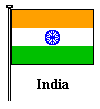
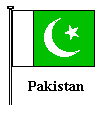
Ghulam Mohammad Governor-
General
of Pakistan,
1951-1955Iskander Mirza Governor-
General
of Pakistan,
1955-1956Pakistan becomes
a Republic, 1956 Although many Indians preserve an ideological or nationalistic animus towards the British (which they may or may not have, for instance, towards the Moghuls), believing that the British exploited India and inhibited its development -- for instance I find an equestrian statue of Edward VII in Toronto that had been relocated from an apparently unwelcoming Delhi (shouldn't the Tāj Mahal be deported to Bābur's Farghāna?) -- there is the striking circumstance that, while on independence in 1947 the Indian economy was twice the size of that of China, that advantage was lost by 1990, and the Chinese economy by 2003 was more than twice the size of India's. Thus, it seems to be that the British promoted Indian development more than otherwise and that the socialist and autarkic policies instituted by Nehru, and later his daughter Indira Gandhi, have done more damage than can ever be blamed on the British (unless it be on the influence of British socialists). Fortunately, these policies began to be reversed in the 1990's and great improvement has occurred, as discussed elsewhere. Today, an American calling a customer service number for an American company may well find themselves speaking to somebody in India. Some resent this, but it is really rather marvelous and would seem to bespeak a handsome kinship between two different subjects of the former British Imperium. Americans are otherwise familiar with the entrepreneurial talent of Indian immigrants to the United States, where they are disproportionately successful in a number of areas of business, including hotels and motels, of all things. In 1982 I was personally bewildered when my car broke down in Artesia, New Mexico, to find a motel run by people from India. The industry of Indians is beyond doubt, all they needed was the sympathy and cooperation of their own government.
 Index of Princely States & Protectorates of British India
Copyright (c) 1998, 1999, 2000, 2001, 2002, 2003, 2004, 2005, 2006, 2007, 2008, 2009, 2010, 2011, 2012, 2013, 2014, 2016, 2018, 2019, 2020, 2021, 2022, 2023, 2024, 2025 Kelley L. Ross, Ph.D. All Rights Reserved
Emperors of India, Note;
Moghuls and Mughals: South Asia in World History,
by Marc Gilbert, Oxford, 2017
λόγοι δὲ φρονίμων ἐν ζυγῷ σταθήσονται.
verba autem prudentium statera ponderabuntur.
But the words of the wise will stand in the balance.
Vulgate, Liber Iesu Filii Sirach, 21:28; cf. wisdom.
Though Timur s descendants called themselves Chatagai, or Timurids, Europeans, following the Persian word for Mongol (Mughal), came to call them Mughals. [Oxford University Press, 2017, p.62]
Diacritics
In this translation, diacritical marks, meaningless to those who do not know Persian and superfluous for those who do, have been dispensed with in spelling. Only the umlaut for Turkish words has been retained... [p.xxvii]
 defeated trying to figure out what an "Arabic" word, supplied without diacritics, is in actual Arabic. The ambiguities are too great. So what Thackston says is absurd.
Moreover the devices perplex the simple and teach nothing to the learned. Either the reader knows Arabic, in which case Greek letters, italics and "upper case," diacritical points and similar typgraphic oddities are, as a rule with some exceptions, unnecessary; or he does not know Arabic, when none of these expedients will be of the least use to him. [The Book of The Thousand Nights and a Night, Volumes I & II, The Heritage Press, 1934, 1962, p.xii]
Here it has been decided not to enter in most cases the diacritical markings that distinguish matching consonsants as well as long and short vowels. For Arabists these are unnecessary and for the general reader they may be thought to add confusion rather than clarity. [The Arabian Nights, Tales of 1001 Nights, translated by Malcolm C. Lyons, with Ursula Lyons, Introduced and Annotated by Robert Irwin, Penguin Classics, 2008, p.xxi]

Emperors of China
 In the table below right, the "short count" Chinese historical era is what used to be given in the Astronomical Almanac [U.S. Government Printing Office, various annual editions]. The "long count" is from the list of Dynasties in Mathews' Chinese-English Dictionary [Harvard, 1972, p.1165].
| THE CHINESE HISTORICAL ERA, long count | 2852 BC |
|---|---|
| 2021 AD + 2852 = 4873 Annō Sinarum | |
| THE CHINESE HISTORICAL ERA, short count | 2637 BC |
| 2021 AD + 2637 = 4658 Annō Sinarum | |
| The Legendary Period, Age of the Five Rulers | 647 years |
Hsia,  , Dynasty , Dynasty | long, 2205-1766 |
| short, 1962-1523 | |
In the absence of a continuous Era, the Chinese reckoned time in terms of the 60 Year Calendar Cycle and then in the years of individual Eras, the Nien-hao, 年號, Niánhào. Details about the Chinese calendar are provided through the links in the list below. The inception of Era names is discussed below.
The traditional Chinese dates for the Emperors are usually for the first full year of the reign, which is also the first year of the appropriate Era. This can be a little confusing, and sources on Chinese history do not always seem consistent (or we run afoul of when the Chinese calendar year starts -- or I have gotten confused!). The convention is even applied to the Chinese Republic, which is often said to have begun in 1912, even though the Ch'ing Dynasty was overthrown in 1911 -- although in this case the Republic was actually not formally proclaimed until January 1, 1912; so the history was arranged to match the chronology.
The convention also makes it possible that Emperors who do not survive beyond their initial calendar year may not even be counted, which is the case, creating some confusion, with a couple of the Mongols. Other Emperors are not listed in Chinese sources as unworthy for other reasons, often dismissed as a Shàodì, 少帝, "insignificant emperor."
In Mathews', only the first year of a reign is ordinarily given. Here, for the Ming and Ch'ing Dynasties, this year corresponds to the first Era given with the reign. All other Era names, from the Han up to and including the Yüan, are given on a popup page -- or it may be opened in the current window.
The Thought Police are hereby informed that the color yellow  is used for the tables and maps for China,
 |
Indeed, Chinese civilization began in the northern valley and plain of the 
 , "Yellow River" (Hwang Ho), which actually is yellow from the loess (löß) brought down from the Tibetan plateau. The Huang He floodplain is thus literally "yellow earth,"
  ,
,  and the Chinese theory of the elements has apparently taken cognizance of this.
The element earth also implies the direction "center" -- with China itself, the "Middle Kingdom" (Chung-kuo,  ) at the center. Thus, China can even be called , "Middle Earth." At least from the Ming Dynasty, yellow tiles were reserved for use on the roofs of Imperial palaces, and so the color came to mean the Emperor himself.
China can also be called the  , "Middle Glorious," with used for "Chinese" in many expressions (almost interchangeably with
  and
and  ), e.g.
  or
or  for "Chinese People," or
  for "Chinese labor (abroad)," or , "Chinese language." We also get , "Glorious and Extensive," as a name for China, where the latter character is the name of the Hsia Dynasty but also simply the character for "summer," which we see in the Solar Terms.
However, as a name for China could also be used just to mean "civilized," like China, and thus could be applied to India, although , or even , is now remembered as the name for Bactria. It is not clear how many Chinese of former times would have been aware that Bactria and India were different places, especially considering that they are "in the West," adjacent, and at the end of the Silk Road. The Kushans occupied both Bactria and Northern India and thus, as the Yüeh-chih, were sometimes identified as such with the latter.
While the "Middle Kingdom" or "Middle Earth" give China a central place in the world, another locution,  , "Under Heaven," can mean both China and the entire World -- all under heaven. Since the title
  , "Emperor," when introduced in the Ch'in, signified uniqueness, supremacy, and universal monarchy, "Emperor," Latin Imperator, is a suitable translation in relation to Roman ideology of universal monarchy over the Cosmopolis, the world state. To all the countries around China, as to Imperial Princes, the Emperors bestowed no more than the title , "King." This was not graciously received in courts, like Japan, where the Monarch was regarded as the equal of the
  , "Son of Heaven."
Several characters are used to mean "dynasty." With the Northern and Southern Dynasties we see  (which, with a different pronunciation, otherwise means "morning," as in the name of the Japanese destroyer Asagiri,
  , "Morning Mist"). With the Five Dynasties, however, we see
  . Indeed, the first entry for "dynasty" in a modern Chinese dictionary is [Concise English-Chinese Chinese-English Dictionary, A.P. Cowie, A. Evison, The Commercial Press, Oxford University Press, Beijing, Hong Kong, 1986, p.134]. With the names of dynasties, however, one often sees
  ("record, annals"), as in
  , "Ming Dynasty" (cf. Mathew's, character 430, p.57, and in Appendix A, with the tables of dynasties, pp.1165-1175).
Wade-Giles writings are intially used here, consistent with the older sources. But Pinyin versions are now generally given, especially for the dynasties, and also exclusively with images of characters. HTML codes used to be very deficient for Pinyin tones. However, Unicode can take care of that, and I think I have fixed up all the examples. Superscript numbers for tones are no longer needed. In fact, there are Unicodes for all the Chinese characters I have looked for; and such characters are now being extensively added to the images (with Pinyin) previously used. One virtue of the Unicode character is that they can be copied and pasted into search engines, which will turn up pages on the Internet about them.
Note that Wade-Giles "ho" and "he" can both be found for Pinyin "he" -- as other writings sometimes reflect older Mandarin pronunciations (e.g. "Peking" itself).
While newer sources use Pinyin exclusively, I think this is improper. As a denial of history, it is like teaching Chinese with only the "simplified" characters. Simplified characters themselves are not given here because they are (1) ugly, (2) ahistorical, (3) not used in older sources, and (4) not used in Taiwan or by many or most overseas Chinese communities (though, I understand, this is changing). It may be too late to stop the simplified character bandwagon, but the attempt should be made -- and oddly enough, traditional characters can often be found in the People's Republic.
While the idea was that simplified characters would make literacy easier, it actually makes larger literacy more difficult when traditional characters must be learned anyway to read older books, historical inscriptions, overseas Chinese, or Japanese kambun ( ), i.e. written Chinese from Japanese writers who didn't actually speak Chinese (a similar phenomenon was formerly found in Korea and Vietnam).
A break with the past was certainly one motivation for the simplification -- though Mao Tse-tung (Zedong) then published his own poetry in traditional characters! Curiously, The Pinyin Chinese-English Dictionary [Editor-in-chief Wu Jingrong, The Commercial Press, Beijing, Hong Kong, & John Wiley and Sons, Inc., 1979, 1985], which gives the simplified character for  in the text [p.266] and in the Chinese Foreword [p.2], nevertheless has the traditional character on the front of the book and on the title page.
Indeed, newer dictionaries in Pinyin do a better job of giving the traditional characters along with the simplified ones. And when an edition was prepared of the 24 Standard Dynastic Histories, the Ershisishi [241 volumes, Zhonghua, 1962-1975], at the personal direction of Chairman Mao, it was all in traditional, "complex" characters.
I've come across a curious mashup of use combining Wade-Giles and Pinyin. This is in some of the science fiction "Ender's Game" books (1985 to present) by Orson Scott Card. He has some characters of Chinese ancestry, one named Han Fei-Tzu and another, his daughter, Han Qing-Jao. Most of these names use Wade-Giles syllables and principles, including the hyphens and the syllables tzu and jao. However, capitalizing the syllables after the hyphens would not be done.
On the other hand, qing only occurs in Pinyin. It would be ch'ing in Wade-Giles. Jao looks vaguely Pinyin, but a Pinyin syllable would be jiao, and jao in Wade-Giles would actually be rao in Pinyin. The result are names whose pronunciation would be indecipherable to most readers; and the author, of course, doesn't give us a pronunciation guide, although he had done so with Portuguese, which occurs in many of the books.
The maps are based on L. Carrington Goodrich, A Short History of the Chinese People [Harper Torchbooks, The University Library, 1963], The Anchor Atlas of World History, Volume I [Hermann Kinder, Werner Hilgemann, Ernest A. Menze, and Harald and Ruth Bukor, 1974], Michael Prawdin, The Mongol Empire, its Rise and Legacy [Free Press, 1961], The [London] Times Concise Atlas of World History, edited by Geoffrey Barraclough [Times Books Ltd, Hammond Inc., 1988], The Cambridge History of Ancient China, from the Origins of Civilization to 221 B.C. edited by Michael Loewe & Edward L. Shaughnessy [Cambridge U. Press, 1999], and a few other sources I've lost track of.
Paludan's Chronicle of the Chinese Emperors, although an excellent book in every other way, is suspiciously deficient in maps, with a glaring mistake on one that is given -- the absence of the trans-Amur Maritime Province, later lost to Russia, on the map of the Ch'ing Empire [p.11]. There seem to be considerable uncertainties, or at least disagreements, about the boundaries in many periods, even well documented ones, like the T'ang and Ming.
The list of Chinese Emperors here was originally as given in Mathews' Chinese-English Dictionary [Harvard University Press, 1972, pp. 1165-1175]. Now most of the names and dates and information are from, A Short History of the Chinese People by L. Carrington Goodrich [Harper Torchbooks, 1943, 1963], The Horizon History of China by C.P. Fitzgerald [American Heritage Publishing, 1969], The Chinese Calendar and the Julian Day Number, a pamphlet by O.L. Harvey [1977, based on Chronological Tables of Chinese History by Tung Tso-pin, Hong Kong University Press, 1960], The Glory and Fall of the Ming Dynasty by Albert Chan [U. of Oklahoma Press, 1982], The Southern Ming, 1644-1662 by Lynn A. Struve [Yale University Pres, 1984], A History of Chinese Civilization by Jacques Gernet [translated by J.R. Foster, Cambridge University Press, 1972, 1982, 1990], the Records of the Grand Historian by Sīmǎ Qián [3 volumes, Qin, Han I, & Han II, Columbia University Press, 1993], the Chronicle of the Chinese Emperors by Ann Paludan [Thames & Hudson, London, 1998], The Cambridge History of Ancient China, from the Origins of Civilization to 221 B.C. edited by Michael Loewe & Edward L. Shaughnessy [Cambridge U. Press, 1999], A Concise History of China by J.A.G. Roberts [Harvard University Press, 1999], Chinese History, A Manual by Endymion Wilkinson [Harvard-Yenching Institute Monograph Series, 52, Harvard U. Press, 2000], the Oxford Dynasties of the World by John E. Morby [Oxford University Press, 1989, 2002, pp.215-221], Historical Records of the Five Dynasties, by Ouyang Xiu [translated by Richard L. Davis, Columbia U. Press, 2004], China, A New History by John King Fairbank & Merle Goldman [Belknap Press of Harvard U. Press, 2006], The Nihon Kodaishi Daijiten, or Dictionary of Ancient Japanese History, on CD-ROM [Yamato Shobō, 2006], A History of China, by John Keay [Basic Books, 2009], The Troubled Empire, China in the Yüan and Ming Dynasties, by Timothy Brook [Belknap Press, Harvard, 2010], and some other books and websites that are referenced at various points below.
The Japanese sources and, of course, many on-line sites, are better at providing Chinese characters for dynasties, eras, and rulers. I would like to have characters for all the rulers, but is a job larger than I am ready to tackle at the moment. I continue to use images for many of the Chinese characters because I have included the Pinyin reading with them. This prevents copying and pasting them for searches, but it so eliminates the need to search for the pronunciation.
Shang,  , Dynasty, , Dynasty,1523-1028 (1766-1122) | |
|---|---|
| Shang-chia | |
| Pao-yi | |
| Pao-ping | |
| Pao-ting | |
| Shih-jen | |
| Shih-kuei | |
| Ta-yi | |
| Wai-ping | |
| Chung-jên | |
| Ch'êng-t'ang? | |
| T'ai-chia | |
| Wu-ting | |
| T'ai-kêng | |
| Hsiao-chia | |
| Yung-chi | |
| T'ai-wu | |
| Chung-ting | |
| Wai-jên | |
| Tsien-chia | |
| Tsu-yi | |
| Tsu-hsin | |
| Ch'iang-chia | |
| Tsu-ting | |
| Nan-kêng | |
| Hu-chia | |
| P'an-kêng | Dynastic name changed to  |
| Hsiao-hsin | |
| Hsiao-yi | |
| Wu-ting | ?-1189 |
| Tsu-kêng | 1188-1178 |
| Tsu-chia | 1177-1158 |
| Lin-hsin | 1157-1149 |
| K'ang-ting | 1148-1132 |
| Wu-yi | 1131-1117 |
| Wên-wu-ting | 1116-1106 |
| Ti-yi | 1105-1087 |
| Ti-hsin | 1086-1045 |
 The Shang, a splendid Bronze Age civilization, is the true beginning of Chinese history, emerging just as India was falling into its own Dark Ages period (1500-800 BC). The system of writing we see developing in the Shang already displays most of the characteristics of Chinese characters and was destined to be the only ancient system of ideographic writing to survive into modern usage, both in China and Japan.
  However, Shang writing is known mainly from oracle bones. There is no surviving literature, documents, or monumental inscriptions from the period. Data like the list of Shang kings or the excavation of Shang royal tombs thus leaves us pretty much in the dark about historical events, though this is not much different from what is often the case with contemporary Egypt or Mesopotamia. The sophistication of Shang culture, on the other hand, may be inspected directly in the magnificent bronzes that are featured in many of the world's museums.
The beginning of Chinese civilization in the North, in the Huang He (or Hwang Ho) valley, means that, among many things, the Chinese diet was not at first what we would expect. Rice only grows further South, where there is much greater rain. The Huang He valley is semi-arid. Even today it is wheat that is grown there. Of course, wheat was used for another characteristic Chinese food: Noodles -- which Marco Polo is supposed to have brought back to Italy. Actually, it looks like noodles had already arrived by way of the Arabs; and there is no evidence, for instance, that the Romans ever ate noodles or knew about them (no plate of spaghetti for Augustus). The characteristic staple food of the Mediterranean world was bread, something the Chinese did not make. Recently [2005], an ancient bowl of noodles made from millet was discovered in China and dated about 2000 BC, antedating even the Shang Dynasty.
The contrast between the dry North and the wet South is summed up in a traditional expression, 


 , "South [by] boat; north [by] horse." The dry Huang He plain, so suitable for horses, contrasts not only with the wet Yangtze Valley, but with the mountains and gorges through which the Yangtze flows (and is now extensively dammed). This terrain was one reason the Mongols had much more difficulty conquering the South than the North.
Used alone, the characters and  can mean, not just "river," but, respectively, the Huang He and the Yangtze rivers specifically. The former usage is now unusual but the latter is common. Thus, the Huang He is, indeed, the , "Yellow River"; but even the Yangtze is commonly expanded into a binome,
  , "Long River." "Yangtze" itself is from a local name,
 , which was generalized, perhaps just by foreigners, for the whole river. This, however, may have been based on a 13th century poem that used the expression .
 Chinese characters in the Shang were still pictographic in form. At right are some examples of common modern characters with their Shang antecedents. The pronunciation, of course, is modern.
There is little and poor evidence about the pronunciation of Chinese at this early period. Chinese at this point may not even have had tones. There are no tones in related languages, like Tibetan, but there are tones in unrelated regional languages, like Vietnamese. Chinese may have picked up tones as part of a Southeast Asian Sprachbund, where, as in the Balkans, unrelated or distantly related languages borrow features from each other. There is also the accepted view that tones developed from morphological features that have now disappeared. There is no reason, however, why influence may not have accompanied such a development. There is also the problem that the inclusion of Chinese in the same language family as Tibetan and Burmese is based on relatively narrow evidence.
Previously, I had not given dates for reigns in the Shang dynasty, because of the uncertainties of early Chinese chronology. However, I have now filled in those given in The Cambridge History of Ancient China [edited by Michael Loewe and Edward L. Shaughnessy, 1999, p.25]. I have left the dates of the Dynasty itself the same, however, to indicate the traditional level of uncertainty. I have kept the Chinese convention of ending a reign a calendar year before the beginning of the next reign, both to indicate that this is the convention and because the uncertainties of the dates make the point moot.
The genealogy of the Shang, from the Nihon Kodaishi Daijiten (Dictionary of Ancient Japanese History) and the Cambridge History of Ancient China, may be examined on a popup image. Different lists of early Shang rulers are to be seen. In Mathews' Chinese-English Dictionary, the dynasty begins with a Ch'eng-t'ang immediately before T'ai-chia. However, the Nihon Kodaishi Daijiten does not give a Ch'eng-t'ang at all and begins the dynasty two generations before T'ai-chia, with Ta-yi. The Cambridge History starts six generations before Ta-yi with Shang-chia. The Nihon Kodaishi and the Cambridge History differ in their construction of the early genealogy. I have tried to indicate where the differences occur. Usually these are in which generation a king belongs. The Cambridge History sometimes has a different element in a name -- I have put their version in parentheses. Where the Nihon Kodaishi has T'ai,  , the Cambridge History usually has Ta, -- the characters differ by a small stroke and can actually mean almost the same thing. Like the Cambridge History, the Nihon Kodaishi does not give dates for rulers before Wu-ting, but it does give the beginning of the dynasty at 1600, as the Cambridge History does at 1570. The numbering on the crowns is that of the Nihon Kodaishi.
Chou,  , Dynasty , Dynasty1027-256 (1122-256) | |
|---|---|
Western Chou,  1027-771 | |
| Wen Wang | 1099/56-1049 |
| Wu Wang | 1049/45-1042 |
| Chou Kung | 1042-1036 |
| Chêng Wang | 1042/35-1005/03 |
| K'ang Wang | 1005/03-977/75 |
| Chao Wang | 977/75-956 |
| Mu Wang | 956-917/15 |
| Kung Wang | 917/15-899/97 |
| Ih Wang | 899/97-872? |
| Hsiao Wang | 872?-865 |
| I Wang | 865-857/53 |
| Li Wang | 857/53-842/28 |
| Kung Ho | 841-827/25 |
| 841, first solid date in Chinese chronology | |
| Hsüan Wang | 827/25-781 |
| Yu Wang | 781-771 |
Eastern Chou,  , ,771-256; Middle Chou, 771-473 | |
| P'ing Wang | 770-719 |
Spring and Autumn,  , ,Period, 722-481 | |
| Huan Wang | 719-696 |
| Hsiang Wang | 696-681 |
| Hsi Wang | 681-676 |
| Hui Wang | 676-651 |
| Hsiang Wang | 651-618 |
| Ch'ing Wang | 618-612 |
| K'uang Wang | 612-606 |
| Ting Wang | 606-585 |
| Chien Wang | 585-571 |
| Ling Wang | 571-544 |
| Ching Wang | 544-520 |
| Tao Wang | 520 |
| Ching Wang | 519-475 |
Warring States,  , ,Period, 481-221 | |
| Yüan Wang | 475-468 |
| Late Chou, 473-256 | |
| Chêng-ting Wang | 468-441 |
| K'ao Wang | 440-425 |
| Wei-lieh Wang | 425-401 |
| An Wang | 401-375 |
| Lieh Wang | 375-368 |
| Hsien Wang | 368-320 |
| Shên-ching Wang | 320-314 |
| Nan Wang | 314-256 |
 Over the long history of the Chou Dynasty (commonly pronounced "Joe" in English), China went from a period even more obscure than the Shang to a flourishing, fully documented historical civilization.
The changes were so drastic that the dynasty is typically divided into three parts, though there are different versions of exactly how to do this. The Early Chou presents us with the least satisfactory material, since things seem to have rather declined after the fall of the Shang.
Of much greater interest is what happens when the central authority of the state actually collapses, which moves us into the Middle Chou or the Spring and Autumn Period. The country breaks up into small domains, which separately become vigorous and expansive, and the Chou kings are reduced to ruling a small county on the Huang He River. We finally get into a period with secure historical dating.
The name of the Spring and Autumn Period itself is derived from the Spring and Autumn Annals, , one of the Chinese classics, which was a chronicle of the state of Lu, the birthplace of Confucius. The origin of the name may be that "Spring and Autumn" was used to simply mean "year," and so by extension an annal or chronicle.
The origin of the phrase, however, is now obscured by its being the name of the book itself. One of the works later interpreted as a commentary on the Spring and Autumn Annals, the Tso Chuan,  , actually contains more information than the Annals itself. Indeed, the Tso Chuan really isn't a commentary but originally an independent narrative history, the first in Chinese literature, covering the same period.
Suddenly we have the beginning of Chinese literature, history, and philosophy, curiously at about the same time as the beginnings of Greek and Indian philosophy also. The following links deal with matters in Chinese philosophy.
In the Spring and Autumn Period, the tradition arose that at various times there were dominant rulers among the many states of the era. By analogy to a similar situation in Classical Greece, these are called "hegemons" -- although I discuss the issue in relation to the nature of the British Empire, which was more of a "hegemony" that it was an "empire."
In China, these were, in succession, the 五霸, Wǔ Bà, or the "Five Hegemons." According to the historian Szu-ma Ch'ien, the five states involved were Ch'i, 齐, Sung, 宋, Chin, 晋, Ch'in, 秦, and Ch'u, 楚. Other lists occur, including Wu, 吴, Yüeh, 越, and 鄭, Cheng. These states are all examined on the States of the Eastern Chou page. The Hegemons of Szu-ma Ch'ien form a tight sequence in the midst of the Spring and Autumn Period, while the other candidates as Hegemons are much earlier or later than those of Szu-ma Ch'ien. This can be inspected on the pop-up lists of rulers.
The "Hegemons" are not so much particular states, as they are particular rulers of the states, who briefly dominated others in their time. They did not conquer or rule all the others. Indeed, that only happened in the following Warring States Period, when the King of Ch'in, 秦, rolled up the remaining states and made China, truly, an "Empire." So the Hegemons were, briefly, predominant; but they did not unify the country, or create a "empire," however we understand that. The individual Hegemons can be examined on the Popup of Rulers of the Spring and Autumn Period and the Popup of Rulers of the Warring States Period pages, where they are identified with the character for "Hegemon," 霸.
A ruler in the Chou Dynasty was a  . Once the country had broken up, but the King retained some kind of precedence, the rulers of the successor states possessed various feudal titles, which can be examined on the State of the Eastern Chou page. The nature of the ranks is also examined under the Chinese elements and under Feudal Hierarchy. Posthumously, rulers are often called by the courtesy rank of
  [kung in Wade-Giles]. And there was, of course, a kind of rank inflation, as rulers wished for a higher status. Thus, we find Confucius visiting "Duke Ching of Ch'i," although the ruler of Ch'i was originally only a Marquis [Analects 12:11].
 Although Confucius hoped to end the warfare between the small states of his time, things actually got worse after he died. The following time thus is often called the "Warring States" period.
As time went on, however, one of the Warring States began to win, and to conquer the others. This was the state of Ch'in (Qin), which lay in Shensi (Shaanxi) Province, in the great bend of the Huang He river. In 256, the ruler of Ch'in, Chao-Hsiang, dethroned the last Chou king. Although the Warring States period was not over, the Chou Dynasty was.
As after the death of Alexander the Great, the successors eventually mostly declared themselves Kings in their own right. Indeed, the Viscount of Ch'u anticipated this and, after 740, made himself King long before the end of the Chou. This is why one of the Five Hegemons is already called a "King." And, as the period went on, the Kingdoms shook down to six, thus appropriately called the "Six Kingdoms."
six kingdoms  | |||||
|---|---|---|---|---|---|
| Ch'i | Ch'u | Han | Wei | Chao | Yen |
 |  |  |  |  |  |
In the table of the Ch'in Dynasty following, we can see the title of the ruler changing from "Duke" to "King" in the year 324. Some rulers (Tsin/Jin, Yen/Yan, and the later Han, Wei, and Chao) originally used  , before upgrading to "Duke". Indeed, as shown in the genealogy of Ch'in below, we see that, before the Spring and Autumn Period, the ruler of Ch'in began as a Marquis also. One state, Ch'u, had used Wàng from an early date; but by the Late Warring States Period almost all of the states had adopted that title. "Duke" and "Marquis" were the first of the feudal "Five Ranks," 五爵, Wǔ Jué, as can be examined on the Feudal Hierarchy page.
Previously, I had not given dates for reigns before 841, because of the uncertainties of early Chinese chronology. However, I have now filled them in from The Cambridge History of Ancient China [edited by Michael Loewe and Edward L. Shaughnessy, 1999, p.25]. Beginning with Hsüan Wang, the dates then seem to match what I was already using. I have left the dates of the Dynasty itself the same, however, to indicate the traditional level of uncertainty. Also, I have eliminated the Chinese convention of ending a reign a calendar year before the beginning of the next reign.
The genealogy of the Chou, from the Nihon Kodaishi Daijiten (Dictionary of Ancient Japanese History), may be examined on a popup image, though the names and dates are from the Cambridge History.
Popup of Rulers of the Spring and Autumn Period
Popup of Rulers of the Warring States Period
| Ch'in, , Dynasty 256-207 BC | |
|---|---|
| Hsiao Kung Ying Hsiao | 361-337 |
| Hui-wen Kung | 337-324 |
| Wang, 324-310 | |
| Wu Wang | 310-306 |
| Dowager Hsüan, Mi Bazi, Mi Yue | Dowager Queen & Regent, 307-271, d.265 |
| Chao-hsiang Wang | during Chou, 306-256 |
| 256-250 | |
| Hsiao-wên Wang | 250, 3 days |
| Chuang-hsiang Wang | 250-247 |
| Wang Chêng, (changes his name to) Shih-huang-ti/ Shǐhuángdì | 247-221 |
| Emperor, 221-210 | |
| End of Warring States Period, 221; burning books, 213 | |
| Erh-shih-huang-ti Ying Huhai | 210-207 |
| Ch'in Wang Tzu-Ying | 207 |
 (or Ch'in Wang Chêng, ), was the son of Chao-chi, the wife of Chuang-hsiang Wang, she may have already been pregnant, previously having been the concubine of another man (Lü Pu-wei). This is like the story of the Empress Eudocia Ingerina, who was the mistress of the Roman Emperor Michael III and was probably already pregnant when she married Basil I, the founder of the Macedonian Dynasty. The story about Wang Chêng, however, looks a bit more like a later Han slander against the Ch'in First Emperor. These relationships can be examined in the genealogy given below. Earlier rulers of Ch'in are given both in the genealogy and with the States of the Eastern Chou.
There is an obscurity in the chronology here.  Sources often say that Chao-hsiang Wang died in 251, but the historian Szu-ma Ch'ien [司馬遷, Sīmǎ Qián], who is about the only real source for the chronology, says that Hsiao-wên Wang, 孝文王, Xiàowénwáng, only reigned for 3 days in what would have been 250. There is no evidence of a hiatus, so the "251" may be an artifact of the Chinese habit of dating new things to the following year (i.e. 250 follows 251). Indeed, Ulrich Theobald rationalizes all the dates as falling in 251, which is probably as reasonable as anything. Meanwhile, Mathews' dictionary places Hsiao-wên Wang in 250, with a gloss that this was 3 days, while dating the following King, Chuang-hsiang Wang, 莊襄王, Zhuāngxiāngwáng, to 249. This is what confuses things. If Hsiao-wên Wang died in 251, then the reign of Chuang-hsiang Wang should have been dated from 250.
Many Chinese histories and king lists, like the Oxford Dynasties of the World, are sparing or skip entirely dates in the Ch'in Dynasty before Shih-huang-ti. So I have just tried to apply the most obvious interpretation to Szu-ma Ch'ien and have dated the death of Chao-hsiang Wang to 250. As it happens, The Cambridge History of Ancient China [edited by Michael Loewe and Edward L. Shaughnessy, 1999] follows the Chinese practice, ends the reign of Chao-hsiang Wang in 251, gives Hsiao-wên Wang 250, and then begins the reign of Chuang-hsing Wang in 249. It thus looks like Hsiao-wên Wang's three days unites all the reigns in 250.
Whatever his origins, Wang Chêng conquered most of the other Warring States and by 221 brought the country together for the first time since the Early Chou. And a much larger and more sophisticated country it now was, too. Although one might say that he was a combination, for Chinese history, of Alexander the Great and Julius Caesar, nevertheless he was not a great general himself, just the ruler. One of the first things he decided to do was come up with a more appropriate title. Previously, Chinese rulers had been styled , or "king" (ō in Japanese, wang in Korean, vương in Vietnamese). This was not going to be good enough. So Wang Chêng made up a new title, , the "August God," or, as we would say, the Emperor. Later, either one  of these characters could be used individually to mean "emperor," as the latter became a suffix for the names of many Han Emperors. The whole expression would become kōtei in Japanese (hwangje in Korean), but much more commonly in Japanese only the first character was used (kō or ō), suffixed to "heaven,"
  , as Tennō in Japanese, "heavenly" or "divine" Emperor. This distinction is even preserved in Vietnamese, where hoàng-đế is "emperor" but thiên-hoàng is "Emperor of Japan." The Emperor could also simply be the "Son of Heaven," , tenshi in Japanese, thiên-tử in Vietnamese. We also see
 , the "Emperor Above."
Along with the title of Emperor, we come to find a characteristic and suitable expression of good wishes, namely the cheer  . This means "Ten Thousand Years," i.e. the length of the reign that we hope for. In Japanese this is pronounced banzai, which became familiar as a battle cry in World War II. Such a cheer seems a little more economical and more generally suitable than would "God Save the Queen" in Britain. A comparable expression,
  , "Life, Prosperity, Health," was used in Ancient Egypt.
The new "Emperor" of China then decided that he would simply be known as the "First Emperor," and that all rulers after him would continue the sequence, "Second Emperor," etc. This made him  (Shih-huang-ti), which he is still usually called. After the "Second Emperor," however, nobody bothered with the numbering. Wàng came to be used for foreign rulers and Imperial Princes. Thus, the "Prince of Fu" who resisted the Manchus as the first Emperor of the Southern Ming, was really Fu Wang, "King of Fu." The rulers of Japan didn't like being called wàng, but it stuck for places like Siam/Thailand or Korea.
Shih-huang-ti's name is now variously rendered. First, we get the name of the dynasty prefixed: Qín Shǐhuángdì, 
 . Next, we get the same expression with "Emperor" abbreviated: Qín Shǐhuáng, or Qín Shǐ Huáng, . This is now common, usually without the tones written -- Qin Shi Huang. For some reason, I find this annoying.
The genealogy of Ch'in here is based on that in The First Emperor of China, by Jonathan Clements [Sutton Publishing, 2006, pp.170-172]. This begins in the Early Chou, with the first Marquis of Ch'in, and continues through all the Dukes and Kings of the Eastern Chou.
Although I have seen no such detail given anywhere else, Clements unfortunately does not discuss the style of Chinese dating and does not address the specific issue of the short, peculiar reign of Hsiao-wên Wang -- which he dates to 451, beginning the next reign in 450. He does actually appear to attribute months, not days, to the reign, with the "three days" confined to the time after the coronation at the New Year (of 450?). I do not know if this is an interpretation or is clearly asserted by some source.
Clements does mention, which I have not seen elsewhere, that the family name of the house of Ch'in was Ying. He also addresses the question of the legitimacy of Wang Cheng, but curiously only as an aside in an appendix, "The First Emperor on Screen" [pp.177-180].  If Lü Pu-wei were the father, Clements says that the queen would have needed to "carry the First Emperor in her womb for eleven months" [p.177]. That would settle the question, but we really do not get the matter argued in an explicit manner.
While Clements gives the earliest rulers of Ch'in the title of , according to Burton Watson [The Tso Chuan, Selections from China's Oldest Narrative History, Columbia U. Press, 1989], this would have been no more than a posthumous rank. The ruler of Ch'in at the beginning of the Spring and Autumn Period was still no more than a  . However, Watson does not chronicle the stages by which the rulers certainly increased their rank, which reached in 324. This matter is discussed with the States of the Eastern Chou.
Until the Ming, Chinese Emperors are usually known by posthumous names, which frequently describe something characteristic of the Emperor or his reign. Until the T'ang, these names are "memorial titles" (shih), most frequently ending in ti , "Emperor." Starting with the T'ang, the posthumous names are "temple names" (miao hao), and the final character is most commonly tsu  , "Founder," or tsung
  , "Ancestor." "Founder" is used at the beginning of the Dynasty, or after an event like a refounding during it. The last Emperor in a Dynasty (or before another kind of hiatus) gets a memorial rather than a temple name, since, at the end, he is not an ancestor.
Personal names, which are not used after ascending the Throne (a reigning Emperor is simply the "Present Emperor," 當今皇上, Dāngjīn Huángshàng), are given for many of the following Emperors. They are identifiable because they begin with the family name of the Dynasty, e.g. Liu for the Han (both of them), Yang for the Sui, Li for the T'ang, and Chu for the Ming. The Mongols and Manchus did not use Chinese family names -- and with both of them we get two "Founders" because Chinese historians officially began the dynasties only when they considered them the legitimate rulers of China.
With the Ming, Emperors start being known by the name they chose themselves for their Era (nien-hao). Earlier there usually were several Eras per reign, so this was not a convenient device, but the Ming Emperors stuck to one, a practice maintained by the Ch'ing and adopted by the Japanese in 1868. The Founder of the Ming, Chu Yüan-chang, thus was given the temple name T'ai Tsu ("Great Founder," 太祖, Tàizǔ), but instead is usually known as the "Hung-wu [Vast Military Power] Emperor," 洪武帝, Hóngwǔ dì. Similarly, Hirohito is now the "Shōwa Emperor [Tennō]," 昭和天皇.
Shih-huang-ti had a ferocious and ruthless disposition that found the advice of the Legalist philosopher Li Szu, 李斯, Lǐ Sī, agreeable. In 213, on Li Szu's urging, Shih-huang-ti outlawed all other schools of thought and began to burn their books. This may be why more is not know about the "Hundred Schools" reputed to have existed under the Chou Dynasty. Scholars who resisted the order were executed: 346 (or more) are supposed to have actually been buried alive. The fall of the Ch'in Dynasty soon thereafter was later seen as proof of the working of the Mandate of Heaven. Mao Tse-tung is reported as saying in 1958:
What's so unusual about Emperor Shih Huang of the Chin Dynasty? He had buried alive 460 scholars only, but we have buried alive 46,000 scholars....We are 100 times ahead of Emperor Shih of the Chin Dynasty in repression of counter-revolutionary scholars. |
Mao is often compared, not surprisingly, to Shih-huang-ti. Elsewhere, the Emperor's ruthlessness was evident in his construction of the Great Wall of China, which is supposed to have cost many lives per mile. A wall in the North, however, was reasonable when nothing but desert and nomads lay beyond. In the South, he sent an army, which for the first time extended the county down to the South China Sea. It would take some years before the enclosed coastal mountains were settled and pacified by the Chinese. If these things were more good than bad for China, Shih-huang-ti also set in motion some real reforms, like a simplification of the writing system and the end of feudal tenure in farmland.
While Mao is gone, his political heirs still favor positive portrayals of Shih-huang-ti. We see this in a recent movie, Hero, 英雄, Yīngxióng, by director Zhang Yimou. This was released in China in 2002, and DVD's of it were soon available elsewhere. The movie was not released to theaters in the United States until 2004. It was said to be "presented by" director Quentin Tarantino, with the hope perhaps that Tarantino's well known enthusiasm for martial arts movies would help draw in audiences. They needn't have worried, since the movie opened in the number one position.
The story is about how assassins attempting to kill Shih-huang-ti become converted to his cause. Although the King of Ch'in himself says that many people think of him as a tyrant, we do not yet see the degree to which his ruthlessness later went. Instead, we are given to understand that, whatever he does, it is simply for the sake of unifying the country and bringing peace. The key element in the conversion of the assassins are the two characters In the Chinese DVD, which did have English subtitles, it is literally translated "under heaven," and means the world or, the practical equivalent, China. This represents the unifying program of Ch'in. However, the subtitles of the film as released in the United States rather awkwardly translate it as "our land," which may indeed be a suitable translation but does have a very different feel to it. We lose the Chinese sense of the universality of its civilization, or of the universal sovereignty of the Emperor. Probably this was not thought suitable for foreign audiences.
An expression does exist in Chinese for "our land," namely The idea for the movie came from a real assassination attempt against Shih-huang-ti. This was by a retainer of the State of Yen (Yan), Jīng Kē 荊軻, in 227 BC. Jīng Kē concealed a poisoned dagger in a scroll to be presented to the King of Ch'in, and the attack was very nearly successful. Shih-huang-ti was able to fend off the assassin until he was able to draw his own sword, and the guards then arrived.
In the image from a Han Dynasty tomb at right, the King has moved behind a pillar and the assassin is at right, having finally and esperately thrown the dagger, which has hit the pillar. Needless to say, Jīng Kē did not decide that 天下 was enough to justify the victory of Shih-Huang-ti. He was killed by the guards, and the King's revenge against Yen seems to have been brutal. But then, it might have been brutal anyway. Otherwise, the movie is stylish and colorful and well worth watching for the visuals alone. All of the set-piece duels and other scenes are color coded: Black, red, yellow, green, blue, white. These are the colors of the Chinese elements; and, indeed, in the "black" duel we see rain and water everywhere. Otherwise, the associations are not obvious. I see no fire in the red sequences; and during the yellow duel, the participants are still wearing red, while yellow is provided by falling yellow leaves. While this is visually very rich, what that would have to do with the element earth, whose color is yellow, I could not say. I don't think that the director or cinematographer was very systematic about it all. Much of the enduring interest in Shih-huang-ti is because of his tomb. This is not far from the modern city of Sian (Xian), which was the capital of China, Ch'ang-An, in several periods. The mound of the tomb has never been excavated. It was robbed after the Dynasty fell, but it was described by historians, with a sarcophagus surrounded by a pool of mercury and other marvels. But a surprise came in the 1970's, when a farmer digging a well near the mound found the first figure in what became an entire army of terracotta soldiers, buried in orderly rows to defend the tomb. These amazing figures appear to be individual portraits, and they show the grooming and appearance of Chinese military men of the 3rd century BC. In the Shang Dynasty, such men had themselves been buried with the kings. Now, even the ruthless First Emperor made do with copies.
Shih-huang-ti is a good example of the ruler who the Taoists said is successful from fear. When he died, his success could not endure.
. These are not actually shown in the film, simply read by the lead assassin.
 , but this is not what is used in the movie.

Kingdom of Nan-Yüeh,  , 204-111 BC; Chieu, Triệu, Dynasty of Vietnam , 204-111 BC; Chieu, Triệu, Dynasty of Vietnam | |
|---|---|
| Chao T'o, Wu Wang | 204-137 |
| Emperor, 183-179 | |
| Chao Mo | 137-122 |
| Chao Ying-ch'i | 122-115 |
| Chao Hsing | 115-112 |
| Chao Chien-te | 112-111 |
| Han conquest, 112-111 | |
The fall of Ch'in cut lose areas in the South that had themselves only been recently attached to the State. The Chinese commander of the area, Chao T'o, styled himself King of Nan-Yüeh (南越, Nányuè), with a capital at P'an-yü, 番禺, Pānyú, the modern Canton. The Kingdom drifted in and out of amicable relations with the Han -- for a while Chao T'o styled himself an Emperor -- until it was reduced by force in 112-111. Subsequently, "Yüeh" continued to be used for southern Kingdoms, and the Cantonese language is still called "Yüeh," but with a different character,  (
( in Cantonese). In Cantonese, Nan-Yüeh will be
 . Since the Kingdom included a good bit of northern Vietnam, the episode also figures as part of the early history of that country. Indeed, "Vietnam,"
 , is "Yüeh-nan" in the Vietnamese reading of Chinese.
| (Former or Western) Han, ,Dynasty, 207 BC- 25 AD | |
|---|---|
| Kao Tsu Liu Pang | 207- 195 |
| Hsiung-nu rout the Chinese, 209 & 200; Treaty, 198 | |
| Hui Ti Liu Ying | 195- 188 |
| Empress Lü 吕后, Lǚ Hòu, Lü Chih | regent 188- 180 |
| Shao Ti Liu Kung | 188- 184 |
| Shao Ti Liu Hung | 184- 180 |
| Wên Ti Liu Heng | 180- 157 |
| Ching Ti Liu Ch'i | 157- 141 |
| Wu Ti Liu Ch'e | 141- 87 |
| Chang Ch'ien explores Central Asia, 139-126; occupation of Sinkiang, 115-105; forays to Ferghana, 104, 102 | |
| Chao Ti Liu Fu-ling | 87-74 |
| Hsüan Ti Liu Ping-i | 74-48 |
| Yüan Ti Liu Shih | 48-33 |
| Hsiung-nu pursued & defeated in Central Asia, Roman Soldiers(!?), escaped from Parthians(?), captured from Hsiung-nu, 36 BC | |
| Ch'eng Ti Liu Ao | 33-7 |
| Ai Ti Liu Hsin | 7-1 BC |
| P'ing Ti Liu Chi-tzu | 1 BC-6 AD |
| Ju-tzu Liu Ying | 6-9 |
Hsin,  , Dynasty , Dynasty | |
| Chia Huang-ti, Wáng Mǎng, 王莽 | 9-23 |
| Huai-yang Wang Liu Hsüan | 23-25, d.26 |

 The importance of the Han Dynasty should be evident in the circumstance that this is what the Chinese have called themselves ever since,
  , the "Han People." The Chinese language is the
  (kango in Japanese), "Han speech"; and Chinese characters are called the
  (Kanji in Japanese, Hanja in Korean), the "Han letters." The expression can mean "Chinese writing," or "literature of the Han Dynasty," or the "Han Emperor Wên Ti."
In Japanese, however, where this is pronounced Kambun, it usually means Chinese as written by Japanese writers, who usually did not speak Chinese. We see the combination of the second characters wén and zì in  (moji or monji in Japanese), which can mean "characters, script, writing." (Be warned that there is a simplified character, 汉, now used for "Hàn" in China.)
Nevertheless, the actual family name of the rulers of the Han Dynasty was Liú, 劉, and this would continue through the Later Han, the Minor Han, and the Posterior Han.
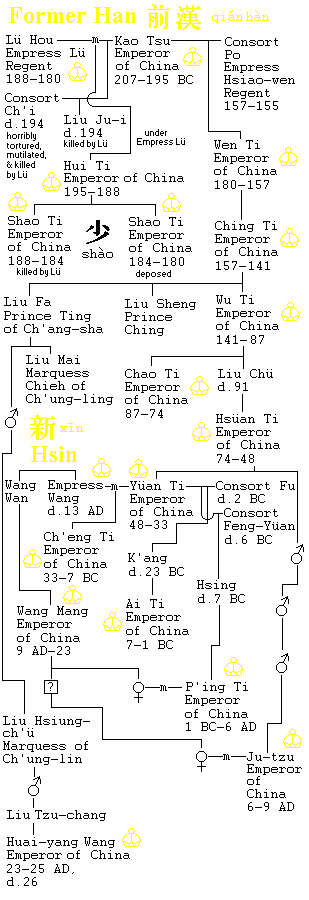 The genealogy of the Former Han is from the Nihon Kodaishi Daijiten (Dictionary of Ancient Japanese History) supplemented with information from the Chronicle of the Chinese Emperors by Ann Paludan [Thames & Hudson, London, 1998]. Paludan, unfortunately, renders the name of the Empress Lü as "Lu."
The Han was barely established before being badly defeated by a steppe people from the North, the Hsiung-nu (Xiōngnú), . Speculation has long centered on them as being the "Huns" who later invaded Europe and India.
One of the principal objections to the identification of the Hsiung-nu with the Huns is that there is too great a chronological gap between the original references to them in China, during the Han, and with their arrival in Europe, in the 5th century.
The implication of the criticism is that the Hsiung-nu disappear in China and then pop up in Europe centuries later, as though they just vanished in the meantime. However, as will be evident below, a Hsiung-nu presence in China continues into the 5th century also. I wonder if the critics are aware of that. Elements of the group could have ventured upon the Steppe towards Europe at any convenient time.
With the death of the founding Emperor Kao Tsu, the Empress Lü, 吕后, Lǚ Hòu, comes to dominate the next fifteen years of Chinese history. She killed dynastic rivals to her own family and even one of her own grandsons in her pursuit of her interests. However, both her grandsons were rendered so insignificant by her power that they were not even given postumous names and are often not even listed as Chinese Emperors. Thus, they are known as the "former insigificant Emperor," 前少帝, Qián Shàodì, and the "later insigificant Emperor," 後少帝, Hòu Shàodì.
Never would the hate of Lü be so terrible, however, as that vented on the Consort Ch'i, 戚姬, Qī Jī, whose son was a rival to her own in becoming the next Emperor. What Lü did to Consort Ch'i is like nothing so much as the mutilations we see in the Dexter books by Jeff Lindsay -- the books, that is, not the Dexter TV shows (2006-2013), which were considerably toned down. It is the stuff of nightmares. But it was all for naught. The Lü family was massacred and Hòu Shàodì deposed and then killed. The son of Consort Po, 薄姬, Bó Jī, became Emperor, and the ancestor of all subsequent Han Emperors.
The greatest Emperor of the Former Han Dynasty was probably Wu Ti, 武帝, Wǔdì. This posthumous name means "Martial Emperor," because of the success of Chinese arms in breaking the Hsiung-nu and in the occupation of the Tarim Basin; but the cultural heritage of his long reign was far more durable. The establishment of Confucianism as the official moral and political ideology of the state was due to the advice of Wu Ti's minister Kung-sun Hung, 公孫弘, Gōngsūn Hóng (200-121 BC). In 136 official experts in each of the Five Classics were appointed at court, and in 124 they took on fifty students. By 50 BC this palace school had 3000 students, and by 1 AD graduates staffed the bureaucracy.
Also at Wu Ti's court was the historian Szu-ma Ch'ien (司馬遷, Sīmǎ Qián, 145-86 BC), the "Grand Historian." Szu-ma angered the Emperor by defending a general who had been captured by the Hsiung-nu. His punishment was castration. Ordinarily, this humiliation (which also, to the horror of the Chinese, involved an element of dismemberment) would have led to suicide, but the historian lived with his shame in order to finish the first great Chinese history, the Shih Chi,  , "Historical Records," which covers all Chinese history up to the Ch'in and early Han Dynasties. This established the standard and the form for subsequent official Chinese dynastic histories -- not narrative history as familiar from Greek and Roman historians, but something more like an encyclopedia, with a chronicle, monographs on various subjects, and biographies. It had been started by Szu-ma's father, Szu-ma Tan (d.110) and was completed in 91 BC.
There would be twenty-four classic histories written in the Chinese tradition. Thus, these would simply be called the 二十四史, Èrshísì Shǐ, the Twenty-Four Histories. The history of Szu-ma Ch'ien is the first history, and can be identified with as Roman numeral, as "(I) 史記, Shǐjì." I will identify subsequent histories with Roman numerals.
When the government of the Republic of China fled to Taiwan in 1949, it took along all the records that had been kept about the Manchu Ch'ing Dynasty. Eventually, in the 1970's, a standard dynastic history was produced from these records; but, of course, this is not recognized by Communist China or, even among Western scholars, reckoned in the sequence, as the 25th Dynastic History.
The prelude to Wu Ti's pentration of Central Asia was the mission of Chang Ch'ien (張騫, Zhāng Qiān, d.c.114 BC). He was originally sent out, around 139, to make contact with the Yüeh-chih, whom the Chinese knew had been fighting the Hsiung-nu. Chang's mission got off to a bad start, since he was immediately captured by the Hsiung-nu and held for ten years. After escaping, he continued on his way, perhaps completely forgotten by Wu Ti. But Chang returned in 126, full of information about the strange places and things he had seen, including the remarkable coins that were used in the West (many of which were probably those from Greek Bactria):
Each coin, he reports, 'bore the face of the king [and] when the king died, the currency was immediately changed and new coins issued with the face of his successor'. Such a practice had never been known in China; since it could be construed as ennobling commerce and demeaning the sovereign by association with it, nor would it be. [John Keay, A History of China, Basic Book, 2009, p.137]
The face of Chinese coins would never bear more than an inscription of the Era name and the equivalent of "legal tender."
Beginning with the reign of Wên Ti, auspicious names begin to be given to periods of time. These become the Era names (nien-hao, niánhào, 年號). Until the Ming, each reign consists of one and sometimes several Eras. The present definition of the Chinese New Year, as the second New Moon after the Winter Solstice, dates from the inception of the T'ai-ch'u Era in 104 BC, in the reign of Wu Ti. The Eras of the Former Han Dynasty can be examined on a popup page. By Chinese reckoning, the reign of each Emperor begins in its first full calendar year. Thus, P'ing Ti (平帝, Píngdì), the "Peaceful Emperor," who comes to the throne in 1 BC, is reckoned to reign properly from 1 AD. Since this also marks the start of the life of the Christian "Prince of Peace," it makes for a nice coincidence with the name of the Chinese Emperor.
Later (Eastern) Han,  , Dynasty, 25-220 AD , Dynasty, 25-220 AD | |
|---|---|
| Kuang-wu Ti Liu Hsiu | 25-57 |
| Ming Ti Liu Yang | 57-75 |
| Chang Ti Liu Ta | 75-88 |
| Ho Ti Liu Chao | 88- 106 |
| Embassy sent to Rome, detained by Parthians, 97; pulp paper making, 105 | |
| Shang Ti Liu Lung | 106 |
| An Ti Liu Yü | 106- 125 |
| Shao Ti Liu Yi | 125 |
| Shun Ti Liu Pao | 125- 144 |
| Ch'ung Ti Liu Ping | 144- 145 |
| Chih Ti Liu Tsuan | 145- 146 |
| Huan Ti Liu Chih | 146- 168 |
| Embassy arrives from Rome, 166 | |
| Ling Ti Liu Hung | 168- 189 |
| Shao Ti, Shun Ti Liu Shun | 189, d.190 |
| Deposed & killed by warlord Tung Cho (董卓, Dǒng Zhuó) | |
| Hsien Ti Liu Hsieh | 189- 220, d.234 |
| Tung Cho destroys Lo-Yang, moves court to Chang-An, 190; assassinated, 192; Emperor escapes, returns to Lo-Yang, 195; Ts'ao Ts'ao (曹操, Cáo Cāo) occupies Capital, dominates Reign, 196 | |

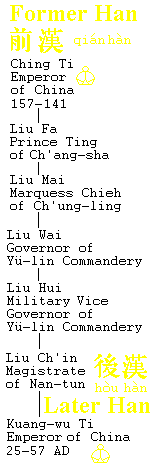 The Later Han is often called the "Eastern" Han because the capital was moved down the Huang He valley, back to where the capital of the Chou had been. This location was actually more easily supplied than the area of Ch'ang-An. Since the previous dynasty is often called the "Former" Han, it seems like the new one should be the "Latter" rather than the "Later" Han, but the usage is established. The "Former Han" is the Ch'ien Han, where
  is "formerly, before, in front of." The Former Han can also simply be called the "Han." "Later" is a translation from Chinese , "afterward, behind, to follow." Actually, looking at those, "former" and "latter" might be the best translations. They are also seen rendered as "early" and "posterior," respectively, with the names of other dynasties.
The change of dynasty was mainly because of rebellion against the "dictator" Wáng Mǎng, 王莽, at the end of the Former Han. The Throne was successfully seized by a distant Han cousin, who retained the Dynastic name. As shown in the genealogies above and below, the last Emperor of the Former Han, the rulers of the Later Han, and the subsequent Minor Han (or Shu Han) all traced descent from Ching Ti of the Former Han. Eventually, the Later Han Emperors for a time returned to the Tarim Basin, conquered Hainan, Tonkin, and Annam, and even moved north of the Great Wall into Mongolia.
One of the notable inventions of the Later Han dynasty was paper. The process of pulp paper making is ascribed to the eunuch Ts'ai Lun (蔡倫, Cài Lún, d.121 AD), who is supposed to have introduced it in the year 105. As a substitute for silk or bamboo strips, this made for a medium that was inexpensive and could be mass produced. Wood pulp could be mixed with shredded rags and other debris to make for papers of different qualities and durability. Later, in the T'ang Dynasty, Chinese artisans familiar with the process are supposed to have been captured by the Arabs at the Battle of Talas in 751. From them the process passed to Caliphal Baghdad and then to Romania.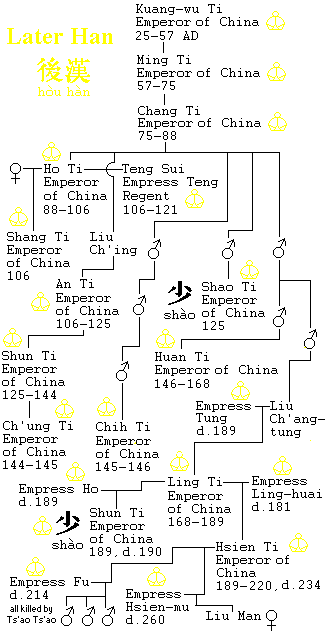
The second great dynastic history is produced during the Later Han Dynasty. This is simply the Like Szu-ma Ch'ien before him, the compiler of the History of the Former Han Dynasty, Pan Ku (班固, Bān Gù, 32 AD-92), ran afoul of the Emperor, in this case actually dying in prison. Nevertheless, this confirmed the tradition of the history of each dynasty being written under the following one. But Pan Ku was imprisoned and died before finishing the history, which leads to an extraordinary thing about it.
Pan Ku's sister, Pan Chao, The Emperors of two short reigns, in 125 and 189, are called In the Later Han, the way the succession here starts jumping between distant cousins reflects the rivalry between Court factions, particuarly the eunuchs and the Court women, usually meaning the Empress Dowager -- such as the Empress Ho ("He" in Pinyin), who was able to install her son as Emperor, until he was deposed and poisoned, as was she, by the warlord Tung Cho (董卓, Dǒng Zhuó, d.192). This conflict finally resulted in the massacre of the hated palace eunuchs in 189, leading to the dominance of warlords, like Tung Cho and Ts'ao Ts'ao.
The History of the Later Han Dynasty records that in the year 166 an embassy arrived in Lo-Yang from a ruler of There had been a previous Chinese attempt to establish some communication overland with "Great Ch'in" [John Keay, A History of China, Basic Book, 2009, p.173], Since we know that the Romans had knowledge of and trade with India and Ceylon, and that Chinese pilgrims like Fa-hsien went by sea from India to China (399-414), The Eras of the Later Han Dynasty can be examined on a popup page. The genealogy of the Later Han is from the Nihon Kodaishi Daijiten (Dictionary of Ancient Japanese History) supplemented with information from the Chronicle of the Chinese Emperors by Ann Paludan [Thames & Hudson, London, 1998]. The period of the "Three Kingdoms" is a brief interlude before things settle down for a while in the dynamic of the following period. It may be remembered now with special attention because of a literary source, The Romance of the Three Kingdoms, According to the History of the Liang, 梁書, Liángshū, in 226 a Roman merchant named 秦論, Qín Lùn, arrived through Vietnam, like the Romans in 166, and was sent to the Court of Sun Ch'üan, who wanted information about his homeland and who provided him with goods to take back, including slaves. The Liángshū says there were Roman merchants in Vietnam and Cambodia, which we might suspect from the route of the Romans in 166 and now in 226. Evidently there is archaeology of Roman goods also in Thailand, Malay, and Indonesia.
In 2008 director John Woo released the first of two epic movies, Red Cliff, followed by Red Cliff II [2009], based on the Battle of Red Cliff, This was a critical event in the formation of the Three Kingdoms. With the last Han Emperor reduced to a figurehead, the Prime Minister, Ts'ao Ts'ao [曹操, Cáo Cāo], attempted to crush the southern forces of Liu Pei [劉備, Liú Bèi] and Sun Ch'üan [孫權, Sūn Quán].
Where the Han River flows into the Yangtze, Ts'ao Ts'ao's fleet and army were broken, with the consequence that Liu Pei and Sun Ch'üan would be able to establish their independent domains of the Minor Han and Wu. Much of the success of Liu Pei was due to the Taoist recluse, the Before the Battle of Red Cliff, K'ung-ming even performs an elaborate rite to call the wind that will be against Ts'ao Ta'ao's fleet and will make for the Southern victory -- like a similar phenomenon, with the tide, that occurred naturally for the Minamoto at Dan-no-Ura. In the movie, he is merely able to predict the wind. This is consistent with his presentation in the movie, where we don't learn anything of his background, his recruitment, his powers, or anything about what would distinguish a Taoist recluse.
But the magical powers of Taoist adepts are firmly enshrined in Taoist tradition. Thus, in the Strange Tales from a Chinese Studio by Pú Sōnglíng, 蒲松齡 (1640-1715) [Penguin, 2006], we find a reference that "the great wizard and strategist Zhuge Liang had once served the Pretender Liu Bei in the time of the Three Kingdoms" ["King of the Nine Mountains," p.232], and several stories in that collection feature the magical powers of Taoist hermits or mendicants, including their returning from the dead.
While the prevalent political ideas of classical China are Confucian, we often see that there is a suspicion that the Taoists may know more about the way things work, in politics, war, and even in terms of magical powers to control nature. Except for the story of The Haunted Monastery [1961], we find Taoists, unlike Buddhists, generally presented positively in Judge Dee. Perhaps John Woo thought that a Western audience, or any properly modern audience, should not be confronted with the use of Taoist magic, or even an actual Taoist, in a historical epic.
A 1986 movie, A Great Wall, about a Chinese-American family who go to visit their relatives back in China, after the beginning of liberalization, contains a striking scene where the families attend a performance by an old woman who sings, with instrumental accompaniment, an episode from The Romance of the Three Kingdoms. The poet and official K'ung Jung (孔融, Kǒng Róng) recommends to Ts'ao Ts'ao the poet and scholar Mí Héng, 禰衡, for an office at Court.
Now, I would swear that when I originally saw the movie, at the time of its release, in a theater in Los Angeles, the old woman went on to recount the famous episode where Mí Héng strips naked at a banquet in order to protest Ts'ao Ts'ao's growing usurpation and tyranny. The 2002 version of the DVD, however, does not contain that development.
I don't know how I could be mistaken, since I remembered the episode for many years, without even realizing it was from the period of the Three Kingdoms, as a fine example of a Conscientious Minister, I have no doubt that the DVD version was censored by the Chinese Government, which objects to the whole Confucian ideal of officials remonstrating with the Throne. Despite the project of putting "Confucius Institutes" in American universities, the Communists do not believe in Confucian principles of government, or of anything. The destruction of freedoms in Hong Kong in 2020, although following years later, reflects a perfectly consistent attitude and policy of the Communist police state.
Even the original version of the movie, however, was not as sharp as the text of the Romance:
Ts'ao Ts'ao prudently endured Mi Heng's insults but sent him off to the provinces hoping that another official would be offended and execute him. This is what happened.
Other records do not have Mi Heng denouncing Ts'ao Ts'ao at the banquet, but just being briefly naked while changing clothes, as requested, although he did end up getting executed in the provinces. Such records are generally more favorable to Ts'ao Ts'ao, but it is not clear why the Romance should otherwise have marked him as a villain. There is a Chinese saying, the equivalent of "speak of the devil," 説曹操, 曹操 到, Shuō Cáo Cāo, Cáo Cāo dào, "Speak of Cáo Cāo, and Cáo Cāo arrives."
The Minor Han is supposed to derive from the Former Han Dynasty. "Shu Han" actually means the "Han of Szechwan." The character After repulsing Ts'ao Ts'ao, Liu Pei moved to occupy Szechwan. The territory he held in Hupei was then taken by Wu. The Romance of the Three Kingdoms does recount extensive campaigns in Yunnan by the now familiar K'ung-ming, so perhaps it is these campaigns, with the subjugation of the "Man" people, that account for its inclusion in the maps of the Shu Han. There is an explicit denial, however, of Chinese occupation or colonization. Yunnan thus has a vassal status that could easily lapse.
The Shu Han kingdom is later absorbed by the Wei (Ts'ao Ts'ao's grandson overthrowing Liu Pei's son). The Wei is replaced in a coup by the founder of the Western Tsin [or Chin, 西晋, Pinyin Xī Jìn], Sima Yan, a general of Wei, in 266. He conquers Wu in 280, reunifying the country. This doesn't last, as civil war breaks out in 290. The Hsiung-nu, There is a curious inconsistency in the Emperors of the Wei between Paludan and the Oxford Dynasties of the World [p.215-216]. Paludan drops Fei Ti, In the list of Mathews' Chinese-English Dictionary [p.1168], however, Shao Ti is Kao Kuei Hsiang Kung. Fei Ti is noted as deposed, and the Oxford Dynasties glosses him as both adopted and deposed. At the Chinaknowledge website, Ulrich Theobald matches Paludan, with Shao Ti identified as Ch'i Wang, which is how Mathews' identified Fei Ti.
What appears to be the case is that, as "Fei Ti," The Eras of the Minor Han and Wei Dynasties can be examined on a popup page. The genealogy of the Three Kingdoms is from the Nihon Kodaishi Daijiten (Dictionary of Ancient Japanese History) supplemented with information from the Chronicle of the Chinese Emperors by Ann Paludan [Thames & Hudson, London, 1998]. The genealogical descent of the Shu Han from the Han is that recounted in the Romance of the Three Kingdoms [Three Kingdoms, Volume I, Foreign Languages Press, Beijing, 1995, 2007]. The combined genealogy of Former Han, Later Han, and Shu Han can be inspected in a popup image.
 , "Han History," or Ch'ien Han Shu, 前漢書, Qián Hàn shū "Early/Former Han History." I will number it (II) 漢書, Hàn shū, in the sequence of great histories.

 , finished the project. This probably makes her the first woman historian, beating out by a thousand years the woman who otherwise could claim that priority, Anna Comnena (1083 1153).

 . This is discussed below with regard to the Emperors of the Three Kingdoms, where it took me a while to figure it out. This simply means that the reigns were short and insigificant, in these cases involving children. However, we have already seen two "Shao" Emperors in the Former Han. One might think that their combined reign of eight years (188-184, 184-180) would make them significant figures; but they had no independence of action apart from their grandmother, the Dowager Empress Lü, and Chinese history judged them insignificant.
, "Great Ch'in," named Andun. This had come up from Vietnam after, apparently, travelling by sea from the West. Andun looks like it might be "Antoninus," which could mean either Antoninus Pius or Marcus Aurelius, both of whom used the name. Thus, "Great Ch'in" is usually taken to mean Rome, and the embassy was sent to explore ways to redirect the silk trade around the route, the Silk Road through Central Asia, dominated by the Parthians. This is something that would indeed concern the Romans. If so, nothing came of it. The possibility of any communication between the great contemporary Empires of Rome and the Han is tantalizing. By the T'ang, regular communication would be established and maintained. The last contact would be in the Ming.
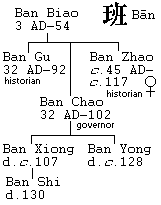 because it was already understood that this was the source of the gold that paid for all the Chinese silk that was going West. This effort was an embassy of 97 AD, sent by Pan Ch'ao (班超, Bān Chāo, 32 102 AD), another member of the family, brother of Pan Ku and Pan Chao and "Protector General of the Western Regions," i.e. Sinkiang, and led by Kan Ying (甘英, Gān Yīng;, c.90's AD). The project was frustrated by the Parthians -- "Parthia" in Chinese was 安息, Ānxī -- who detained the embassy and persuaded Pan Ch'ao that for various reasons (distance, plague) it was impractical to continue to the West. Kan Ying seems to have reached either the Persian Gulf or the Black Sea, and was discouraged from crossing by the Parthians. Since the Persian Gulf doesn't need to be crossed on a route to Rome, this suggests that the obstacle was more like the Black Sea, or even the Caspian, unless Kan Ying is being deceived about the geography altogether.
it is not at all impossible or unlikely that some Romans, in the days of the Kushans in India, could have done what the dynastic history says. The History was actually written in Anterior Sung Dynasty (420-479), and the Chinese were still aware that the Parthians (and by then the Sassanids) were frustrating attempts at direct trade with "Great Ch'in." Also, if the Romans went by sea, then obviously they would not have encountered the interference of the Parthians on route such as foiled the mission of Kan Ying. In fact, the account of Kan Ying says that the Parthians had previously prevented Roman enjoys from getting through overland to China.
The Three Kingdoms,  , 220-266
Minor Han,  ,
,
Dynasty, 221-263Wei, , Dynasty, 220-266Wu,  , Dynasty, 222-280
Chao-lieh Ti
Liu PeiKing of Shu/
Han-chung,
219-221;
Emperor,
221-223Wen Ti
Ts'ao P'i [Cao Pi]Emperor, 220-226 Wu Ta Ti
Sun Ch'üanKing of Wu,
222-229;
Emperor,
229-252Hou Chu
Liu Shan223-263,
d.271Ming Ti
Ts'ao Jui226-239 Shao Ti, Fei Ti,
Ch'i Wang
Ts'ao Fang239-254,
d.274Fei Ti
Sun Liang252-258 Shao Ti,
Kao Kuei Hsiang Kung
Ts'ao Mao254-260 Ching Ti
Sun Hsiu258-264 conquest by Wei, 263 Yüan Ti
Ts'ao Huan260-266,
d.302Mo Ti
Sun Hao264-280,
d.281overthrown by Chin, 266 conquest by Chin, 280 
 (from the Ming Dynasty). The expression can mean a "historical novel/romance," but literally it reads "practice righteousness," which suits its often moralizing approach. Although occasionally fictionalized, the novel covers the entire period from the fall of the Later Han to the succession of the Western Chin with largely historical detail. It became a very influential treatment of the history, and of history in general.

 , in the year 208.
 When Ts'ao Ts'ao's son Ts'ao P'i deposes the last Han Emperor in 220, Liu Pei and Sun Ch'üan declare independence. Traditionally, Wei was counted as the "legitimate" successor to the Han, but in the Three Kingdoms the sympathy and regard is all for Liu Pei.


 , "mountain and forest hermit," Chu-ke Liang (諸葛 亮, Zhūgě Liàng), known as K'ung-ming (孔明, Kǒngmíng). Liu Pei travels three times to find and petition K'ung-ming before obtaining his services. The Taoist then serves the Dynasty with superior administrative, diplomatic, strategic, and tactical abilities.

 , remonstrating about wrongful government. Surely there was not some other Chinese movie that related this event! The movie as now available says nothing about what Mi Heng did.
"How dare you commit such an outrage [i.e. stripping]," Cao cried, "in the hallowed hall of the imperial court?" "To abuse one's lord," Mi Heng shot back, "to deceive the sovereign, is what I call an 'outrage,' Let everyone see that I have kept the form my parents gave me free of blemish." "If you are so pure," Cao demanded, "who is corrupt?" Mi Heng responded, "That you cannot distinguish between the able and the incompetent shows that your eyes are corrupt. Your failure to chant the Odes and the Documents [i.e. early Confucian Classics] shows that your mouth is corrupt. Your rejection of loyal advice shows that your ears are corrupt. Your ignorance of past and present shows that your whole being is corrupt. Your conflicts with the lords of the realm show that your stomach is corrupt. Your dream of usurpation shows that your mind is corrupt..." [Three Kingdoms, Volume I, Foreign Languages Press, Beijing, 1995, 2007, p.391]
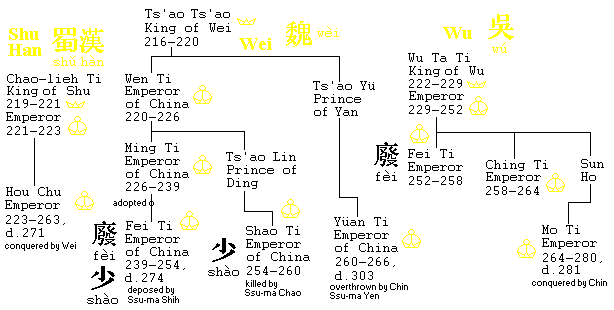 does not mean "minor." I have always been intrigued that the Shu Han is shown by L. Carrington Goodrich (A Short History of the Chinese People, Harper Torchbooks, 1959, 1963, p.59) occupying an area of Yunnan that had only been partially occupied by the Han, is missing from many maps of the T'ang, and was only properly settled by Chinese with veterans at the beginning of the Ming. J.A.G. Roberts, in A Concise History of China [Harvard, 1999], more reasonably identifies the area as Szechwan [Sichuan, north of the Yangtze], but then doesn't provide a map of the period (the maps he does provide jump directly from Confucius to the T'ang). Ann Paludan (Chronicle of the Chinese Emperors, Thames & Hudson, 1998) provides a nice map of the Three Kingdoms [p.64], though, mysteriously, none of the Sui or T'ang, showing somewhat less, thought still substantial, territory south of the Yangtze.
, sacked the capital of Luoyang in 311.
does not mean "minor." I have always been intrigued that the Shu Han is shown by L. Carrington Goodrich (A Short History of the Chinese People, Harper Torchbooks, 1959, 1963, p.59) occupying an area of Yunnan that had only been partially occupied by the Han, is missing from many maps of the T'ang, and was only properly settled by Chinese with veterans at the beginning of the Ming. J.A.G. Roberts, in A Concise History of China [Harvard, 1999], more reasonably identifies the area as Szechwan [Sichuan, north of the Yangtze], but then doesn't provide a map of the period (the maps he does provide jump directly from Confucius to the T'ang). Ann Paludan (Chronicle of the Chinese Emperors, Thames & Hudson, 1998) provides a nice map of the Three Kingdoms [p.64], though, mysteriously, none of the Sui or T'ang, showing somewhat less, thought still substantial, territory south of the Yangtze.
, sacked the capital of Luoyang in 311.
 , from the list and attributes his reign years to "Shao Ti," . A "Kao Kuei Hsiang Kung" [Gao Gui Xiang Gong] is then inserted between Shao Ti and Yüan Ti, with Shao Ti's regal years. "Kao Kuei Hsiang Kung" is, of course, a peculiar name, without the "Ti" element, which should mean that, in some sense, he was not judged legitimate ("Kung,"
  , as we know, is "Duke"). But Paludan, who discusses the era as the Dynasties does not, does not address this question.
, simply means the "overthrown Emperor," and "Shao Ti," , simply means the "minor Emperor" (in the sense of either young or insignificant). Thus, more than one Emperor in a dynasty, even successors, might be "Fei" or "Shao" or both -- see the Former Han. So I suspect "Shao" has been used for both Emperors in question. "Mo Ti,"
, as we know, is "Duke"). But Paludan, who discusses the era as the Dynasties does not, does not address this question.
, simply means the "overthrown Emperor," and "Shao Ti," , simply means the "minor Emperor" (in the sense of either young or insignificant). Thus, more than one Emperor in a dynasty, even successors, might be "Fei" or "Shao" or both -- see the Former Han. So I suspect "Shao" has been used for both Emperors in question. "Mo Ti,"  , means the "last Emperor," usually for the end of a dynasty -- see the Ch'ing for the very last Emperor.
| The Northern and Southern Empires, , 266-589 | |
|---|---|
| The Six Southern Dynasties, | |
1. Western Chin/Tsin,  , Dynasty, 266-316 , Dynasty, 266-316 | |
| Wu Ti Ssu-ma Yen/Sima Yan | 266-290 |
| Mission arrives from Rome, 284 | |
| Hui Ti Ssu-ma Chung | 290-307 |
| Huai Ti Ssu-ma Ch'ih | 307-313, d.318 |
| siege of Loyang, 309-311; captured by Hsiung-nu of the Early Chao, 313 | |
| Min Ti Ssu-ma Yeh | 313-316, d.318 |
| moved court to Ch'ang-an, 313; captured by Hsiung-nu of the Early Chao, 316; excecuted with Huai Ti, 318 | |
| 2. Eastern Chin/Tsin, , Dynasty, 317-420 | |
| Yüan Ti Ssu-ma Jui | 317-323 |
| Ming Ti Ssu-ma Shao | 323-325 |
| Ch'êng Ti Ssu-ma Yen | 325-342 |
| K'ang Ti Ssu-ma Yüeh | 342-344 |
| Mu Ti Ssu-ma Tan | 344-361 |
| Ai Ti Ssu-ma P'i | 361-365 |
| Fei Ti, Hai-hsi Ti Ssu-ma I | 365-372 |
| Chien-wên Ti Ssu-ma Yü | 372 |
| Hsiao-wu Ti Ssu-ma Yao | 372-396 |
| An Ti Ssu-ma Te-tsung | 396-419 |
| Kung Ti Ssu-ma Te-wen | 419-420 |
3. Anterior Sung,   , Dynasty, 420-479 , Dynasty, 420-479 | |
| Wu Ti Liu Yü | 420-422 |
| Fei Ti, Shao Ti, Ying-yang Wang Liu I-fu | 422-424 |
| Wen Ti Liu I-lung | 424-453 |
| Hsiao-wu Ti Liu Chün | 453-464 |
| Ch'ian Fei Ti Liu Ye | 464-466 |
| Ming Ti Liu Yü | 466-472 |
| Hou Fei Ti, Ts'ang-wu Wang Liu Yeh | 472-477 |
| Shun Ti Liu Chün | 477-479 |
| 4. Southern Ch'i, , Dynasty, 479-502 | |
| Kao Ti Hsiao Tao-ch'eng | 479-482 |
| Wu Ti Hsiao Tse | 482-493 |
| Yü-lin Wang Hsiao Chao-yeh | 493-494 |
| Hai-ling Wang Hsiao Chao-wen | 494 |
| Ming Ti Hsiao Luan | 494-498 |
| Tung Hun Ho Hsiao Pao-chüan | 498-501 |
| Ho Ti Hsiao Pao-jung | 501-502 |
5. (Southern) Liang,  , Dynasty, 502-557 , Dynasty, 502-557 | |
| Wu Ti Hsiao Yan | 502-549 |
| Chien-wên Ti Hsiao Kan | 549-551 |
| Yü-chang Wang Hsiao Tung | 551, d.552 |
| Yüan Ti Hsiao I | 552-555 |
| Wu-ling Wang Hsiao Chi | 555 (552?) |
| Ching Ti Hsiao Fang-chih | 555-557, d.558 |
| 5a. Later Liang, , Dynasty, 555-587 | |
| Yi Ti Hsiao Ch'a | 555-562 |
| Ming Ti Hsiao K'uei | 562-585 |
| Ts'ung Hsiao Ts'ung | 585-587 |
6. Southern Ch'ên,  , Dynasty, 557-589 , Dynasty, 557-589 | |
| Wu Ti Ch'en Pa-hsien | 557-559 |
| Wên Ti Ch'en Ch'ien | 559-566 |
| Fei Ti, Lin-hai Wang Ch'en Po-tsung | 566-568, d.570 |
| Hsüan Ti Ch'en Hsü | 569-582 |
| Hou Chu Ch'en Shu-pao | 582-589, d.604 |
| Falls to Sui, 589 | |
the Sixteen Kingdoms of the Five Barbarians,    | |
|---|---|
| 1. Early Chao, , (Northern Han) Dynasty, 304-329 (Hsiung-nu), Shansi, Hopei, & Shensi | |
| Kao Tsung Liu Yuan | 304-309 (311?) |
| Liu Ho | 309 |
| Chao-wu Ti Liu Ts'ung | 310-317 |
| Sack of Loyang, 311; captures last two Chin Emperors, 313, 316; ends Western Chin, 316 | |
| Yin Ti, Shao-chu Liu Ts'an | 317 |
| Ch'in Wang Liu Yao | 318-329 |
| fell to Later Chao | |
| 2. Later Chao, , Dynasty, 319-352 (Chieh) | |
| Kao Tsu Shih Le | 319-333 |
| Hai-yang Wang Shih Hong | 333-334 |
| T'ai Tsu Shih Hu | 334-349 |
| Ch'iao Wang Shih Shih | 349 |
| P'eng-ch'ung Wang Shih Tsun | 349 |
| I-yang Wang Shih Chien | 349-350 |
| Hsin-hsing Wang Shih Chih | 350-351 |
| Jan Min | 350-352 |
| fell to Early Yen | |
3. Ch'eng-Han,  , Dynasty, 304-347 (Ti), Szechwan , Dynasty, 304-347 (Ti), Szechwan | |
| Shih Tsu Li T'e | 302-303 |
| Chin-wen Wang Li Liu | 303 |
| T'ai Tsung Li Hsiung | 303-334 |
| Ai Ti Li Pan | 334 |
| You Ti, Fei Ti Li Ch'i | 334-337, deposed |
| Chung Tsung Li Shou | 338-343 |
| Hou Ti Li Shih | 343-347 |
| fell to Eastern Chin | |
4. Early Liang,  , Dynasty, 313-376 (Chinese), Kansu , Dynasty, 313-376 (Chinese), Kansu | |
| Wu Wang, T'ai Tsung Chang Kui | 301-314 |
| T'ai Tsung Chang Shih | 314-320 |
| Ch'eng Wang Chang Mao | 320-324 |
| Wen Wang Chang Chün | 324-346 |
| Ming Wang Chang Ch'ung-hua | 346-353 |
| Ai Kung Chang Yao | 353 |
| Wei Wang Chang Tsuo | 353-355 |
| Ch'ung Wang Chang Hsüan-ching | 355-363 |
| Tao Kung Chang Tien-Hsi | 363-376 |
| fell to Early Ch'in | |
| 5. Later Liang,, Dynasty, 386-403 (Ti) | |
| T'ai Tsu Lü Kuang | 386-399 |
| Yin Wang Lü Shao | 399 |
| Ling Ti Lü Tsuan | 399-401 |
| Hou-chu Chien-k'ang Kung Lü Lung | 401-403 |
| fell to Later Ch'in | |
| 6. Southern Liang, , Dynasty, 397-404, 408-414 (Hsien-pei) | |
| Lieh Tsu T'u-fa Wu-ku | 397-399 |
| K'ang Wang T'u-fa Li-lu-ku | 399-402 |
| Ching Wang T'u-fa Ju-t'an-li | 402-414 |
| fell to Western Ch'in | |
| 7. Western Liang, , Dynasty, 401/5-421 (Chinese) | |
| T'ai Tsu Li Kao | 400-417 |
| Hou-chu, Liang Kung Li Hsin | 417-420 |
| Kuan-chün Hou Li Hsün | 420-421 |
| fell to Northern Liang | |
| 8. Northern Liang, , Dynasty, 397-439 (Hsiung-nu) | |
| Chien-k'ang Kung Tuan Yeh | 397-400 |
| T'ai Tsu, Wu-hsüan Wang Chü-ch'ü Meng-hsün | 401-432 |
| Ai Wang Chü-ch'ü Mu-chien | 433-439 |
| [Chü-ch'ü Wu-hui] | 443 |
| [Chü-ch'ü An-chou] | 444-460 |
| fell to Northern Wei | |
| 9. Early Yen, , Dynasty, 349-370 (Hsien-pei), Shansi & Hopei | |
| P'u-kuei | 281-283 |
| Shan | 283-285 |
| Wu-hsüan Ti Mu-jung Hui | 285-333 |
| T'ai Tsu Mu-jung Huang | 333-348 |
| Lieh Tsu Mu-jung Chün | 348-360 |
| Yu Ti Mu-jung Wei | 360-370 |
| fell to Early Ch'in | |
| 10. Later Yen, , Dynasty, 384-408 (Hsien-pei) | |
| Shih Tsu Mu-jung Ch'ui | 384-396 |
| Lieh Tsung Mu-jung Pao | 396-397 |
| K'ai-feng Kung Mu-jung Hsiang | 397 |
| Chao Wang Mu-jung Lin | 397 |
| Chung Tsung Mu-jung Sheng | 398-401 |
| Chao-wen Ti Mu-jung Hsi | 401-407 |
| Hui-i Ti Kao Yün | 407-408 |
| fell to Northern Yen | |
| 11. Southern Yen, , Dynasty, 398-410 (Hsien-pei) | |
| Shih Tsu Mu-jung Te | 398-405 |
| Pei-hai Wang Mu-jung Chao | 405-410 |
| fell to Eastern Chin | |
| 12. Northern Yen, , Dynasty, 409-436 (Chinese) | |
| T'ai Tsu Feng Pa | 408-430 |
| Chao-ch'eng Ti Feng Hong | 430-436 |
| fell to Northern Wei | |
| 13. Early Ch'in, , Dynasty, 351-394 (Ti), Shensi [Shaanxi] | |
| T'ai Tsu Fu Hong | 349-350 |
| Kao Tsu Fu Chien | 350-354 |
| Chao Li Wang Fu Sheng | 354-357 |
| Shih Tsu Fu Chien | 357-385 |
| Ai P'ing Ti Fu P'i | 385-386 |
| T'ai Tsung Fu Teng | 386-394 |
| Mo-chu Fu Ch'ung | 394 |
| fell to Later or Western Ch'in | |
| 14. Later Ch'in, , Dynasty, 384-417 (Ch'iang) | |
| Shih Tsu Yao I-chung | |
| Wei Wu Wang Yao Hsiang | |
| T'ai Tsu Yao Ch'ang | 383-393 |
| Kao Tsu Yao Hsing | 393-415 |
| Hou-chu Yao Hong | 415-417 |
| fell to Eastern Chin | |
| 15. Western Ch'in, , Dynasty, 385-390, 409-431 (Hsien-pei) | |
| Lieh Tsu Ch'i-fu Kuo-jen | 385-387 |
| Kao Tsu Ch'i-fu Ch'ien-kuei | 387-411 |
| T'ai Tsu Ch'i-fu Chih-p'an | 411-427 |
| Ho-chu Ch'i-fu Mu-mo | 427-431 |
| fell to Hsia | |
| 16. Hsia, , Dynasty 407-431 (Hsiung-nu), Shensi | |
| Shih Tsu Ho-lien Po-po | 407-425 |
| Fei-chu, Ch'in Wang Ho-lien Ch'ang | 425-428 |
| Hou-chu, P'ing-k'ang Wang Ho-lien Ting | 428-431 |
| fell to Northern Wei | |
Chinese historians regarded the Southern Dynasties as the legitimate succession of the Chinese Throne, which is why, even though Yang Chien came to a unified Northern Throne in 581, the period is reckoned to extend down to 589 and the Sui begun in 590.
All sources tend to neglect listing the rulers of the Northern Dynasties and Kingdoms, or even many of the Northern Dynasties and Kingdoms themselves. The latter neglect tends to follow a division, between the less Chinese, more ephemeral, and so less noteworthy "Sixteen Kingdoms," and the "Five Northern Dynasties" which unify the North, last longer, become much more Sinified, and lead, by way of the Northern Chou, to the reunification of the country.
The Eras of the Six Southern Dynasties can be examined on a popup page.
The genealogies of the Six Southern Dynasties, the Sixteen Kingdoms, and the Five Northern Dynasties can all be examined on a very large [90.0K] popup image [use a default gray background for best effect]. Or it can be loaded into the current window.
Or the three groups of genealogies can be examined in individual popups: The Six Southern Dynasties, the Sixteen Kingdoms, and the Five Northern Dynasties. These genealogies are entirely from the Nihon Kodaishi Daijiten (Dictionary of Ancient Japanese History), though the names and dates may be from other sources.
It will be noticed that there are two Later Liang dynasties -- pronounced the same but not using the same character -- one with the Six Dynasties (, #5a), but not one of them, and another among the Sixteen Kingdoms (, #5). The former, while not an official part of the Six Dynasties or the Northern Kingdoms or Dynasties, was simply a survival of the official Liang Dynasty (#5), after it had been displaced by the Southern Ch'ên (#6). As such, it is often ignored or anomalously placed with the Sixteen Kingdoms.
The "Anterior" Sung is actually called the Sung, i.e. the Sung of the Liu family, which otherwise is the family of Han Dynasties -- though not, as it happens, of the Ch'eng Han, whose surname is Li (like the T'ang Dynasty). The character means "final," as though this was the very last Han dynasty. It wasn't, and the character is not otherwise used.
It is under the Western Chin (266-316) that the tradition of dynastic histories was continued, with the Record of the Three Kingdoms, San Kuo Chih, (III) 三國志, Sānguózhì, by Ch'en Shou, 陳夀, Chén Shòu, in 289.
Under the Anterior Sung Dynasty (420-479) we get the publication, in 445, of the important and classic History of the Later Han Dynasty, the  , (IV) 後漢書, Hòu Hàn shū, by Fan Yeh, 范曄, Fà Yè (398-455),
This completes what are then called the "Early Four Histories," 前四史, Qiánsì Shǐ, encompassing the Ch'in, the Han dynasties, and the Three Kingdoms. The production of these is a little out of sequence, since the Later Han came before the Three Kingdoms.
Under the (Southern) Liang (502-557) two dynastic histories were completed: The History of the [Anterior] Sung, Sung Shu, (V) 宋書, Sòng Shū, by Shen Yüeh, 沈約, Shěn Yuē (441 513), in 488; and the History of the Southern Ch'i, Nan Ch'i Shu, (VI) 南齊書, Nán Qíshū, by Hsiao Tzu-hsien, 蕭子顯, Xiāo Zǐxiǎn (489 537), in 537. The date the first history, however, is evidently itself under the Southern Ch'i.
Under the Northern Ch'i (557-589) one history was completed, the History of the [Northern & Eastern] Wei, Wei Shu, (VII) 魏書, Wèi Shū, in 554, by Wei Shou, 魏收, Wèi Shōu (506 572).
While something like the Sixteen Kingdoms sounds like an obscure period, like the Dark Ages in Europe, this is only an impression, not because of lack of records, as in the European Dark Ages. There was a history, the Shíliùguó Chūnqiū, 十六國春秋, or the Spring and Autumn Annals of the Sixteen Kingdoms, by Ts'ui Hong [Cui Hong]. Unfortunately, the original of this was lost, though, as with many Greek and Roman histories, elements of it were preserved in later writers.
| the Five Northern Dynasties, | ||
|---|---|---|
| 1. Northern Wei, , Dynasty, 386-534 (Hsien-pei) | ||
| Tao Wu Ti, T'ai Tsu T'o-pa Kuei | 386-409 | |
| Ming Yüan Ti T'o-pa Ssu | 409-423 | |
| T'ai-wu Ti T'o-pa T'ao | 423-452 | |
| Nan-an Wang T'o-pa Yü | 452 | |
| Wên Ch'êng Ti T'o-pa Chün | 452-465 | |
| Hsien Wên Ti T'o-pa Hong | 465-471, d.476 | |
| Hsiao Wên Ti Yüan Hong | 471-499 | |
| Hsüan Wu Ti Yüan K'o | 499-515 | |
| Hsiao Ming Ti Yüan Hsü | 515-528 | |
| Hsiao Chuang Ti Yüan Tzu-yu | 528-530, d.531 | |
| Tung-hai Wang Yüan Yeh | 530 | |
| Fei Ti, Chieh Min Ti Kuang-ling Wang Yüan Kung | 530-531, d.532 | |
| Hou-fei Ti, An-ting Wang Yüan Lang | 531-532 | |
| Hsiao Wu Ti Yüan Hsiu | 532-535 | |
| 2. Eastern Wei, , Dynasty, 534-550 (Hsien-pei) | ||
| Hsiao Ching Ti Yüan Shan-chien | 534-550, d.552 | |
| 3. Western Wei, , Dynasty, 535-556 (Hsien-pei) | ||
| Wên Ti Yüan Pao-chü | 535-551 | |
| Fei Ti Yüan Ch'in | 551-554 | |
| Kung Ti Yüan K'uo | 554-557 | |
| 4. Northern Ch'i, , Dynasty, 550-577 | ||
| Wên Hsüan Ti Kao Yang | 550-559 | |
| Fei Ti Kao Yin | 559-560, d.561 | |
| Hsiao Chao Ti Kao Yen | 560-561 | |
| Wu Ch'êng Ti Kao Chan | 561-565, d.569 | |
| Hou-chu Kao Wei | 565-577 | |
| An-te Wang Kao Yen-tsung | 577 | |
| Yu-chu Kao Heng | 577 | |
| 5. Northern Chou, , Dynasty, 557-581 (Hsien-pei) | ||
| Hsiao Min Ti Yü-wên Chüeh | 557 | |
| Ming Ti, Shih Tsung Yü-wên Yü | 557-560 | |
| Wu Ti, Kao Tsu Yü-wên Yung | 560-578 | |
| Abolishes Buddhism and Taoism, 574 | ||
| Hsüan Ti Yü-wên Yün | 578-579, d.580 | |
| Ching Ti Yü-wên Ch'an | 579-581 | |
| Overthrown by Yang Chien, 581 | ||
Indeed, the history of the period ends up being covered by no less than eight of the standard dynastic histories. The Six Southern Dynasties are featured in the (XIII) Jinshu (History of Tsin/Jin), (V) Songshu (History of the Anterior Sung), (VI) Nan Qishu (History of the Southern Ch'i), (VIII) Liangshu (History of the Liang), and (IX) Chenshu (History of the Ch'en).
The Five Northern Dynasties are featured in the (VII) Weishu (History of Wei), (X) Bei Qishu (History of Northern Ch'i), and (XI) Zhoushu (History of Chou).
Since there were only 24 standard dynastic histories finished before the end of Imperial China in 1912, this group counts for exactly a third of the whole corpus. However, there is more. Two more histories of the period, the Southern Dynasties, (XIV) 南史, Nánshǐ, and the Northern Dynasties, (XV) 北史, Běishǐ, were added by T'ang historians. So this came to 10 out of the 24 histories. Eight of these were completed in the T'ang Dynasty and consequently were called the "Eight Histories of the T'ang Dynasty," 唐初八史, Táng Chū Bā Shǐ.
The Sixteen Kingdoms are of the "Five Barbarians," These were:
(1) the Hsiung-nu, 匈奴, the Early Chao, 前趙,
the Northern Liang, 北涼, and the Hsia, 夏; (2) the Chieh, 羯, (3) the Hsien-pei [or Hsien-pi], 鮮卑, the Southern Liang, 南涼, the Early Yen, 前燕, the Later Yen, 後燕, the Southern Yen, 南燕, the Western Ch'in, 西秦,
the Western Yen, 西燕, the Tai, 代,
the Northern Wei, 北魏, the Eastern Wei, 東魏, the Western Wei, 西魏, and the Northern Chou, 北周;
The Hsien-pei, Xiānbēi, were the ones who drove the Hsiung-nu out of the Mongolian Plateau in 93 AD. In time, this brought them into conflict with the Han, but their power collapsed after the death of the leader Tanshihuai in 181 AD. Obviously, by the time of the Northern and Southern Empires, groups infiltrated South and formed these various kingdoms and dynasties. The majority of the Five Northern Dynasties were Hsien-pei, including the Northern Chou, which was the jumping off point for Yang Chien, who founded the Sui; (4) the Ch'iang, 羌, (5) the Ti, 氐, the Ch'eng-Han, 成漢, the Later Liang, 後涼, the Early Ch'in, 前秦, the Former Ch'iu-ch'ih, 前仇池, and the Later Ch'iu-ch'ih, 後仇池.
The Ch'iang and the Ti, like the later Hsi-Hsia kingdom, were early groups of Tibetan or Tangut, 黨項, Dǎngxiàng (Japanese Tangūto), peoples, all speaking languages ultimately related to Chinese in the Sino-Tibetan language family. The other groups were all speaking Altaic languages, closely related to Turkish, Mongolian, and Manchu. One wonders if the current murderous Chinese treatment of the Tibetans is in revenge for the Tangut dynasties and kingdoms here and for the Tibetan sack of Ch'ang-an in 763. The Indo-European speaking Yüeh-chih, 月氏, One thing that fragmented and weakened government made possible was basic cultural innovation. Buddhism took a while to catch on in China. Confucians would really never accept a teaching that advised people to abandon their families and become dependants on society, as Buddhist monks and nuns did. Buddhism had arrived during the Later Han, not always attracting negative official notice, but basic Confucian hostility was only overcome by the weakening of central authority with the now fragmented nature of the country, especially under the barbarian Northern dynasties, where undiscriminating "barbarian" tastes perhaps didn't know any better.
It was from the Northern Wei that the fabulous Buddhist cave shrines began to be carved and painted at Dūnhuáng, 敦煌, on the Silk Road in western Kansu [Gānsù, 甘肃]. There was also a change in Buddhism itself: Mahāyāna Buddhism had become less hostile to the world than earlier forms, and this was altogether more agreeable to the Chinese.
, i.e. five barbarian peoples. In the tables, these are color coded.
, shown in gray. Gray is also reserved for the Mongols, and for any non-Chinese dynasty whose ethnic character is unknown, at least to me. Also, the barbarian states on the maps are in gray; despite all the trouble that the Hsiung-nu gave the Han, there are only three kingdoms of this group here. This may be because most of the group has moved West, as the Huns in Europe and India:
 , or
, or  , 羯古, in dark red; the Later Chao, 後趙, is the only kingdom of this group;

 , in olive green; there are no less than ten dynasties and kingdoms of this group:
 , in purple; the Later Ch'in, 後秦, is the only kingdom of this group; and
 , or
, or  , 氐羌, in brown; there are five dynasties and kingdoms of this group:
, are long gone, appearing as the Kushans in Central Asia and India, after they were defeated and driven away by the Hsiung-nu in 170 BC (in the early days of the Han Dynasty). As noted above, a reasonable speculation holds that the Hsiung-nu are none other than the Huns, whose linguistic (Altaic) affinity was probably with Mongolian, though some sources say Turkish. The Hsien-pei, in turn, appear to have been Turkish. However, it may be that all the languages are rather close to proto-Altaic and the Mongolian and Turkic groups have not definitely separated yet. A few of the Northern Dynasties were evidently Chinese, but all became increasingly Sinified both in culture and, through intermarriage, ethnically. The general terms for barbarians in different directions are discussed below.
, 氐羌, in brown; there are five dynasties and kingdoms of this group:
, are long gone, appearing as the Kushans in Central Asia and India, after they were defeated and driven away by the Hsiung-nu in 170 BC (in the early days of the Han Dynasty). As noted above, a reasonable speculation holds that the Hsiung-nu are none other than the Huns, whose linguistic (Altaic) affinity was probably with Mongolian, though some sources say Turkish. The Hsien-pei, in turn, appear to have been Turkish. However, it may be that all the languages are rather close to proto-Altaic and the Mongolian and Turkic groups have not definitely separated yet. A few of the Northern Dynasties were evidently Chinese, but all became increasingly Sinified both in culture and, through intermarriage, ethnically. The general terms for barbarians in different directions are discussed below.
| Unclassified Dynasties | |
|---|---|
| 1. Western Yen, , (= Later Han?) Dynasty, 384-394 (Hsien-pei), Shansi & Hopei | |
| Mu-jung Hong | 384-385 |
| Wei Ti Mu-jung Ch'ung | 385-386 |
| Mu-jung I | 386 |
| Mu-jung Yao | 386 |
| Mu-jung Chung | 386 |
| Mu-jung Yung | 386-394 |
| fell to Later Yen | |
| 2. Tai, , Dynasty, 315-376 (Hsien-pei), Shensi | |
| T'o-pa I-lu | 315-338 |
| T'o-pa Shih-i-chien | 338-376 |
| fell to Early Ch'in | |
3. Former Ch'iu-ch'ih, , Dynasty, 296-371 (Ti), Kansu , Dynasty, 296-371 (Ti), Kansu | |
| Yang Mao-sou | 296-317 |
| Yang Nan-ti | 317-334 |
| Yang I | 334-337 |
| Yang Ch'u | 337-355 |
| Yang Kuo | 355-356 |
| Yang Chün | 356-360 |
| Yang Shih | 360-370 |
| Yang Ts'uan | 370-371 |
| fell to Early Ch'in | |
| 4. Later Ch'iu-ch'ih,, Dynasty, 385-443 (Ti) | |
| Wu Wang Yang Ting | 385-394 |
| Hui-wen Wang Yang Sheng | 394-425 |
| Hsiao-chao Wang Yang Hsüan | 425-429 |
| Yang Pao-tsung | 429 |
| Yang Nan-tang | 429-441 |
| Yang Pao-ch'ih | 441-443 |
| fell to Northern Wei | |
5. Wu-tu,  , Dynasty, 447-477 , Dynasty, 447-477 | |
| Yang Wen-te | 443-454 |
| Yang Yüan-te | 454-466 |
| Yang Seng | 466-473 |
| fell to Northern Wei | |
6.Wu-hsing,  , Dynasty, 478-530 , Dynasty, 478-530 | |
| Yang Wen-hong | 478-480 |
| Yang Chi-shih | 480-503 |
| Yang Shao-hsien | 503-? |
| Yang Pi-hsieh | ?-530 |
| fell to Northern Wei | |
The popularity of Buddhism ushered in the great era of missionaries and pilgrims. Buddhist missionaries arrived to spread the dharma. One of these was Kumārajīva (344-413), the great translator of the Lotus Sutra, who arrived in China in 401. Another was the semi-mythical Bodhidharma (died circa 528), who founded the Ch'an (Zen) School of Buddhism, which combined Buddhism with Chinese ideas from Taoism.
This missionary effort was reciprocated by Chinese pilgrims who travelled to India, like Fa-hsien (法顯, Fǎxiǎn, d.c.422), whose route, overland going (on the Silk Road), by sea returning, is shown below. This is recounted in his Records of Buddhist Kingdoms, 
 , which includes a remarkable account of the Gupta Court and contemporary India. The purpose of the pilgrims was usually not just to visit holy sites but to learn Sanskrit and fetch back texts to translate into Chinese.
Hunting down the details of this period has been a challenge. The print histories I have seen are woefully deficient in chronological apparatus, with few lists of rulers and often lacking even lists of dynasties, especially of the Sixteen Kingdoms and Five Northern Dynasties. The rulers of the Five Northern Dynasties are from the Oxford Dynasties of the World, by John E. Morby [Oxford University Press, 1989, 2002, pp.217-218]. L. Carrington Goodrich [A Short History of the Chinese People, Harper Torchbooks, 1943, 1963] had the first detail of the Sixteen Kingdoms that I had seen. Otherwise, I have had to resort of other kinds of resources.
The Nihon Kodaishi Daijiten (Dictionary of Ancient Japanese History) actually gives genealogies for all the Dynasties and Kingdoms but, being all in kanji, requires (for me) a slow effort of decipherment. On line, Wikipedia has good treatments, and some other websites give complete lists of rulers. I now find the most complete treatment of the Sixteen Kingdoms, however, at the Chinaknowledge website of Ulrich Theobald. He includes all the forms of the names of the rulers, with characters and era names. This is pretty definitive.
Theobald strictly uses Pinyin readings, which are sometimes jumbled together with Wade-Giles at some sites, sometimes even in the same names. Here, of course, I try to give Wade-Giles first with some Pinyin alternatives, but the process of imposing uniformity in these tables is not yet complete. There are some minor differences in dates for the Sixteen Kingdoms between Goodrich and Jacques Gernet [A History of Chinese Civilization, translated by J.R. Foster, Cambridge University Press, 1972, 1982, 1990]. There are systematic differences in dates between the Nihon Kodaishi Daijiten and other sources, probably explicable in terms of the practice of dating a reign from the first full year. The Daijiten dates, reflecting that practice, are given here.
Some unclassifed dynasties occur in different sources -- i.e. they are not in the traditional roster of the Six Southern Dynasties, the Sixteen Kingdoms, or the Five Northern Dynasties. Goodrich mentions and the Daijiten lists the Southern "Later Liang" discussed and listed above. Goodrich also mentions a "Western Yen," and some websites list a "Later Han" and a "Tai." The "Western Yen" and the "Later Han" suspiciously both have the same starting and finishing dates, so I have taken the liberty of equating them. Theobald gives full information on the Western Yen, Tai [Dai], and several others, of which I had added the Former and Later Ch'iu-ch'ih [Qiuchi], the Wu-tu, and Wu-hsing.
I have never seen a map of the arrangement or history of the kingdoms, north or south, in this period. Theobald does give some geographical designations, which I have added to the names of the dynasties. Dynasties with the same names (e.g. Chao, Liang, Yen) follow in the same geographical areas. Note that Shansi is now written as Shanxi, and Shensi as Shaanxi. The former means Western Mountain ( ), the latter Western Mountain Passes (
 ). Shensi is in the great bend of the Huang He river, west of Shansi. This was the homeland of Ch'in and the seat of the Former Han, as it would be of the T'ang, at Ch'ang-an (modern Sian or Xian). A while ago a correspondent objected that there is no word "Shaanxi" in Chinese. That is true, but using the two a's is the convention adopted in China itself to distinguish between the two provinces, which otherwise, in the absence of written tones, would have identical names.
Sui,  , Dynasty, , Dynasty,589-618 | |
|---|---|
| Wên Ti Yang Chien | Northern Empire, 581-604 |
| Southern Empire, 589-604 | |
| Yang Ti Yang Kuang | 604-617, d.618 |
| Kung Ti Yang Yu | 617-618, d.619 |
| Yüeh Wang, Kung Ti Yang T'ung | 618-619 |
 Yang Chien was rather like the Chinese Justinian, with some important exceptions: (1) He began in the Barbarian North (as a general of the Northern Chou, grandfather and regent for the Chou Emperor Ching Ti, whom he deposed in 581) and conquered the Chinese South; and (2) he completely restored the Empire. Justinian's work began from the remaining Empire and was incomplete. If Charlemagne had reunited the entire Roman Empire, the effect would have similar to what we see in China.
Yang Chien was raised a Buddhist; and on assuming the Northern Throne in 581, he announced that his rule, promoting the "ten Buddhist virtues," would be like that of a Cakravartin, चक्रवर्तिन्, the universal monarch of Indian ideology, translated into Chinese as the , "Wheel Turning Sacred King." There could be no more striking a testimony to the legitimization of Buddhism as a Chinese religion. However, Confucians never liked Buddhism very much, and it was certainly not forgotten that Buddhism was a foreign introduction. There was latent hostility towards it, though no anti-Buddhist measures would ever go so far as they subsequently would in Korea.
Besides reuniting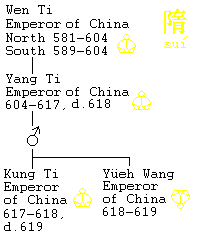 the country, the Sui is particularly famous for the building of the Grand Canal. This took essentially the entire duration of the Dynasty, and aroused great resentment from the severity of the forced labor. More than 3,000,000 workers were impressed, and those evading service were executed. The project was pursued by the Emperor Yang Kuang, who also provoked opposition with disastrous attempts to conquer Korea. Then, when rebellions broke out, he did little to suppress them and was eventually killed by the captain of his own guard. Meanwhile, the T'ang had become established at Ch'ang-an. The last person on the list, the Prince (Wang) of Yüeh, is often not included among the Emperors. The T'ang had already deposed the dynasty.
In 607, Prince Shōtoku supposedly wrote a letter for his aunt, the Empress Suiko, to the Sui Emperor Yang Ti. He referred to Japan as the land where the "Sun Rises,"  (Nippon, Nihon), and to China as the land where the "Sun Sets,"
  (Nichibotsu). To the Chinese, however, there could be only one Emperor, , and Son of Heaven, . The ruler of Japan was simply the "King of Wa,"
  , i.e. of the "land of dwarves." Yang Ti was furious at the pretention of there being another Emperor, and of China, the "Middle Kingdom," , being reduced to the place where the "sun sets" (which can also mean "dies" or "drowns"). Yang Ti informed his officials that he was not again to be shown a letter from barbarians who did not know how to address the Emperor of China. Nevertheless, this contact did initiate a period of exchanges between China and Japan.
The Eras of the Sui Dynasty can be examined on a popup page. The genealogy of the Sui is from the Nihon Kodaishi Daijiten (Dictionary of Ancient Japanese History), with some help from the Chinaknowledge website of Ulrich Theobald.

T'ang,  , Dynasty, , Dynasty,618-907 | |
|---|---|
| Kao Tsu Li Yüan | 618-626 |
| T'ai Tsung Li Shih-min | 626-649 |
| Embassy arrives from Constantinople, 643; Nestorian missionaries arrive in Ch'ang-an, 635; Conquest of Tarim Basin, 645 | |
| Kao Tsung Li Chih | 649-683 |
| Legendary life of Ti Jen-chieh (狄仁杰, Dí Rénjiè) Judge Dee, 630-700; Transoxania occupied, 659-665; Korea occupied, 668-676 | |
| Chung Tsung Li Che | 6 weeks, 684, 705-710 |
| Wu Hou, "Empress Wu," (Chou, , Dynasty) | Empress, 655; regent, 684-690; sole Rule, 690-705, deposed, d.705 |
| Jui Tsung Li Tan | 684-690, 710-712, regent, 712-713, d.716 |
| Hsüan Tsung, Ming Huang Li Lungchi | 712-756 |
| appeal for alliance from Kashmir, 713; Battle of Talas, Arabs defeat Chinese, under Kao Hsien-chih, but advance no further into Central Asia, paper makers captured, 751; An Lu-shan Rebelion, 755-763 | |
| Su Tsung Li Yü | 756-762 |
| Tai Tsung Li Yü | 762-779 |
| Loss of Tarim Basin to Tibetans, Ch'ang-An occupied by Tibetans, 763 | |
| Tê Tsung Li Shih | 779-805 |
| Nestorian Table, 782; Battle of T'ing-chou, Kansu lost to Tibetans, 791 | |
| Shun Tsung Li Sung | 805 |
| Hsien Tsung Li Ch'un | 805-820 |
| Mu Tsung Li Heng | 820-824 |
| Ching Tsung Li Chan | 824-827 |
| Wen Tsung Li Ang | 827-840 |
| Wu Tsung Li Yen | 840-846 |
| Persecution of Buddhism, 845 | |
| Hsüan Tsung Li Ch'en | 846-859 |
| Yi Tsung Li Wen | 859-873 |
| Hsi Tsung Li Yen | 873-888 |
| Canton captured by pirates, population slaughtered, including 120,000 Middle Easterners, 878; Chinese ports closed to foreigners, 878; rebel Huang Ch'ao seizes Ch'ang-an, 881 | |
| Chao Tsung Li Chieh | 888-904 |
| Chao-hsüan Ti, Ai Ti Li Chu | 904-907, d.908 |
 The T'ang may very well have been the greatest Chinese dynasty. None other, for a time, so dominated its surroundings or so influenced its neighbors. Japanese civilization, for instance, basically came into existence under T'ang (and Korean) influence. Similarly, the mountainous coastal regions of the South of China were first integrated into the state. A remaining artifact of this is that in Cantonese, the Chinese people are not the "Han People," , but the "T'ang People,"
  , or
, or  , as pronounced in Cantonese itself.
The Founder of the dynasty was more or less a figurehead for his great son, Li Shih-min, the real creator of the T'ang state, and the mastermind of rebellion against the Sui while only 16 years old. This, at least, is what Li Shih-min later said, and some scepticism is now expressed about it. Nevertheless, while Emperor himself, remembered as T'ai Tsung, with the realm well established, Li Shih-min created the system of civil service examinations in the Classics that would choose China's bureaucrats for nearly the next 1300 years.
The family name of the T'ang Emperors was  , or "Lee," as Americanized Chinese used to write it. This made it look like an American name, one held, for instance, by the Confederate General Robert E. Lee. In World War II, Admiral Willis Augustus Lee had made it a joke, after a posting to China, that he was actually Chinese -- he was in fact related to Robert E. Lee himself. This was less a joke when that was used to help identify him, as "Ching Lee," on the battleship Washington at the Naval Battle of Guadalcanal, where the Washington sank the Japanese battleship Kirishima. This was a decisive moment in World War II. Meanwhile, was also a surname in Vietnam and in Korea -- where, as
  , "Lee," or "Rhee" (also read
  , "Yee"), it is the most common surname.
Buddhism, which became entrenched during the period of the Northern and Southern Empires, was finally accepted (probably with ill grace by Confucian officials) as a properly Chinese religion (the third of the "Three Ways") during the Sui and T'ang. Chinese pilgrims, like Hsüan-tsang (玄奘, Xuánzàng, d.664), continued to brave the Silk Road and the Pamirs to travel to India, visiting the Court of Harsha Vardhana, to learn Sanskrit and bring back Buddhist texts. The story of Hsüan-tsang, who travelled in the days of the T'ai Tsung Emperor, was later embellished and expanded into a popular Ming Dynasty novel, the Journey to the West, According to the Old History of the Tang Dynasty [Jiu Tangshu], an embassy arrived at the Court of the Emperor T'ai Tsung in the year 643. This was from In 635 there is a report that Nestorian Christian missionaries arrived in Ch'ang-an. At first such a one of these seems to have been called a We may suspect, however, that the missionaries had already been in China for a while. This is because around the year 550 a couple of them arrived at the Court of the Emperor Justinian bearing silk worm larvae. More than just a questionable report, this resulted in the undoubted establishment of sericulture in the Roman Empire, eliminating what had been the principal client of the trade at the Western end of the Silk Road. In the troubled times of the Northern and Southern Empires, we can imagine both that the presence of the missionaries escaped general notice and that they had opportunties to leave with the larvae, whose export was prohibited by the Chinese and whose very existence was a Secret to the West. Overall, however, this seems to have had little effect on the health of the Chinese silk industry.
One of T'ai Tsung's own concubines seduced his weak son on his succession and, as the "Empress Wu," 武后, Wǔ Hòu, dominated the next 45 years of Chinese history. Consort of Kao Tsung, mother of Chung Tsung and Jui Tsung, effectively the sole ruler from 684 to 705, and ruler in her own name from 690, she was the only woman to thus rule China in all of Chinese history.
Her career was similar to that of the Empress Irene, who was the first Roman Empress to rule in her own name, and the only one to seriously exercise power on her own initiative. Thus, like Irene, the Empress Wu had a relatively weak willed husband; and, when he died, she first dethroned one son, then acted as regent for another, dethroned him, and then assumed the throne in her own right. Meanwhile, the Empress had eliminated her two elder sons, who had both been their father's Crown Prince. The first, Li Hung, was made Crown Prince in 656, only four years old. As he grew older, however, he came into conflict with his mother, to the point where she is believed to have poisoned him in 675. His father postumously dignified him as the I Tsung Emperor.
The second son of the Empress, Li Hsien, was then made Crown Prince. By then he was 20 years old. Conflict with his mother developed again, and in 680 he was accused of treason and exiled, where the Empress forced him to commit suicide in 684, a year after his father's death. Kao Tsung probably would not have authorized his death.
The third son of the Empress, Li Che, had briefly succeeded his father in 684, before being deposed in favor of his younger brother, Li Tan, who himself was deposed in 690. Both brothers would return to the Throne after the deposition of the Empress in 705, although subject to the manipulations of their sister.
While the Empress Irene had her son blinded, an injury from which he died, and ruled only briefly in her own right, Wu killed two sons and then pushed aside two more, ruling alone for fifteen years. Both Wu and Irene ruled rather well, but were then deposed, without being killed. At that point Wu herself may have just been too old to resist. In retrospect, Wu seems a bit more ruthless than Irene.
Subsequently, misogynistic Confucians portrayed Wu as consumed with bloody and immoral appetites. Irene's reign gave Pope Leo III justification for crowning Charlemagne Roman Emperor, since neither believed that a woman could be a legitimate Roman ruler. Irene, however, would be fondly remembered, and Canonized in the Orthodox Church, for ending the first phase of Iconclasm and restoring the Icons.
Li Tan, who became the Jui Tsung Emperor, was dominated by his youner sister, the Princess Taiping. After she forced Jui Tsung into retirement and installed the Hs an Tsung Emperor in 712, he had her executed, in 713, doubtlessly suspecting her of further plotting, and ending the nominal Regency of his father. This was not the end of women's influence in the T'ang Court, but it was the end of the story of the Empress Wu's children.
The Empress Wu's grandson Hsüan Tsung was the last great figure of the dynasty, also known as 明皇, Míng Huáng, or the "Bright [or brilliant] Emperor." In the rebellion of An Lu-shan (755-763), when the Court fled Ch'ang-An, the palace guards blamed Yang Kuei-fei and demanded that the Emperor allow her to be executed, which he did (756). Hsüan Tsung's long reign thus ended troubled by this rebellion, which substantially impaired the strength of the state for the rest of the history of the dynasty. Nevertheless, important innovations continued to occur. Books began to be printed in the 9th century, porcelain became common, and tea began to be made regularly, not just used as a medicine. The wine drinking of Judge Dee's day gave way to the more sober potable.
Judge Ti (Dí, Dee; 630-700) became a hero of later Chinese detective fiction. Such stories always featured a District Magistrate as the protagonist; and since the Magistrate was also the Police Chief, Prosecutor, and Judge in his District, this allowed for dimensions of crime fiction that now in Western fiction would usually belong to separate genres.
Judge Ti was brought into modern fiction by the Dutch diplomat and linguist Robert van Gulik (1910-1967). Van Gulik first translated a Chinese story, the Dígōng Àn, 狄公案 ("Judge Ti Cases"), as the Celebrated Cases of Judge Dee in 1949. He hoped this would spark a revival of such stories in Chinese and Japanese; but when it didn't, he began writing a series of such stories himself. This is examined in more detail elsewhere. The culture of van Gulik's Dee stories, and the costumes he illustrated in his own drawings, were more of Ming times than of T'ang, however, since van Gulik was more familiar with that.
Judge Ti has independently been featured in Chinese television and now in a series of movies, most of which feature his relationship with the Empress Wu, of an ahistorical and often fantastic nature.
In the decline of the T'ang, Tibet becomes a major factor. It was the Tibetans who drove the T'ang out of the Tarim Basin (763) and then even took Kansu (791). This collapse even included an brief occupation of Ch'ang-An itself by the Tibetans (763). Tibetans remained in Kansu, later founding the durable Tangut or Hsi-Hsia state, which survived until the Mongol conquest. The irony of these Tibetan successes is now considerable, in light of recent events. Some might think of present Chinese claims and policies in Tibet as little more than a long delayed revenge for the Tibetan humiliation of the T'ang.
The Eras of the T'ang Dynasty can be examined on a popup page. The genealogy of the T'ang is entirely from the Nihon Kodaishi Daijiten (Dictionary of Ancient Japanese History).
In the T'ang Dynasty the process of producing the dynastic histories started becoming a matter of a team at the Historiographic Bureau, with an editor, rather than individual efforts, though some were produced in that way. Eight histories were produced during the T'ang, a third of the whole corpus. These were then called the "Eight Histories of the T'ang Dynasty," 唐初八史, Táng Chū Bā Shǐ. This is no less than a third of all of the 24 dynastic histories.
In 636 five histories were finished. The History of the [Southern] Liang, (VIII) 梁書, Liángshū, and the History of the [Southern] Ch'en, (IX) 陳書, Chénshū, were by Yao Ch'a and Yao Szu-lien. The History of the Northern Ch'i, (X) 北齊書, Běi Qíshū, was by Li Te-lin and Li Po-yao. The History of the [Northern] Chou, (XI) 周書, Zhōushū, and the History of the Sui, (XII) 隋書, Suíshū, were produced by the Bureau, edited by Ling-hu Te-fen and Wei Cheng, respectively.
In 646 the Bureau produced the History of the [Western & Eastern] Chin, (XIII) 晉書, Jìnshū, edited by Fan Hsüan-ling. Finally, in 659, we get the History of the Southern Dynasties, (XIV) 南史, Nánshǐ, and the History of the Northern Dynasties, (XV) 北史, Běishǐ, by Li Yen-shou.
Note that all of these histories, VIII-XV deal with the previous period of the Northern and Southern Empires, accept for the (XII) 隋書, Suíshū, which deals with the subsequent Sui Dynasty. Histories V-VII, also about the Northern and Southern Empires, were themselves completed during that period. As noted above, no less than 10 of the dynastic histories are about the Northern and Southern Empires. ("Record of the Western Journey"). Few historical details are left in this story, but miraculous events and memorable characters, especially the Immortal Monkey King, made it a perennial favorite in China, with an increasing audience in the West. A recent movie, The Forbidden Kingdom [Lionsgate, 2008], extracts the Monkey King with some other elements from the Journey to the West and constructs an unrelated story around him.

 , which apparently is now the Chinese version of "Constantinople," perhaps derived from "City" in the accusative, Πολίν -- a Mandarin syllable, of course, could not have ended in an "s." This would have been in the time of Constans II. Unlike the earlier record of contact in the time of the Antonines, in the Later Han Dynasty, this came overland and initiated regular trading relations. Roman solidi became prized in China, even to the point of imitation coins being produced.


 , i.e. a "follower" of -- Zoroastrianism! This confusion is perhaps understandable. The character was used for "the god of the Zoroastrians," but then it had also been applied to the god of the Manicheans. Another religion coming down the Silk Road from Central Asia, with a similar God, perhaps was just another version of the same thing. A more detailed discussion of this can be found with the treatment of Zoroastrianism under the Sassanids.
Where Fa-hsien had journeyed to India by land and sea, and Hsüan-tsang had gone entirely by land, I-ching (義淨, Yìjìng, d.713), heading to the Buddhist center at Nālandā (where he would stay 11 years), went entirely by sea. This involved interesting interludes in Indonesia, at Palembang in the kingdom of Srivijaya, on Sumatra. On the way out, he stayed there to study Sanskrit, also learning Malay -- although this would not yet be the language influenced by Islam and Arabic. On the way back to China, in possession of some 400 Buddhist texts, not only did he linger in Palembang to work on his translations, but he briefly returned to Canton (Guangzhou) from there to fetch back ink and paper. So his stay in Indonesia ended up involving several years. On his return to China, he was received and welcomed by the Empress Wu, who was a patron of Buddhism.
, i.e. a "follower" of -- Zoroastrianism! This confusion is perhaps understandable. The character was used for "the god of the Zoroastrians," but then it had also been applied to the god of the Manicheans. Another religion coming down the Silk Road from Central Asia, with a similar God, perhaps was just another version of the same thing. A more detailed discussion of this can be found with the treatment of Zoroastrianism under the Sassanids.
Where Fa-hsien had journeyed to India by land and sea, and Hsüan-tsang had gone entirely by land, I-ching (義淨, Yìjìng, d.713), heading to the Buddhist center at Nālandā (where he would stay 11 years), went entirely by sea. This involved interesting interludes in Indonesia, at Palembang in the kingdom of Srivijaya, on Sumatra. On the way out, he stayed there to study Sanskrit, also learning Malay -- although this would not yet be the language influenced by Islam and Arabic. On the way back to China, in possession of some 400 Buddhist texts, not only did he linger in Palembang to work on his translations, but he briefly returned to Canton (Guangzhou) from there to fetch back ink and paper. So his stay in Indonesia ended up involving several years. On his return to China, he was received and welcomed by the Empress Wu, who was a patron of Buddhism.
The Empress Wu
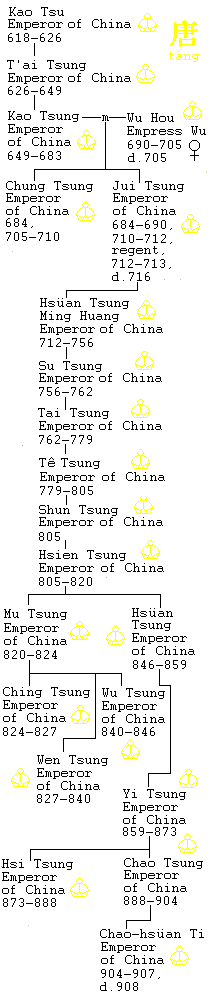
 Charming stories are associated with Hsüan Tsung, for instance that he released butterflies onto an assembly of concubines and candidates and would take to bed the woman upon whom they settled. If this was his practice, he stopped it under the (reportedly) unhealthy influence of the concubine Yang Kuei-fei (楊貴妃, Yáng Guìfēi) -- one of the "Four Great Beauties" of Chinese history.
| The Five Dynasties, , 907-960 | |
|---|---|
| 1. Posterior Liang, , Dynasty, 907-923 | |
| T'ai Tau, T'ai Tsu Chu Wen | 907-912 |
| Ying Wang Chu Yu-kuei | 912-913 |
| Mo Ti Chu Yu-chen | 913-923 |
| 2. Posterior T'ang, , Dynasty, 923-937 (Turkish) | |
| Chuang Tsung Li Ts'un-hsü | 923-926 |
| Ming Tsung Li Tan | 926-933 |
| Min Ti Li Ts'ung-hou | 933-934 |
| Fei Ti Li Ts'ung-k'e | 934-937 |
| 3. Posterior Chin/Tsin, , Dynasty, 937-947 (Turkish) | |
| Kao Tsu Shih Ching-t'ang | 937-942 |
| Ch'u Ti Shih Ch'ung-kuei | 942-947, d.964 |
| 4. Posterior Han, , Dynasty, 947-951 (Turkish) | |
| Kao Tsu Liu Chih-yüan | 947-948 |
| Yin Ti Liu Ch'eng-yu | 948-951 |
| 5. Posterior Chou, , Dynasty, 951-960 | |
| T'ai Tsu Kuo Wei | 951-954 |
| Shih Tsung Ch'ai Juong | 954-959 |
| Shih Tsung Ch'ai Tsung-Hsün | 959-960, d.973 |
| The Ten Kingdoms, , 896-979 | |
|---|---|
1. Min,  , Dynasty, 896-944, Fukien [Fujian] , Dynasty, 896-944, Fukien [Fujian] | |
| Wang Ch'ao | 896-897 |
| T'ai Tsu Wang Shen-chih | 897-925 |
| Sze Tsung Wang Yen-han | 925-926 |
| Hui Tsung Wang Lin | 926-935 |
| K'ang Tsung Wang Ch'ang | 935-939 |
| Ching Tsung Wang Hsi | 939-944 |
| Tien-te Ti Wang Yen-cheng | 943-944 |
| fell to Southern T'ang | |
| 2. Ch'u, , Dynasty, 896-951, Hunan | |
| Ch'u Wu-mu Wang Ma Yin | 896-930 |
| Heng-yang Wang Ma Hsi-sheng | 930-932 |
| Ch'u Wen-chao Wang Ma Hsi-fan | 932-947 |
| Fei Wang Ma Hsi-kuang | 947-950 |
| Ch'u Kung-hsiao Wang Ma Hsi-o | 950-951 |
| Ch'u Wang Ma Hsi-ch'ung | 951, d.962 |
| fell to Southern T'ang | |
| 3. Former Shu, , Dynasty, 907-925, Szechwan | |
| Kao Tsu Wang Chien | 907-918 |
| Hou-chu Wang Yen | 918-925 |
| fell to Posterior T'ang | |
| 4. Later Shu, , Dynasty, 930-965 | |
| Kao Tsu Meng Chih-hsiang | 930-934 |
| Hou Chu Meng Ch'ang | 934-965 |
| fell to Sung | |
| 5. Wu, , (Huai-nan) Dynasty, 902-937, Kiangsi [Jiangxi] | |
| Tai Tsu Yang Hsing-mi | 902-905 |
| Lieh Tsu Yang Wu | 905-908 |
| Kao Tsu Yang Wei | 908-920 |
| Jui Ti Yang P'u | 920-937 |
| fell to Southern T'ang | |
| 6. Southern T'ang, , Dynasty, 937-975, Kiangsi [Jiangxi] | |
| Lieh Tsu Li Sheng | 937-943 |
| Yüan Tsung Li Ching | 943-961 |
| Hou Chu, Wu Wang Li Yü | 961-975 |
| fell to Sung | |
| 7. Wu-Yüeh, , Dynasty, 907-978, Chekiang [Zhejiang] | |
| Wu-su Wang Ch'ien Liu | 907-932 |
| Wen-mu Wang Ch'ien Yüan-kuang | 932-941 |
| Chung-hsien Wang Ch'ien Hong-tso | 941-947 |
| Chung-hsün Wang Ch'ien Hong-tsung | 947-948 |
| Chung-i Wang Ch'ien Hong-ch'u | 948-978 |
| fell to Sung | |
| 8. Southern Han, , Dynasty, 909-971, Kwantung [Guandong] | |
| Jang Huang Ti, Lieh Tsung Liu Yin | 909-911 |
| Kao Tsu Liu Yen | 911-942 |
| Defeated by Vietnamese, 938 | |
| Shang Ti Liu Fen | 942-943 |
| Chung Tsung Liu Ch'eng | 943-958 |
| Hou-chu Liu Chi-hsing, Ch'ang | 958-971 |
| fell to Sung | |
9. Ching-nan,  , (Nan-P'ing [Nanping]) Dynasty, 907-963, Hupei [Hubei] , (Nan-P'ing [Nanping]) Dynasty, 907-963, Hupei [Hubei] | |
| Wu-hsin Wang Kao Chi-hsing | 907-928 |
| Wen-hsien Wang Kao Kung-hui | 928-948 |
| Chen-i Wang Kao Pao-jung | 948-960 |
| Ssu-chung Kao Pau-hsü | 960-962 |
| Kao Chi-ch'ung | 962-963 |
| fell to Sung | |
| 10. Northern Han, , Dynasty, 951-979, Shansi [Shanxi] | |
| Shih Tsu Liu Min, Ch'ung | 951-954 |
| Jui Tsung Liu Ch'eng-chün | 954-968 |
| Fei Ti, Shao-chu Liu Chi-en | 968 |
| Ying-wu Ti Liu Chi-yüan | 968-979 |
| fell to Sung | |
The priority apparently goes to the North as constituting the more unified part of the country. As at the end of the Northern and Southern Empires, a coup against the last Northern Dynasty ushered in reunification, under the Sung. One of the greatest differences, however, is just in the time scale. The Five Dynasties only last 53 years, while the Northern and Southern Empires endured 323 long years -- it is more like the period of the Three Kingdoms, at 46 years, that is comparable in scale to the Five Dynasties.
The Eras of the Five Dynasties can be examined on a popup page. The genealogies of the Five Dynasties and the Ten Kingdoms can all be examined on a large popup image. Or it can be loaded into the current window. These genealogies are entirely from the Nihon Kodaishi Daijiten (Dictionary of Ancient Japanese History), though the names and dates may be from other sources.
In this transition period some basic Chinese customs of later history are supposed to have originated. Previously people sat on floor mats, as the Japanese continued to do, but now chairs came into common use. Also, the bizarre and disturbing custom of binding the feet of women began, an affectation, as with the long fingernails of the Mandarin bureaucrats, to display one's freedom from physical labor. Unfortunately, a long fingernail seems merely ridiculous, and can easily be cut off in need, but ruined feet cannot be remade without extensive modern reconstructive surgery. Interestingly, when the Manchurians came to power, footbinding was prohibited among their own people; but the tyranny of fashion, or the desire to assimilate to the Chinese, meant that the prohibition eroded in practice.
One peculiarity of the Five Dynasties and Ten Kingdoms is that, when listed, we often see six dynasties and nine kingdoms. This is because the Northern Han (like the Later Liang of the Six Dynasties) actually derives from the Posterior Han Dynasty. As the Posterior Han (4th of the Five Dynasties) was replaced in 951, the Northern Han began as one of the Ten Kingdoms. To indicate this connection, it is always tempting to list them together. This not done here. While the rest of the Ten Kingdoms are in the South, the origin of the Northern Han is evident in its situation in the North, in Shansi province.
One dynastic history was produced during the Five Dynasties, this was the Old History of the T'ang, (XVI) 舊唐書, Jiù Tángshū, produced by the Historiographic Bureau in 945, during the Posterior Chin (937-947), edited by Liu Hsü, 劉昫, Liú Xū. The Chin was a Sinified Turkish dynasty; but it would not be the only dynasty not of Chinese origin to produce one of the 24 histories. The Mongol Yüan Dynasty produced three.
| Tartar Dynasties | |
|---|---|
Liao,  , (Khitan, , (Khitan,   ) Dynasty, ) Dynasty,907-1125 | |
| T'ai Tsu Yeh-lü A-pao-chi | 907-926 |
| T'ai Tsung Yeh-lü Te-kuang | 927-947 |
| Shih Tsung Yeh-lü Ju-an | 947-951 |
| Mu Tsung Yeh-lü Ching | 951-969 |
| Ching Tsung Yeh-lü Hsien | 969-982 |
| Shêng Tsung Yeh-lü Lung-hsü | 982-1031 |
| Hsing Tsung Yeh-lü Tsung-chen | 1031-1055 |
| Tao Tsung Yeh-lü Hong-chi | 1055-1101 |
| T'ien-tso Ti Yeh-lü Yen-hsi | 1101-1125, d.1128 |
| displaced by the Kin/Chin; relocated to Sinkiang as Western Liao | |
| The Hsi-Hsia, (Tangut,   ) Dynasty, ) Dynasty,990-(1032)-1227 | |
| Li I-chao | 933-935 |
| Li I-hsing | 935-967 |
| Li Chi-jui | 968-978 |
| Li Chi-Chun | 978-979 |
| Li Chi-feng | 980-1004 |
| Li Chi-Ch'ien | 982-1004 |
| Li Te-ming | 1004-1032 |
| Ching Tsung Li Yüan-hao | 1032-1048, Emperor, 1038 |
| I Tsung Li Liang-tzu | 1048-1068 |
| Hui Tsung Li Ping-Ch'iang | 1068-1086 |
| Ch'ung Tsung Li Ch'ien-shun | 1086-1139 |
| Jen Tsung Li Jen-Hsiao | 1139-1194 |
| Huan Tsung Li Ch'un-yu | 1194-1206 |
| Mongol vassal, 1206-1227 | |
| Hsiang Tsung Li An-Ch'üan | 1206-1211 |
| Shen Tsung Li Tsun-hsu | 1211-1223 |
| Hsien Tsung Li Te-wang | 1223-1226 |
| Li Hsien, Mo Ti | 1226-1227 |
| conquered by Mongols, 1226-1227 | |
The genealogy of the Liao, from the Nihon Kodaishi Daijiten (Dictionary of Ancient Japanese History), may be examined on a popup image. I had not found a genealogy of the Hsi-Hsia, which was not regarded as Chinese enough to rate a dynastic history. Now however, Jan van den Burg has sent me a genealogy from a French website, which can be examined in another popup image. This information reports the surname of the Hsi-Hsia Dynasty as Chao (Zhao) rather than Li. Ulrich Theobald, however, does have the surname Li.
"Tartar" is a European rendering of Persian Tātār. The extra "r" seems to have crept in from Greek/Latin Tartarus, the deepest region of Hades, i.e. Hell. This reflects the judgment that the Tartars were like demons from Hell, which is more or less what the Chinese and ultimately other objects of Mongol conquest would have thought themselves. The "Tartar" dynasties here and the later ones below were not in the same league as the Mongols, and were ultimately Mongol victims, but were regarded as no less alien by the Chinese. With the Mongols, all the groups appear to be speakers of Altaic languages, except the Hsi-Hsia, who, as noted above, were Tanguts, closely akin to the Tibetans. "Tatar" remains as the name of a Turkic language spoken across Central Asia and in the area of the former Mongol Khanate of Kazan in Russia.
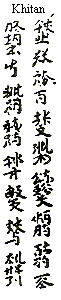
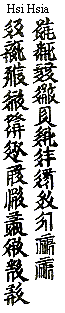 The Khitans and the Hsi-Hsia both wrote their languages using Chinese characters, as shown at left. This is revealing of the degree to which they part of the Chinese cultural sphere, in contrast to the Uighur alphabets later used by the Mongols and Manchurians.
Information about the Ten Kingdoms is often minimal in print histories of China, and it is possible to read a fair amount of material and actually be unaware of them. As with the Sixteen Kingdoms, I have needed to resort to sources like the Nihon Kodaishi Daijiten (Dictionary of Ancient Japanese History) and to various websites.  The Daijiten gives genealogies for all the Kingdoms but, being all in kanji, requires (for me) a slow effort of decipherment. The dates given by the Daijiten are, as in the section above, preferred. Some details were supplied from Wikipedia articles. But the most complete treatment of the Ten Kingdoms, as noted for other periods, appears to be at the Chinaknowledge website of Ulrich Theobald. He includes all the forms of the names of the rulers, with characters and era names. The treatment looks definitive.
Some small maps of this period are given in the Chronicle of the Chinese Emperors by Ann Paludan, but only the Five Dynasties are actually identified on them. Paludan's maps, however, appear to be based on, or related to (her edition antedates it), those in the Historical Records of the Five Dynasties, by Ouyang Xiu [or Ou-yang Hsiu, translated by Richard L. Davis, Columbia University Press, 2004], which identifies all the states. This is actually one of the standard dynastic histories of Chinese literature, the Wudai Shiji or Xin Wudaishi (New Five Dynasty History). Theobald also supplies some geographical information on the Kingdoms, given with the names of the dynasties. Here above/right is displayed a version of the first map, of the Posterior Liang Dynasty and contemporaries, in the Historical Records. Note that Ch'i, Chin, and Yen are not among the Ten Kingdoms. Maps for the rest of the period can be examined on popups for the Posterior T'ang, the Posterior Chin and Han, and the Posterior Chou.
| (Northern) Sung, , Dynasty, 960-1127 | |
|---|---|
| T'ai Tsu Chao K'uang-yin | 960-976 |
| T'ai Tsung Chao Kuan-i | 976-997 |
| Chên Tsung Chao Te-ch'ang | 997-1022 |
| Jên Tsung Chao Chen | 1022-1063 |
| Observation of Crab Nebula Supernova, 1054 | |
| Ying Tsung Chao Shu | 1063-1067 |
| Shên Tsung Chao Hsü | 1067-1085 |
| Embassy arrives form Rome, 1081 | |
| Chê Tsung Chao Hsü | 1085-1100 |
| Hui Tsung Chao Chi | 1100-1126 |
| Ch'in Tsung Chao Huan | 1126-1127 |
| displaced by the Chin/Kin, 1127 | |
 The Sung restored the unity of China, but it would never have the power or empire of the T'ang. "Tartar" states, the Hsi Hsia and Liao, hemmed it in from the north, foreshadowing the era of barbarian domination that would overwhelm the Huang He valley under the Jurchen and then all of China under the Mongols. Nevertheless, the Sung would be remembered along with the T'ang as the classic period of Chinese civilization, so that Chu Yüan-chang, founder of the Ming, would promise the restoration of "the T'ang and the Sung."
Of great interest during the Sung was the observation of a supernova in the constellation Taurus. Unlike Western astronomers at the time,  the Chinese did not believe that the heavens were unchanging, and they were always on the lookout for what they called "guest stars," 客星, kèxīng, i.e. novas (novae, nova stella in Latin, "new star") and supernovas. It would not be understood until modern astronomy that these were exploding stars. The guest star of 1054 was an extraordinarily bright and enduring supernova. A supernova can shine for a while with light equivalent to the whole rest of the galaxy. The remnant of the explosion today is the Crab Nebula, with an active Pulsar, or Neutron Star, at its center.
The Eras of the Sung Dynasty can be examined on a popup page. The genealogy of the Sung is entirely from the Nihon Kodaishi Daijiten (Dictionary of Ancient Japanese History).  Both the Sung proper (or Northern Sung) and the Southern Sung are included in the same diagram. It is especially noteworthy how the first Emperor of the Southern Sung was actually the brother of the last Emperor of the Northern Sung. But the succession then passed to a very distant (sixth) cousin (once removed). The succession subsequently made an even larger leap to another collateral line.
During the Sung three dynastic histories were produced. In 974 the Historiographic Bureau published the Old History of the Five Dynasties, (XVII) 舊五代史, Jiù Wǔdàishǐ, edited by Hsüeh Chü-cheng, 薛居正, Xuē Jūzhèng.
In 1053, Ou-yang Hsiu, 歐陽脩, Ōuyáng Xiū, published, as noted above, the Historical Records of the Five Dynasties, (XVIII) 五代史記, Wǔdài Shǐjì, or the New History of the Five Dynasties, (XVIII) 新 五代史, Xīn Wǔdài Shǐ. This was the last dynastic history by an individual historian.
Finally, in 1060 we get the New History of the T'ang, (XIX) 新唐書, Xīn Tángshū, by Ou-yang Hsiu and Sung Ch'i, 宋祁, Sòng Qí.
| Southern Sung, , Dynasty, 1127-1279 | |
|---|---|
| Kao Tsung Chao Kou | 1127-1162, d.1187 |
| Navy of 11 squadrons, 3,000 men, 1130 AD; invading Kin/Chin defeated by land and sea, first gunpowder bombs launched by catapult, 1161 | |
| Hsiao Tsung Chao Po-tsung | 1162-1189, d.1194 |
| Navy of 15 squadrons, 21,000 men, 1174 AD | |
| Kuang Tsung Chao Tun | 1189-1194, d.1200 |
| Ning Tsung Chao K'uo | 1194-1224 |
| Li Tsung Chao Yü-chü | 1224-1264 |
| Navy of 20 squadrons, 600 ship, 52,000 men, 1237 AD | |
| Tu Tsung Chao Meng-ch'i | 1264-1274 |
| Kung Tsung Chao Hsien | 1274-1276, d.1323 |
| Mongols control Yangtze valley, 1175; take capital, Emperor captured, 1276 | |
| Tuan Tsung Chao Shi | 1276-1278 |
| Ping Ti Chao Ping | 1278-1279 |
| conquered by Mongols, 1267-1279 | |
| Tartar Dynasties | |
|---|---|
| Northern Liao, , (Khitan, ) Dynasty, 1122-1123 | |
| Hsüan Tsung Yeh-lü Ch'un | 1122-1123 |
| Hsiao-te | 1122 |
| Liang Wang Yeh-lü Wali | 1123 |
| Western Liao, , Dynasty (Qara-Khitaï, "Black Cathay"), 1125-(1141)-1218 | |
| Te Tsung John Yeh-lü [Yeliuy] Dashi | 1124-1144 |
| defeat of Seljuks, Khwārazm, and Qarakhānids, occupation of Transoxania, 1141 | |
| Kan-T'ien-Hou Tabuyan, T'a-Pu-Yen | 1144-1151 |
| Jen Tsung Elias Yeh-lü I-lieh | 1151-1163 |
| Ch'eng-T'ien-Hou Yeh-lü Pusuwan | 1163-1178 |
| Mo Ti George Yeh-lü Chi-lu-ku | 1177-1211, 1213 |
| David Küchülüg | 1211-1218, d.1229 |
| conquered by Mongols, 1217-1218 | |
Kin/Chin,  , Dynasty (Jurchen/Nü-chên, , Dynasty (Jurchen/Nü-chên,   ), 1115-1234 ), 1115-1234 | |
| T'ai Tsu Wan-yen A-ku-ta | 1115-1123 |
| T'ai Tsung Wan-yen Sheng | 1123-1135 |
| Hsi Tsung Wan-yen Tan | 1135-1150 |
| Hai-ling Wang Wan-yen Liang | 1150-1161 |
| Shih Tsung Wan-yen Yung | 1161-1189 |
| Chang Tsung Wan-yen Ching | 1189-1208 |
| Wei-shao Wang Wan-yen Yung-chi | 1208-1213 |
| Hsüan Tsung Wan-yen Hsün | 1213-1224 |
| Ai Tsung Wan-yen Shou-hsü | 1224-1234 |
| Mo Ti Wan-yen Ch'eng-lin | 1234 |
| conquered by Mongols, 1230-1234 | |
[south [by] boat; north [by] horse]. The Mongols undoubtedly were more comfortable with horses than with boats. The southern terrain posed a challenge that the Mongols could not meet with their accustomed cavalry tactics. The Sung state was also more formidably organized than many opponents of the Mongols. The Sung had resources unavailable to the Russians or the Khawarizm Shāhs. But the wages of resistance to the Mongols was, of course, death. On one account, Qubilai Khān, in the course of his conquest and rule over China, killed "more than 18,470,000 Chinese" (R.J. Rummel, Death by Government, Transaction Publishers, 1995, p. 51). This would put him in the same league, at least, as Adolph Hitler.
The Mongols did need to build a fleet to defeat the Sung, even as the Sung had learned early on that their position in the South meant that they would be more involved with maritime matters. This lead to the cultivation of their navy, which stood them in good stead against their enemies, even as they developed new weapons, using gunpowder to create bombs (with shrapnel) that could be thrown by catapults. It also led to the easing of Confucian attitudes against trade. The founding Emperor, Kao Tsung, is supposed to have said, "Profits from maritime commerce are very great. If properly managed, they can amount to millions [of strings of cash]. Is this not better than taxing the people?" [Louise Levathes, When China Ruled the Seas, Oxford, 1994, p.41]. Indeed. When the Ming later moved their capital to the North, the Northern and Confucian disparagement of trade reemerged.
The Eras of the Southern Sung Dynasty can be examined on a popup page.
Readily available histories of China never seem to give any of the actual "Tartar" dynasty rulers, despite their importance in this era. The rulers of the Liao and the Kin/Chin Dynasties are from the Oxford Dynasties of the World, by John E. Morby [Oxford University Press, 1989, 2002, p.219]. Here the Hsi-Hsia rulers were originally taken from Ah Xiang's Xi Xia page and Bruce R. Gordon's Regnal Chronologies. I also discovered a list of the Qara-Khitaï (Western Liao) rulers at Gordon. The names are fascinating for their combination of Christian, Chinese, and Turkic elements. The Christian elements are due to the effect of the Nestorian missionaries who converted many in Central Asia in this period. Because of this, the Syriac alphabet ended up being adopted for many Central Asian languages, including Uighur, Mongolian, and Manchu, although written vertically, like Chinese, rather than right to left. The first name given by Gordon antedates the beginning of the Qara-Khitaï state, which is interesting since the Western Liao was simply the relocation of the Liao. Since the Liao was breaking up under Jurchen attack, my suspicion is that John Yeliuy [or Yeh-lü] Dashi begins as a bit of a rebel, or refugee. Morby's comment on this would have been nice, but the Oxford Dynasties is innocent of narrative. The closest we get is a note that "Chinese dates for Western Liao (here omitted) are unreliable" [p.221]. OK. Now I have added some information to this from the very detailed "Kara-Khitan Khanate" page at Answers.com, which evidently mirrors a similar page at Wikipedia. The most complete treatment of the Western Liao, however, appears to be at the Chinaknowledge website of Ulrich Theobald. He includes all the forms of the names of the rulers,
 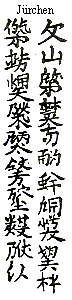 Christian names included, with characters and era names. This is pretty definitive. Theobald also includes the ephemeral "Northern Liao," which I have not seen otherwise noted. John Yeliuy Dashi was apparently not the only Khitan leader looking to refound the state. In Chinese terms, however, the Northern and Western Liao were never Chinese enough to be considered part of Chinese history; and there never was a formal dynastic history of them (or of the Hsi-Hsia) as there was of the Liao and the Kin/Jin. What I would wonder is if the Western Liao continued using the Chinese script of the Khitans, or if they adopted the alphabetic writing of the Uighurs, who would have been the predominating ethnic group in their domain, largely the modern Sinkiang. Meanwhile, the Jurchen were writing with Chinese characters, like their Khitan predecessors. The genealogy of the Kin/Chin, from the Nihon Kodaishi Daijiten (Dictionary of Ancient Japanese History), may be examined on a popup image. I had not found the genealogy of the Northern or Western Liao; but now Jan van den Burg has found a couple of sources for the Western Liao, although they do not agree in all particulars, including the dates. What seems to be the most likely version can be examined in a popup image. My guess is that the three persons in the Northern Liao represent father, mother, and son, with the latter, the "Prince of Liang," perhaps never properly ruling. It seems to be uncertain when Hsüan Tsung died (1122 or 1123).

Yüan,  (Mongol, (Mongol,   ), ),Dynasty, 1280-1368 | |
|---|---|
| Temüjin Chingiz Khān T'ai Tsu | 1206-1227 |
| Western Liao conquered, 1217-1218; The Hsi-Hsia State conquered, 1226-1227 | |
| Ögedei Khān T'ai Tsung | 1229-1241 |
| Kin/Chin Dynasty conquered, 1230-1234 | |
| Töregene Khātūn, regent | 1241-1246 |
| Güyük Khān Ting Tsung | 1246-1248 |
| Oghul Ghaymish, regent | 1248-1251 |
| Möngke Khān Hsien Tsung | 1251-1259 |
| Yünnan conquered, 1253/54; Annam invaded, 1257-1258; Southern Sung invaded, 1257-1259 | |
| Qubilai Khān Shih Tsu | 1260-1294 |
| 1280 | |
| Southern Sung conquered, 1267-1279; Japan invaded, 1274, 1281 | |
| Temür Öljeytü Khān Ch'êng Tsung | 1294-1307 |
| 1295 | |
| Qayshan Gülük Hai-Shan Wu Tsung | 1307-1311 |
| 1308 | |
| Ayurparibhadra Ayurbarwada Jên Tsung | 1311-1320 |
| 1312 | |
| Beginning of Little Ice Age, heavy rain for five years in Europe, famine, 1315-1320 | |
| Suddhipala Gege'en Shidebala Ying Tsung | 1320-1323 |
| 1321 | |
| Yesün-Temür Tai-ting Ti | 1323-1328 |
| 1324 | |
| Arigaba Aragibag T'ien-shun Ti | 1328 |
| Jijaghatu Toq-Temür Wen Tsung | 1328-1329 1329-1332 |
| 1330 | |
| Qoshila Qutuqtu Ming Tsung | 1329 |
| 1329 | |
| Rinchenpal, Irinjibal Irinchibal Ning Tsung | 1332-1333, 53 days |
| Toghan-Temür Hui Tsung, Shun Ti | 1333-1370 |
| 1333 | |
| Mongols expelled from China, 1368 | |
| Northern Yüan, , Dynasty | |
| Ayushiridara Biliktü Qaghan Chao Tsung | 1370-1379 |
| Togus-Temür Usaqal Qaghan | 1379-1389 |
| line continues in Mongolia until Manchurian Conquest, 1696 | |
 Although it is understandable that the Mongols chose an auspicious name, Yüan [Yuán], "Beginning," rather than a traditional Chinese regional name for their Dynasty, this creates a precedent that lasts for the rest of Chinese Imperial history -- though certainly the Ch'ing [Qing] as foreigners also were in a similar situation.
  This character was formerly seen for the monetary unit of the People's Republic of China, replacing the traditional character for "dollar," which meant "round" and was applied to the Spanish silver dollars that were brought to Manila every year from Mexico and distributed across East Asia. Now, however, an actual simplified version of the original character has come to be used, as shown. A silver coinage had never existed in China, and the Spanish dollars established a monetary standard all over the Orient. Thus, the Japanese ¥en was also originally a silver dollar, long debased. In Japan now a special simplified character is used for the yen, and, as it happens, the "y" in the old Romanization never was pronounced.
While Mongol occupation and rule is an important chapter in the history of China, the Mongol domain, which extended all the way to Hungary and Egypt, is a much larger topic, covered separately under the "The Mongol Khāns."
There may be some question about just how bad Mongol rule was in China. Apart from R.J. Rummel's figures, like that above, we have accounts like this:
For a time it appeared as if the conquest would destroy Chinese culture and even the nation itself... Cities were annihilated, and tens of thousands of homeless refugees fled to the mountains, where they starved or survived as vast hordes of wandering mendicants. Great areas of land went out of cultivation... [C.P. Fitzgerald, The Horizon History of China, American Heritage Publishing, 1969, p.244] |
On the other hand, other accounts, e.g. L. Carrington Goodrich, A Short History of the Chinese People [Harper Torchbooks, 1943, 1963] or
Ann Paludan, Chronicle of the Chinese Emperors [Thames & Hudson, London, 1998],  don't describe anything in the way of population loss. Each account, however, gives some hint of the Mongol ferocity familiar from their other campaigns.
Paludan mentions the loss of over 100,000 Chinese in the very last, three week long battle of the Mongol conquest of the Southern Sung, off Kwantung in 1279 [p.147], and the proposal by Bayan, chancellor of Toghan-Temür, to exterminate "all Chinese with the five most popular names, some 90 per cent of the population!" [p.157].
There was always a faction among the Mongols that wanted a steppe culture imposed on China, with the extermination of agriculture, and population, that that would entail. Paludan mentions that the amount of land under cultivation tripled just between 1371 and 1379, in the early years of the Ming, and that "in 1395 alone, 41,000 resevoirs were rebuilt or restored" [pp.161-162]. This would imply some neglect or abandonment under the Yüan. Goodrich mentions how Qubilai Khān, emulating Shih-huang-ti, tried to suppress Taoism, ordering (1258 & 1281) that all of its books (with some exceptions) be burned [op.cit., pp.183-184].
The Mongols, as we might imagine, often did not trust the Chinese with offices in their government. Consequently, Europeans and others who wandered in were often given offices of importance. Marco Polo and his family members seem to have numbered among those.
Of particular interest was a Roman under Qubilai Khān, perhaps a refugee from the Latin Emperors, since he had already been at Court under Güyük Khān. His Chinese name I see as "Ai-sie," without it given in Chinese characters. This is thought to transcribe "Joshua" or "Joseph."
Under Qubilai he was employed as an astronomer and physician, which means it is shame we don't know about his education back in Romania. His nationality is obvious, however, in the title he was given, 拂菻王, Fúlǐn Wáng -- which in China we would render as the "Prince of Fulin," but which is the title otherwise used for the Roman Emperors themselves. There is a biography of this man in the History of the Yüan, 元史, the Yuánshǐ, and he seems to have lived out his life, with children, under the Mongols. I see little information available about him; and the biography in the Yuánshǐ, like so many in the Chinese histories, does not seem to be available, except on line in Chinese.
I had some problems with reconciling the Mongolian dates and names [The Mongols, David Morgan, Basil Blackwell, 1986, and The New Islamic Dynasties, Clifford Edmund Bosworth, Edinburgh University Press, 1996, which do not give Chinese names] with the Chinese list of Yüan emperors [Mathews' Chinese-English Dictionary, Harvard University Press, 1972, p. 1175, which does not give the Mongolian names]. This is now cleared up by Ann Paludan's Chronicle of the Chinese Emperors.
Two Emperors did not reign long enough to be acknowledged by Chinese historians. Also, Chinese sources list Ming Tsung before Wen Tsung (or Wen Ti, in Mathews') because only the second reign of the latter is counted. The list is confirmed by the Oxford Dynasties of the World, by John E. Morby [Oxford University Press, 1989, 2002, p.220], which also gives Chinese names for the Khāns before Qubilai. The Eras of the Yüan Dynasty can be examined on a popup page.
During the Yüan three dynastic histories were produced, the 元末三史, Yuánmòsānshǐ. In 1344 the Historiographic Bureau published the History of the [Tartar] Liao, (XX) 遼史, Liáoshǐ, and the History of the [Tartar] Chin, (XXI) 金史, Jīnshǐ. In 1345 the History of the [Northern & Southern] Sung, (XXII) 宋史, Sòngshǐ. All the histories were edited by T'o-t'o, 脫脫, Tuōtuō (1314-1356) -- from a Mongolian name, Toqtogha or Toqto a,  -- a Mongol with a Confucian education. T'o-t'o was also a gifted general, who was successfully suppressing rebellions against the Yüan. However, he was removed in a palace intrigue, exiled, poisoned, and replaced with less able commanders, who ultimately could not save the regime.
The Founder of the Han had originally been of low station also, a peasant, but he had already styled himself "King of Han" (Han Wang) before definitively claiming the Ch'in Emperorship.
Perhaps because of his origins, the Ming Founder was suspicious of the Scholars and sought to balance their influence in the Court with a competing Military institution of comparable depth and prestige. This wise provision, a kind of system of checks and balances, ultimately failed, as Emperors fell under the influence of the Scholars, and then even of the Palace Eunuchs, and neglected the Military. When the Manchus then seized power, some Chinese generals actually went over to them, expecting better status and attention. It was the same Chinese general, Wu San-kuei, 吳三桂, Wú Sānguì (1612-1678), who allowed Manchu forces through the Great Wall in 1644 and then personally executed the last of the Southern Ming Emperors in 1662. This was the ultimate payoff of the ancient Confucian denigration of the military.
L. Carrington Goodrich begins his chapter on the Ming Dynasty by saying, "The Ming has had a bad press" [A Short History of the Chinese People, Harper Torchbooks, Harper & Row, 1943, 1959, 1963, p.189]. This problem seems to have begun with historians taking later Ch'ing propaganda too seriously. A very different perspective on the Ming is now available from Timothy Brook, in The Troubled Empire, China in the Yüan and Ming Dynasties [Belknap Press, Harvard, 2010].
While many explanations of the Fall of the Ming involve minute descriptions of the brutality and corruption of the Ming regime, explained in part as the heritage of the Mongols, Brook avoids indulgence in this sort of thing -- which suspiciously sounds like the moralistic non-explanations for the Fall of Rome, something that obviously goes back to the Roman historian Livy. Indeed, it would not be foreign to the traditional moralizing of Chinese historiography itself. But Brook takes very seriously Chinese reports that match the climate research of our own day.
Both the Yüan and the Ming suffered from the effects of the Little Ice Age. This period of anomalous cooling has been identified as stretching from 1550 to 1850, with a particularly cold period beginning about 1650, near the end of the Ming. However, the cooling after the Mediaeval Warm Period began a bit earlier. In Europe there was heavy rain for five years, with crop failure and famine, from 1315 to 1320. We know that the last vinyard in Mediaeval England, for a time known for its wines and threatening to French vintners, closed in 1469 -- right before the Ming began rebuilding the Great Wall in 1474.
Brook cites a cold period in China from 1261 to 1393, with drought from 1262 to 1306 and 1352 to 1374 [p.269]. This may have helped finish off the Yüan, which fell in 1368. What certainly helped finish off the Ming was severe cold from 1629 to 1643 with severe drought from 1637 to 1643. This not only meant starvation, with a death rate, according to Chinese sources (it may be exaggerated), of 70% to 90% in places, but also epidemics, which may have been the Bugonic Plague (to effect London in 1665) or smallpox, or both. Brook says, "When 1644 arrived, 80 percent of counties [i.e. what he calls the districts, We are not surprised then to learn that there was no defense of Peking when the rebel Li Tzu-ch'eng, 李自成, Lǐ Zìchéng, arrives in 1644. Although the Maunder Minimum, 1645-1715, a period of few sunspots and lower solar energy, follows the fall of the Ming, the number of sunspots had been declining since around 1600 and the cold and the drought of the 1629-1643 period may reflect this development. The Míng was the first Chinese dynasty not to be named after a local ancient kingdom (Ch'in, Han, T'ang, etc.). This was because the Founder, Chu Yüan-chang, 朱元璋, Zhū Yuánzhāng, was of humble origin, not nobility that would have identified with such a locality. Like the Mongol Yüan ("Beginning"), the name is instead chosen to be auspicious,
 "Bright."
 , of a magistrate] had stopped fowarding any taxes at all. The central treasury was empty" [p.252].
| Ming, , "Bright" Dynasty, 1368-1644 | Era | |
|---|---|---|
| T'ai Tsu Chu Yüan-chang | 1368-1398 | 1368 Hung-wu |
| Writes letter to Emperor John V Palaeologus (1341-1376, 1379-1391) of announcing new Dynasty, last contact with Constantinople; Conquest of Mongol controlled Yunnan, including slaughter of 60,000 Miao and Yao tribesmen, 1381-1382 | ||
| Hui Ti Chu Yün-wen | 1398-1402 | 1399 Chien-wên |
| Ch'eng Tsu Chu Ti | 1402-1424 | 1403 Yung-Lo |
| moves capital from Nanking (Nan-ching/Nanjing) to Peking (Pei-ching/Beijing); Tibet refuses tribute, 1413 | ||
| Jen Tsung Chu Kao-chih | 1424-1425 | 1425 Hung-hsi |
| Hsüan Tsung Chu Chan-chi | 1425-1435 | 1426 Hsüan-tê |
| Ying Tsung Chu Ch'i-chen | 1435-1449 | 1436 Chêng-T'ung |
| captured by Mongols at T'u-mu, 1449 | ||
| 1457-1464 | 1457 T'ien-shun | |
| T'ai Tsung, or Ching Ti Chu Ch'i-yü | 1449-1457 | 1450 Ching-t'ai |
| Hsien Tsung Chu Chien-shen | 1464-1487 | 1465 Ch'eng-hua |
| Reconstruction of Great Wall started, 1474 | ||
| Hsiao Tsung Chu Yü-t'ang | 1487-1505 | 1488 Hung-chih |
| Wu Tsung Chu Hou-chao | 1505-1521 | 1506 Chêng-tê |
| Portuguese arrive, 1514, Tomé Pires at Canton, 1517 | ||
| Shih Tsung Chu Hou-ts'ung | 1521-1567 | 1522 Chia-tsing |
Portuguese expelled, 1522; some Portuguese & their firearms captured, 1523; foreign trade shut down, 1525; Portuguese at Macao, 1553-1554, Amoy, 1544; Japanese pirates,  , besiege Nanking, 1555; Army ejects pirates from Fukien (Fujian), 1560-1563 , besiege Nanking, 1555; Army ejects pirates from Fukien (Fujian), 1560-1563 | ||
| Mu Tsung Chu Tsai-hou | 1567-1572 | 1567 Lung-ch'ing |
| foreign trade reopened, 1567 | ||
| Shên Tsung Chu I-chün | 1572-1620 | 1573 Wan-Li |
| Alessandro Valignano founds Jesuit Mission, 1577; Matteo Ricci reaches Peking, 1598, received at Court, 1601 (dies in 1610); war in Burma, 1599-1600; Japanese invasion, war in Korea, 1593-1598; Jesuits charged with correction of calendar, 1611; Emperor becomes recluse, refuses to attend Court, 1600-1620 | ||
| Kuang Tsung Chu Ch'ang-le | 1620 | 1620 T'ai-ch'ang |
| Hsi Tsung Chu Yü-chiao | 1620-1627 | 1621 T'ien-ch'i |
| Nurhachi invades Liao-tung, 1618; Chinese defeated at Sar-hu, 1619, driven behind Great Wall, 1622; Mao Wen-lung invades Manchuria, 1624, defeats Manchus, 1626 | ||
| Szu Tsung Chu Yü-chien | 1627-1644 | 1628 Ch'ung-chên |
| Mao Wen-lung executed, Jesuits charged with correction of calendar, 1629; foreign trade closed, 1638; Rebellion of Li Tzu-ch'eng, 1640, occupies Peking, Emperor commits suicide, 1644; Wu San-kuei allows in Manchurians, Manchu occupation, 1644 | ||
This was composed in 1371, in the days of Emperor John V. It was not sent by a Chinese emissary but was entrusted to a "merchant" named Nieh-ku-lun, 捏古倫, Niēgǔlún. The suspicion is that this was actually the Archbishop of Peking, Nicolaus de Bentra, who had been appointed by the Pope in 1333. The 明史, Míngshǐ, dynastic history says that Nieh-ku-lun arrived at the Yüan Court, but then the Dynasty fell.
The Hung-wu Emperor summoned him to carry the letter to Constantinople. We do not know if the letter was successfully transmitted. We might even wonder if de Bentra carried the letter directly to Rome rather than Constantinople, arriving on the eve of the Great Schism. It may be lying around somewhere in the Vatican Library.
A key passage in the letter is as follows:
| 朕爲臣民推戴卽皇帝位定有天下之號曰大明建元洪武於今四年矣。
Zhèn wéi chénmín tuīdài jí Huángdì Wèi dìng yǒu Tiānxià zhī hào yuē Dàmíng jiàn yuán Hóngwǔ yūjīn sì nián yǐ. We [朕, zhèn] were selected by Our people to occupy the Imperial Throne [皇帝位], Under Heaven [天下, Tiānxià], under the dynastic title of "the Great Ming" [大明], commencing with Our reign styled "Hung-wu" [洪武], of which we now are in the fourth year. [China and the Roman Orient, by Friedrich Hirth, 1885, photostat by Legare Street Press, pp.66,109, translation modified] |
The Imperial pronoun, 朕, zhèn, was also used in Japanese, pronounced chin. When the surrender message of the Emperor Hirohito was broadcast in 1945, many Japanese could not understand it, both because of the unusual Court language and because the Emperor was nervous and unfamiliar with broadcasting. The pronoun 朕, the "Imperial We," is something people may not have heard before, since Hirohito had never spoken in public.
It is a shame we do not know the fate of the Hung-wu's letter, since the Chinese otherwise record the reception of Roman missions, not occasions of Chinese communication in return.
After the letter to Constantinople, the next contact of the Chinese Court with the West was the arrival of Matteo Ricci (1552-1610), who was invited to the Imperial Court in 1601 -- long after the Fall of Constantinople.
While climate is a previously overlooked factor in Chinese history, other characteristics of Chinese government would ultimately effect the Ch'ing as well as the Ming. One indication of Chu Yüan-chang's attitude about the Scholars concerns the conduct of the great Civil Service Examinations, which had been suspended under the Mongols. In 1370, the Emperor reinstituted the examinations. In 1371, 75% of the degrees from the national examination had gone to candidates from the South of China.
This displeased the Emperor, who believed, with many traditionalists, that Northerners were morally more worthy -- from the area where Chinese civilization had begun -- and possibly, given the Emperor's suspicions, more trustworthy. The examinations were thus suspended until 1385, but then the geographical division of those who passed did not change. At a special Palace examination in 1397, all of the 52 candidates who passed were Southerners. Borrowing from the Josef Stalin school of bureaucracy, the Emperor had two of the examiners executed, pour encourager les autres. In a subsequent retesting, all the successful candidates were Northerners.
By 1425 it was decided that places in the national examinations would be reserved by region, with 35% for the North, 55% for the South, and 10% for some places in the middle [cf. Brook, op.cit., pp.36-37].
This extraordinary provision was imposed on a nation that to us may seem to be uniform in race, language, and religion. But clearly there were cultural differences, and not merely of an economic character. The moral aspect of these now apparently figured in the Emperor's judgment, who imposed a system of discriminatory preferential policies or "affirmative action" for Northerners. The more general meaning of such policies, which are now all the rage among the American ruling class, which promotes ethnic and racial quotas, and rejects merit and programs for gifted students (smearing them as "white supremacy," even though it is "Asian" students who then suffer the most discrimination), I have considered elsewhere.
For the first time in Chinese history, the Míng Emperors employed only one Era name for their reigns. It thus becomes convenient to refer to the Emperors by the Era, e.g. the "Yung-Lo Emperor." This practice continued in the following Dynasty, but was not adopted in Japan until the Meiji Restoration. The necessity or convenience of this device may not be obvious, but it should be noted that the personal names (e.g. Chu Yüan-chang) of the Emperors were properly no longer used once they came to the Throne, and that the names they are otherwise known by (e.g. T'ai Tsu) are posthumous. If a reigning Emperor is not simply to be called the "Current Emperor" (which is proper), he can at least be unambiguously identified by the Era.
The first capital of the Ming at is at Nanking on the Yangtze. The name means "Southern Capital," This was the site of one of the Mongol capitals of China, Khanbaliq in Mongolian or Ta-tu, In an age when the politically correct absurdly fall all over themselves to say "Beijing," for 北京, rather than "Peking," probably without being able to pronounce "Běijīng," we can expect few to be aware that 北京 is pronounced different ways in the countries around China that borrowed Chinese characters to write their own languages, which themselves are unrelated to Chinese and have their own, very different, phonology.
Thus, Japanese pronounces 北京 either as Hokkyō, or even Pekin, where there is no "ng" in Japanese. In Korean, the traditional reading is Buk-gyeong, written 북경. Korean now tries to render Běijīng phonetically, although Korean has no tones. In Vietnamese, 北京 was read, and now put in the Latin alphabet, as Bắc Kinh. Vietnamese does have tones, but it follows its own traditional reading of Chinese characters. Also Běijīng, after all, is simply the version in Mandarin, but not in Cantonese, Shanghai, or the other Chinese "Dialects."
The whole issue, of course, revolves around the absurd notion that not using the "endonym" for a place is somehow "offensive," even though this principle is totally ignored for many historic locations. It is part of the absurdities that are rapidly turning modern scholarship and public discourse into an "idiocracy."
The location of Peking was clearly part of a forward strategic plan for the defense of the border. Unfortunately, in the absence of a genuine forward defense, i.e. attacks into Mongolia, it created a very shallow defensive backup and exposed the capital to sudden raids, for which the Ming were to pay dear. Nevertheless, the Peking (or Beijing) of today retains the landmarks of the Ming city, especially the Imperial Palace of the Forbidden City. The formal entrance to the Palace, the southern gate, the "Gate of Heavenly Peace,"
 At right is a portrait of Chu Yüan-chang, the Hung-wu Emperor. It is important to keep this image in mind, because one often sees an ugly Ch'ing caricature of the Emperor, even presented as a genuine and unproblematic portrait in otherwise respected history books (e.g. China, A New History by John King Fairbank & Merle Goldman, Harvard, 1992, 2006, plate 12). Historians have no business insensibly promoting Manchu propaganda against the Chinese dynasty they overthrew [note].
 . I don't think this was a name initially used, since its meaning mainly serves to contrast it with the capital subsequently founded by the Yung-Lo Emperor much further north, which then became the "Northern Capital," , Peking (note that this spelling is not a mistake but simply reflects, in both syllables, an older pronunciation of Mandarin).
 , in Chinese, "Great Capital," occupied by Qubilai Khān in 1264. In 1272 it was renamed from what it had been as the capital of the Kin/Chin Dynasty,
  , "Middle Capital." I had previously confused this with Shang-tu, , in Inner Mongolia about 171 miles north of Peking. The latter was kept as a Mongol summer capital and is remembered by Coleridge as "Xanadu." Dà-dū had at first been renamed Peip'ing,
  , "Northern Peace," by the Ming, before the capital was moved there -- a name that would be restored by the Nationalists in 1928.

 , gives its name to Tiananmen Square, immortalized by the tragic and outrageous events of 1989.
| Yung-Lo Era, 1402-1424 | ||
|---|---|---|
| 1 | 1405-1407 | 317 ships |
| 2 | 1407-1409 | 249 ships |
| 3 | 1409-1411 | 48 ships |
| 4 | 1413-1415 | 63 ships |
| 5 | 1417-1419 | ? |
| 6 | 1421-1422 | 41 ships |
| Hsüan-Tê Era, 1425-1435 | ||
| 7 | 1431-1433 | 100 ships |
Chinese sources report that the largest ships, the baochuan or "treasure ships," were 440 feet long. However, most of the records of the expeditions were destroyed (in 1477), and the reported dimensions are unrealistic (e.g. a beam of 180 feet, which sounds more like a bathtub than a sailing ship).
Bruce Swanson says that a modern surviving Chinese junk of five masts, the Jiangsu trader, was 170 feet long. He does not think the Ming ships were any larger; but since baochuan were reported to have up to nine masts, if this is accurate and the number of masts was proportional to the length, we might extrapolate ships of 306 feet in length [Eighth Voyage of the Dragon, Naval Institute Press, 1982, p. 33] [note].
These dimensions are comparable to the length of some 19th century clipper ships: The Great Republic of 1853, the largest ship of its time, was 325 feet long. Although this is larger, by half again, than Swanson wants to allow, there now have been some archaeological discoveries of ship fittings that seem consistent with the larger sizes, as with the rudder below.
Admiral He established a base at Malacca,  where the local Sulṭān became a tributary of China and even sailed to China to pay homage to the Emperor. A Chinese cantonment protected, stored, and shipped goods from China and those obtained on the expeditions. On nearby Sumatra, a Chinese governor was installed at Palembang after a Chinese pirate was defeated, captured, and sent back to China for execution.
In northern Sumatra, at Semudera, troops were put ashore to interfere in local politics (as Europeans would do later), installing one king and sending a rival back to China, where he was executed. A king in Ceylon was defeated and sent to China, but then the Emperor returned him to his kingdom (thought he evidently was unable to recover his throne). Some of Zhèng Hé's detachments went into the Persian Gulf, the Red Sea, and even down the coast of Africa, perhaps as far as Zanzibar.
The triumph of the xenophobic faction of the Scholars at Court, who, of course, were also undermining the Army,  meant that the expeditions were terminated. It became a capital offense to build a ship with more than two masts, Chinese were prohibited from trading abroad, and when a request was submitted in 1477 to examine Zhèng Hé's logs, they were "lost" by a vice president of the Ministry of War. The Minister himself expressed astonishment, "How is it possible for official documents in the archives to be lost?" [Louise Levathes, When China Ruled the Seas, Oxford, 1994, p.179].
The records appear to have been deliberately destroyed -- a very shocking expedient given Chinese conscientiousness about history: We know details of the expeditions from an account by Ma Huan, who sailed with Zhèng Hé on three voyages, from other accounts, and from inscriptions actually left by Zhèng Hé at different places. As in Roman history, the epigraphic evidence, sometimes neglected and sometimes only recently discovered, can add substantially to historical knowledge.
China withdrew into itself at the very time when the sea-lanes of the world were about to open to cosmopolitan traffic. There were times when foreign trade was reopened, but then also when it was shut down again. The ambivlance of the regime is palpable. Part of the problem was a misconception. It was believed that trade promoted piracy. When prohibitions of trade promoted smuggling, with increased piracy, the lesson of experience began to sink in. Chinese traders could be found in the Indian Ocean; but Chinese warships, never again.
Vasco da Gama arrived in India in 1498, just 65 years after Admiral He had left. It is even said that on the coast of Africa, where the Portuguese put in, some old people actually remembered the Chinese. The Portuguese then found little to resist them at sea, when the Chinese probably had had superior technology and much larger forces. Having simply abdicated the contest, China would shortly fall behind and never catch up.
Curiously, Zhèng Hé came to be celebrated in a later Ming novel, a play, and then in a cult of his own person, maintained largely by Chinese settlers in the Southeast Asian places where he had visited. It survives until today, generally under the form of one of his titles,  , Sanbao, the "Three Treasure" or "Jewel." This also happens to be a Buddhist term, for the "Treasures" of the Buddha, the Dharma, and the Sangha; but then Zhèng Hé himself was a Muslim, which makes his apotheosis all the more remarkable. Another cult associated with the Admiral and his expeditions was that of the goddess
  , Tianfei (or Tien-fei), the "Heavenly Consort." More commonly known as
  , Mazu (or Ma-tsu), she is a goddess of the sea, fishermen, and sailors, although originally a mortal woman, thought to have lived from 960 to 987. After her death, miracles and visions associated with her resulted in deification, much as such things result in the recognition of Christians saints. Zhèng Hé, a Muslim again, nevertheless erected tablets honoring Tianfei.

The innovations of European civilization were dramatically demonstrated when the Portuguese arrived in China in 1514 and were received at Canton in 1517. Although the Chinese had invented gunpowder and cannon, the Portuguese brought the first hand-held firearms. These were then named 
 . This interesting expression could mean "Portuguese" or later "Spanish," but it also looks like a combination of , the familiar "Frank" of Middle Eastern and Indian languages (although it would literally mean "Buddhist gentleman"),
  , ferengi in Hindī, with , which can mean "machine." Firearms as the "machines of the Franks" would be appropriate. The Portuguese presented cannon at Court in 1522, right before, for the time being, they were expelled.
Before long, some in the Chinese government became interested in the weapons. At the time of attacks by Japanese pirates, the fearsome , such as the siege of Nanking in 1555, General Yü Ta-yu urged that Chinese ships be equipped with cannon. He said, "In sea battle, there is no trick; the side that has more ships defeats the side that has fewer, the side that has more guns defeats the side that has less" [Keay, A History of China, Basic Book, 2009, p.429]. From 1568 to 1582, General Ch'i Chi-kuang experimented with artillery along the Great Wall. In 1622 and 1629, Hsü Kuang-ch'i, Vice-Minister of War, received permission to hire Portuguese to manufacture and use guns for the army. An illustration of the defense of Liao-yang in Liao-tung in the 1620's, as the Manchus are attacking, shows cannon outside the walls [Keay, ibid.].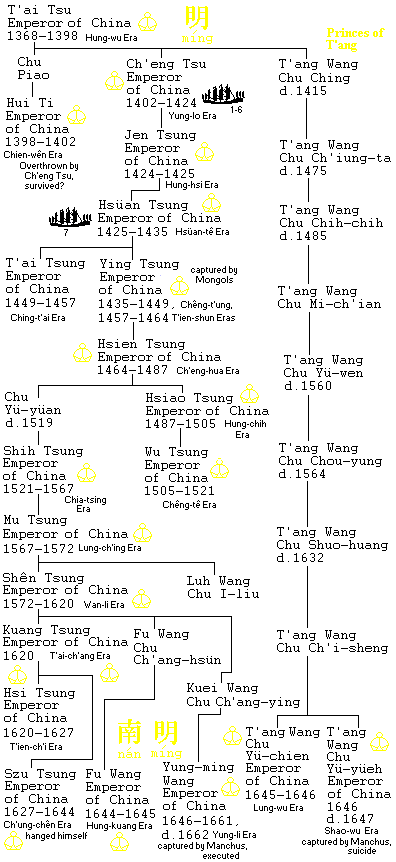
Thus, more modern weapons were for a time helpful against the Manchus, but it was also often stated that native Chinese were not very good dealing with the new technology. More important, Hsü's use of the Portuguese was a matter of intense controversy at Court. Since he was himself by then a convert to Christianity, the xenophobes were happy to accuse him of being loyal to the Franks, rather than to China, and of preparing for a Portuguese takeover. In the long run, of course, one might say that Europeans would be the greater threat to China. However, at the time, the Manchus were the clear and present danger, a danger that became more pressing when Hsü's arguments failed and the advantage of the help of the Portuguse was inconsistently employed.
How valuable this advantage could have been we see when the Manchu Khan Nurhachi was wounded by cannon fire at the Battle of Ning-yüan in 1626 and then died. This was during a period, 1623-1629, when the Ming Court had itself had canceled the offical use of the Portuguese. The Ming General at Ning-yüan, Mao Wen-lung, a bit of a loose cannon himself (he was executed in 1629), apparently used the Portuguese on his own authority. Thus, Timothy Brook says, "attempts to borrow European technology and expertise were always compromised and had little cumulative impact on the Ming's defensive posture" [op.cit., p.224] -- very different from the way in which the Portuguese enabled Ethiopia to repulse attacks from Islām in 1543. It would be the Ch'ing, not the Ming, that became the "gunpowder empire."
Given the general xenophobia of Confucianism, the conflict about the adoption of Portuguese technology is not surprising, but something else is all but astonishing. The Jesuit Mission in China, begun in 1577, had worked its way into the Court by 1601. Matteo Ricci (1552 1610), an accomplished student of Christopher Clavius, and soon impressively fluent and learned in Chinese, obtained a permanent berth for the Jesuits, destined to last centuries, by demonstrating the greater accuracy of Western astronomy and calendrical methods. The reaction against this was sometimes fierce and temporarily effective; but in the end, the Jesuits were repeatedly charged, even under the Manchus, with governing the calendar. If the earlier Ming had only been so open to its own successes, the history of China might have been much different.
Despite all the ways in which the Scholars and their Confucianism hampered the economic development of China, we sometimes find that administrators could be open-minded and flexible on economic issues. It is thus surprising to follow how the government experimented in dealing with famine, which afflicted parts of China, at least, with some regularity -- especially in this time of the Little Ice Age. As it was the duty of the government to "Manage the world, aid the people," After centuries of experience, the Chinese were still trying to get it right, and even relying on the market and the detested merchants began too look like a good idea.


 , the Government always felt responsibility for dealing with famines. Yet there was a saying in China, "There are no good policies for famine relief" [Timothy Brook, op.cit., p.122]. This is because of the hard experience of unintended and perverse consequences that were encountered over time. Distributing money for relief meant that corrupt local officials would be tempted to steal it. Distributing grain meant that prices could be driven down and local produce would be shipped away to where there were higher prices. Consequently:
The idea that the commercial economy does a better job of redistributing grain than does the state became a key element in the administrative reform that Qiu Jun (1420-1495) laid before the Hongzhi emperor in 1487. In the same vein, Lin Xiyuan (ca. 1480-ca. 1560), who undertook to reformulate famine policies in the sixteenth century, argued against the expectation that the state should provide relief. [ibid. p.125]
| Southern Ming,, Dynasty, 1644-1662 | Era | |
|---|---|---|
| Fu Wang, Prince of Fu Chu Yu-sung | 1644-1645, d.1646 | 1644 Hung-kuang |
| Emperor also regarded as last of Ming; captured by Manchus, 1645; executed, 1646 | ||
| T'ang Wang Chu Yü-chien | 1645-1646 | 1645 Lung-wu |
| Emperor captured by Manchus, executed, 1646 | ||
| T'ang Wang Chu Yü-yüeh | 1646-1647 | 1646 Shao-wa |
| Emperor captured by Kuei Wang, suicide, 1647 | ||
| Kuei Wang, Yung-ming Wang Chu Yü-lang, Ch'ang-ying | 1646-1661, d.1662 | 1646 Yung-li |
| Emperor captured in Burma, 1661; executed by General Wu San-kuei, who had let the Manchus in through the Great Wall, 1662 | ||
Despite these exceptions to their xenophobia and anti-commercial instincts, the triumph and dominance of the Scholars (exactly the power that modern academics would like to have) not only stifled the innovative spirit of the Chinese to explore and create but opened China to foreign conquest. This then exposed China again, although under the Ch'ing, to new foreign encroachment, as European creativity and power waxed in the 18th and 19th centuries. The cultural readiness of the Chinese people to compete on modern terms was later demonstrated time and again as overseas Chinese communities often came to dominate the economy of places where they started with nothing and were often disliked -- the Philippines, Malaya, Indonesia, Thailand, Vietnam, etc. In China itself, the first chance for the Chinese to really prosper in a free economy was, ironically, in the British Crown Colony of Hong Kong.
Note that while the Southern Ming Emperors draw from the ranks of Imperial Princes, and are commonly thus identified (e.g. the "Prince of Fu"), their actual title in Chinese protocol was (e.g. Fu Wang). In the West, this is comparable to the Heir of the Holy Roman Empire being styled the "King of the Romans." That tradition was continued by Napoleon, who crowned his son, Napoleon II, "King of Rome." The Emperor of China was thus literally a "King of Kings," and Imperial Princes were put on a level of equality with the rulers of foreign countries like Korea or Siam.
The genealogy of the Ming is derived from the Nihon Kodaishi Daijiten (Dictionary of Ancient Japanese History), with relevant additions from The Southern Ming, 1644-1662 by Lynn A. Struve [Yale University Pres, 1984].
One dynastic history was produced by the Historiographic Bureau during the Ming, the History of the Yüan, (XXIII) 元史, Yuánshǐ, in 1370, edited by Sung Lien, 宋濂, Sòng Lián (1310 1381). It is regarded as perhaps the least satisfactory of the dynastic histories, but then the Chinese had no particular reason to expend effort on a fair or detailed treatment of the Mongol conquerors.
Manchu,   , ,Ch'ing,  , "Clear" , "Clear"Dynasty, (1616, 1636)-1644-(1662)-1911 | Era | |
|---|---|---|
T'ai  Tsu TsuAisin Giorro Nurhachi | 1616-1626 | 1616 T'ien-ming |
| Invades Liao-tung, 1618; Chinese defeated at Sar-hu, 1619, driven behind Great Wall, 1622; Mao Wen-lung invades Manchuria, 1624; Nurhachi mortally wounded, Battle of Ning-yüan, 1626 | ||
| T'ai Tsung Aisin Giorro Aberhai | 1626-1643 | 1627 T'ien-ts'ung |
| 1636 Ch'ung-te | ||
| Proclamation of Ch'ing Dynasty, 1636 | ||
| Shih Tsu Aisin Giorro Fu-lin | 1643-1661 | 1644 Shun-Chih |
| Chinese General Wu San-kuei allows Manchurians through Great Wall, Peking occupied, End of Ming proclaimed, 1644 | ||
| Shêng Tsu Aisin Giorro Hsüan-ye | 1661-1722 | 1662 K'ang-Hsi |
| Shih Tsung Aisin Giorro Yin-chen | 1722-1735 | 1723 Yung-chêng |
| Christianity prohibited, but Jesuits retained at Court, 1724 | ||
| Kao Tsung Aisin Giorro Hong-li | 1735-1796 | 1736 Ch'ien-Lung |
| Jên Tsung Aisin Giorro Yung-yen | 1796-1820 | 1796 Chia-ch'ing |
| Hsüan Tsung Aisin Giorro Min-ning | 1820-1850 | 1821 Tao-kuang |
| Wen Tsung Aisin Giorro I-chu | 1850-1861 | 1851 Hsien-fêng |
| Taiping Rebellion, 1853-1864 | ||
| Mu Tsung Aisin Giorro Tsai-ch'un | 1861-1875 | 1862 T'ung-chih |
| Tz'u Hsi [Cixi] the Empress Dowager | regent, 1861-1873, 1875-1889, 1898-1908 | |
| Tê Tsung Aisin Giorro Tsai-t'ien | 1875-1908 | 1875 Kuang-hsü |
| Boxer Rebellion, 1900-1901 | ||
| Mò Ti Aisin Giorro P'u-i [Puyi] | 1908-1911 | 1909 Hsüan-t'ung |
| Emperor of Japanese controlled "Manchukuo," , 1934-1945,d.1967 | ||
 The Manchurian conquest of China was a deeply humiliating experience for the Chinese. The Manchus, indeed, made things harder for themselves, as foreign rulers, with their decree that Chinese men would have to adopt Manchu costume, including the infamous "queue," where the front of the head is shaved and the hair in back grown out and braided into a long pig-tail. This was the style of the Manchus themselves and so, at least, was not used to specifically mark the Chinese.
Manchu costume replaced the deep sleeves that had always been used as pockets in Chinese dress with tight tailored cuffs, as in modern Western shirts. Even the Mongols had imposed no requirements of grooming and dress so personal and intimate on the Chinese. It provoked violent Chinese popular resistance and helped the "Southern Ming" princes rally forces against the Manchus for almost two decades. Subsequently, the queue could only be avoided by taking a Buddhist tonsure. The Manchus gave up trying to determine whether this was done sincerely,  and Chinese could be buried in Ming costume.
Oddly enough, conflict over Manchu costume continues until today, when many do not understand the history of Chinese dress, and adaptation of Manchu style into Westernize clothing.
The Manchus themselves spoke an Altaic language from the Tungusic group. They wrote their language with a variety of the Syriac alphabet that had been brought by Nestorian missionaries into Central Asia. It was written from top to bottom, like Chinese, rather than from right to left like Syriac. The Manchus continued to use their language and alphabet until the end of the Dynasty -- the reverse of their coins featured the name of the mint in Manchu -- but the survival of their language, and their ethnic identity, was already all but swamped under the Han Chinese.
Some Chinese histories do not begin the list of Ch'ing rulers until the fall of the Southern Ming in 1662 -- hence two successive Emperors are named "Tsu," "Founder." This usually means the founder of the Dynasty, although we also see it in a dynasty refounded, as the Ming was by its third Emperor. Nurhachi, , the founder of the Dynasty back in Manchuria in 1616 is also a "Tsu."
Like the Mongols, the Manchus practiced the Vajrayāna form of Buddhism. The desire of the Manchus to be accepted as proper Confucian rulers, however, was otherwise intense. Even before incursion into China proper, they chose (1636) a name for the dynasty following the Ming precedent: Ch'ing, , means "Clear." The deliberate implication was that, as Ming, "Bright," implies Fire,  , Ch'ing implies Water,
  , which "overcomes" fire in the "mutually overcoming" cycle of the Chinese elements.
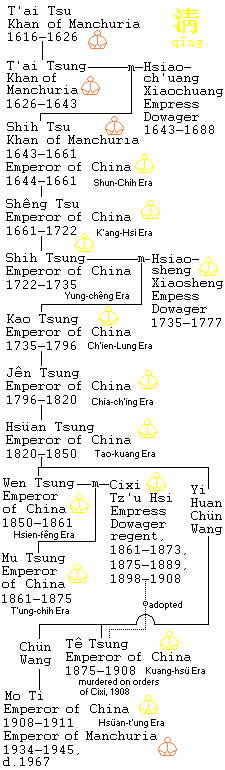 The genealogy of the Ch'ing is entirely from the Nihon Kodaishi Daijiten (Dictionary of Ancient Japanese History).
One dynastic history was produced by the Historiographic Bureau during the Ch'ing, the History of the Ming, (XXIV) 明史, Míngshǐ in 1739, edited by Chang T'ing-yü, 張廷玉, Zhāng Tíngyù. This is the source of a great deal of the Manchu propaganda that has sucked in various uncritical historians in their treatment of the Ming, as noted.
While the Ch'ing was experienced bitterly as a foreign conquest of China, later it would be regarded as entirely Chinese in terms of the encroachment of European Powers and Japan on the territory and sovereignty of China. The oppressive Ch'ing Imperium, which even denied the Chinese their traditional sleeves, thus becomes the victim, ironically, of "imperialism."
The rhetoric about this can be rather heated. Histories may say that China was "dismembered" or even "crucified" by the Powers. It hardly went that far. Indeed, there were areas detached by foreign states, the large ones mainly by Russia and Japan -- the Russian ones still in Russia's hands -- otherwise cities. Then there were Treaty Ports, cities opened to trade with particular or perhaps many foreign states, spheres of influence, and concessions. The "unequal treaties" governed such cessions and concessions, which also included extraterritoriality for foreign citizens, i.e. The latter was a provision that European powers usually claimed against all traditional governments (e.g. Turkey and Japan), for the very sensible reason that their judicial procedure used torture and then inflicted cruel punishments that might include living dismemberment, as was the practice in China. In several cities, but most famously in Shanghai, there was an "International Settlement" that mainly operated under its own laws. Even the United States, although promoting a "hands off" policy towards China, nevertheless contributed gunboats to keep the peace and protect foreigners. The 1966 movie The Sand Pebbles commemorates the confused and thankless nature of such missions. The "unequal treaties" all began because China simply wasn't interested in any dealings, let alone actual trade, with foreigners, except under the forms, or at least the fictions, of tribute and subordination that had been traditional. This was already beginning to change in treaties with the Russians, but the British, beginning in 1793, absolutely refused even the fiction of tribute or subordination.
The Portuguese had had a foot in the door since the 16th century, and their own settlement at Macao. They weren't particularly troubled by the way the Chinese wanted to understand the whole business. Even the failure of the British mission in 1793 didn't make too much difference in the way trade, and smuggling, continued to function.
The flash point turned out to be the importation of opium -- Legalization lost; and in 1839 a Special Commissioner for Frontier Defense, Lin Tse-Hsü, 林則徐, Lín Zéxú, was sent to Canton to deal with the matter. The result was War with the British East India Company, the Opium War (1840-1842). To the astonishment of the Chinese, their war junks and forts were blown to bits by a military technology that had advanced beyond their comprehension.
According to John Keay [A History of China, Basic Books, 2009], part of the problem in this conflict was a mistranslation. He says that in Commissioner Lin's letters the character It fouled Anglo-Chinese relations; it permeated racial stereotyping; and it corrupted -- and still does -- most non-Chinese writing on the entire course of China's history. [pp.461-462] This is a curious argument. Mr. Keay ought to be aware that the Greek term βάρβαροι (singular βάρβαρος), bárbaroi, itself originally just meant "not Greek, foreign" [Liddell and Scott's An Intermediate Greek-English Lexicon, Oxford, 1889, 1964, p.146]. Is it a "mistranslation" to say that bárbaroi is "barbarians," rather than "non-Greeks"? Not really, since it is their word; and the connotations, perhaps negative or "objectionable" that we have of "barbarians" originated with the Greeks and the Romans using the word for peoples that they considered culturally inferior.
The Chinese did have a large vocabulary for peoples who were non-Chinese. We have The Chinese used these in exactly the same way that the Greeks used βάρβαροι, since the Chinese regarded most of the peoples around them as culturally inferior to themselves -- as indeed and in fact they were. As it happens, the Greeks may have had more respect for the older civilizations they knew about, Egypt and Babylon, than the Chinese did for the originally entirely illiterate people surrounding China. The Greeks knew that Egypt and Mesopotamia held complex, literate civilizations that were far older than Greece. There were no places like that around China. The closest was India, which was separated from China by the highest mountains in the world, requiring long, circuitous, dangerous travel, over vast deserts or hazardous seas, to get there. The Chinese were never even quite sure what direction India was from China.
Mathews' dictionary has no difficulty using "barbarians" with all the traditional characters. Perhaps Keay thinks that this has "corrupted -- and still does -- most non-Chinese writing on the entire course of China's history." However, it is often difficult to avoid the traditional translations for the traditional characters. In the ABC Chinese-English Comprehensive Dictionary, by John DeFrancis [Hawai'i, 2003], which reflects modern, indeed contemporary, usage, In this dictionary we see "barbarians" used where it is with scare quotes, sometimes replaced with "tribes," which doesn't imply much civilization, and finally just with "non-Chinese peoples." So it looks like DeFrancis and/or Chinese usage is moving in the direction that Keay indicates. But we cannot ignore the context in "the entire course of China's history" that Keay invokes. The Chinese had no greater regard, and no reason to have any, than the Greeks or the Romans did for their neighbors.
We really don't have a vocabulary to distinguish between proper "barbarians" and something like "equally civilized non-Chinese neighbors." I don't believe that Keay can honestly maintain that the Chinese had ever made that distinction -- unless we find it with Buddhists speaking of remote India (and no Confucian would have a reason to make even that exception). At the same time, it was not necessary to translate On the other hand, when the Chinese used the expression  Chinese laws and courts did not apply to them.

 or
or  , which could also mean tobacco, or , "great" opium. The practice of smoking opium had actually originated in China, and a for while the government was relatively complacent about it. As alarm grew about the opium trade, arguments were actually made, as today, for and against legalization.
 was wrongly rendered as "barbarian" rather than "foreigner," which was insulting to the British.
The equation of yi with 'barbarian' seems to have originated with a Pomeranian missionary who was serving the British as a translator at the time; it is not evident in earlier works, such as Macartney's [the envoy in 1793] or Ricci's journals. A small mistake perhaps, it surfaced in the run-up to the Opium War and gained a wide and notorius currency. The Chinese insisted that yi had always signified merely those non-Chinese peoples who were 'easterners' (the British frequented the east coast) -- just as man did those who were 'southerners', rong 'northerners' [sic] and di 'westerners' [sic]. They were directional, not objectionable terms. But the British declined to find yi as other than highly insulting...
for eastern barbarians,  for western barbarians,
  for northern barbarians, and
  for southern barbarians (Keay has switched the words for "northern" and "western"). This fits into the directional associations of
  Five Element Theory. We find other expressions for barbarians in general. As the character used with the "Five Barbarians" above, is already familiar. The expression
  , "outside person," we see as the Japanese gaijin, but it already has that meaning in Chinese -- "outsider; an alien" [Mathews' Chinese-English Dictionary, Harvard, 1972, p.1036].
can mean "'barbarian' tribes, esp. in the east yídí" [p.1134] -- , "tribes in the east and north" [p.1138]. Despite its use in the previous expression, alone is only defined as a "Surname" [p.186] -- in fact the surname of no less than Judge Dee. is "barbaric, fierce yemán" and "southern 'barbarians'" [p.595] --
, "outside person," we see as the Japanese gaijin, but it already has that meaning in Chinese -- "outsider; an alien" [Mathews' Chinese-English Dictionary, Harvard, 1972, p.1036].
can mean "'barbarian' tribes, esp. in the east yídí" [p.1134] -- , "tribes in the east and north" [p.1138]. Despite its use in the previous expression, alone is only defined as a "Surname" [p.186] -- in fact the surname of no less than Judge Dee. is "barbaric, fierce yemán" and "southern 'barbarians'" [p.595] --  is "uncivilized; savage" and "barbarous; cruel" [p.1131]. is defined as "weapons; military affairs róngdí," where, however, then means "non-Chinese peoples of the north and west" [p.776]. Finally, , is defined as "foreign" or "non-Han peoples in the northwest" [p.374], and as "the Northern tribes" [p.404]. Thus, its use for the northern "Five Barbarians" influences the sense of direction.
as "barbarians" rather than "foreigners"; but even now it is not difficult to imagine that the Chinese had good reasons to regard the British as no less barbarous than the Greeks would have the invading Achaemenid Persians. They each represented something outlandish, threatening, and oppressive -- and the Persians weren't even trying to maintain the opium trade.
is "uncivilized; savage" and "barbarous; cruel" [p.1131]. is defined as "weapons; military affairs róngdí," where, however, then means "non-Chinese peoples of the north and west" [p.776]. Finally, , is defined as "foreign" or "non-Han peoples in the northwest" [p.374], and as "the Northern tribes" [p.404]. Thus, its use for the northern "Five Barbarians" influences the sense of direction.
as "barbarians" rather than "foreigners"; but even now it is not difficult to imagine that the Chinese had good reasons to regard the British as no less barbarous than the Greeks would have the invading Achaemenid Persians. They each represented something outlandish, threatening, and oppressive -- and the Persians weren't even trying to maintain the opium trade.

 (洋鬼子, yángguǐzǐ), or 鬼佬, guǐlǎo, "foreign devil," there is no doubt how they felt about the foreigners.
British Hong Kong  | |
|---|---|
| Charles Elliot | administrator, 1841 |
| Sir Henry Eldred Curwen Pottinger | 1841-1843, Governor, 1843-1844 |
| Alexander Robert Johnston | agent, 1841-1843 |
| Sir John Francis Davis | 1844-1848 |
| William Staveley | acting, 1848 |
| Sir Samuel George Bonham | 1848-1854 |
| William Jervois | agent, 1852-1853 |
| Sir John Bowring | 1854-1859 |
| William Caine | acting, 1859 |
| Sir Hercules George Robert Robinson | 1859-1865 |
| William T. Mercer | acting, 1865-1866 |
| Sir Richard Graves MacDonnell | 1866-1872 |
| Henry Wase Whitflield | acting, 1872 |
| Sir Arthur Edward Kennedy | 1872-1877 |
| John Gardiner Austin | agent, 1874, 1875, 1877 |
| Sir John Pope Hennessy | 1877-1882 |
| Malcolm Struan Tonnochy | acting, 1882 |
| Sir William Henry Marsh | acting, 1882-1883 |
| Sir George Ferguson Bowen | 1883-1885 |
| Sir William Henry Marsh | acting, 1885-1887 |
| William Gordon Cameron | acting, 1887 |
| Sir George William Des Voeux | 1887-1891 |
| George Digby Barker | acting, 1891 |
| Sir William Robinson | 1891-1898 |
| Wilsone Black | acting, 1898 |
| Sir Henry Arthur Blake | 1898-1903 |
| Francis Henry May | acting, 1903-1904 |
| Sir Matthew Nathan | 1904-1907 |
| Sir Francis Henry May | acting, 1907 |
| Sir Frederick John Dealtry Lugard | 1907-1912 |
| Claud Severn | acting, 1912 |
| Sir Francis Henry | 1912-1918 |
| Claud Severn | acting, 1918-1919 |
| Sir Reginald Edward Stubbs | 1919-1925 |
| Claud Severn | acting, 1925 |
| Sir Cecil Clementi | 1925-1930 |
| Wilfrid Thomas Southorn | acting, 1930 |
| Sir William Peel | 1930-1935 |
| Sir Wilfrid Thomas Southorn | acting, 1935 |
| Norman Lockhart Smith | acting, 1935 |
| Sir Wilfrid Thomas Southorn | acting, 1935 |
| Sir Andrew Caldecott | 1935-1937 |
| Norman Lockhart Smith | acting, 1937 |
| Sir Geoffrey Alexander Stafford Northcote | 1937-1941 |
| Norman Lockhart Smith | agent, 1940 |
| Edward Felix Norton | agent, 1940-1941 |
| Norman Lockhart Smith | acting, 1941 |
| Sir Mark Aitchinson Young | 1941-1947, prisoner, 1941-1945 |
Japanese Occupation,  , ,25 December 1941 - 16 August 1945 | |
| Takashi Sakai & Masaichi Niimi | military, 1941-1942 |
| Rensuke Isogai | 1942-1944 |
| Hisaichi Tanaka | 1945 |
| Franklin Charles Gimson | provisional, 1945 |
| Sir Cecil Harcourt | military, 1945-1946 |
| David Mercer MacDougall | acting, 1947 |
| Sir Alexander William Grantham | 1947-1957 |
| David Edgeworth Beresford | acting, 1957-1958 |
| Sir Robert Brown Black | 1958-1964 |
| Edmund Brinsley Teesdale | acting, 1964 |
| Sir David Clive Crosbie Trench | 1964-1971 |
| Sir Hugh Selby Norman-Walker | acting, 1971-1971 |
| Sir Murray MacLehose | 1971-1982 |
| Sir Philip Haddon-Cave | acting, 1982 |
| Sir Edward Youde | 1982-1986 |
| Sir David Akers-Jones | acting, 1986-1987 |
| Sir David Wilson | 1987-1992 |
| Christopher "Chris" Patten | 1992-1997 |
Chinese Hong Kong  | |
| Tung Chee-hwa | 1997-2005 |
| Sir Donald Tsang | 2005-2012 |
| Leung (C.Y.) Chun-ying | 2012-2017 |
| Carrie Lam | 2017-2022 |
| John Lee Ka-chiu | 2022-present |
The Peace of Nanking (1842) ceded Hong Kong (with the Mandarin pronunciation: , "Fragrant Harbor") and opened five ports to trade. There followed a series of incidents, wars, and treaties. The Second Opium (or Lorca) War (1856-1858/60) led to the Treaty of Tientsin, followed by the occupation of Peking and the Treaty of Peking (1860). This created the international embassy area in Peking that would be famously besieged during the Boxer Rebellion in 1900. The Convention of Chih-fu (1876) opened four more treaty ports, the Convention of Chungking (1890) opened Chungking, and the Franco-Chinese commercial convention (1886/87, after the Sino-French War, 1883-1885) opened three more cities in the south to France.
Meanwhile, the Powers sometimes helped prop up Ch'ing rule. The Taiping Rebellion (1853-1864) stood a good chance of overthrowing the Ch'ing altogether. With partially Christian inspiration, that might have resulted in a very different China. However, it was eventually put down with the help of Charles "Chinese" Gordan, who later died at Khartoum. Residual Chinese claims over Tonkin (Vietnam) and Burma were ceded to France (1885) and Britain (1886) respectively. Japan, beginning her predatory ways, went to war with China (Sino-Japanese War, 1894-95).
Winning a naval battle and successful on land, the Peace of Shimonoseki ceded to Japan Taiwan, the Pescadores, and the Liaotung Peninsula, and recognized the independence of Korea. This was too much for some of the Powers. The "Triple Intervention" of France, Russia, and Germany forced Japan to retrocede the Liaotung to China. However, Russia then soon moved into the void. In 1897, Darien (Dalian) and Port Arthur (
 ) were occupied in the Liaotung, Korea was made a Russian protectorate, and work was begun on the Chinese Eastern Railroad, which cut across Manchuria from the Siberian Railroad to Vladivostok.
The same year, the murder of German missionaries led to the German occupation of Tsingtao (Ch'ing-tao, Qingdao). In 1898, Tsingtao and the neighboring Kiaochow (Chiao-chou) were leased to Germany for 99 years, as was Weihai (or Weihai Wei, Port Edward, until 1930) and the new Territories of Hong Kong (previously enlarged in 1860 by Kowloon) to Britain, and Kwangchouwan (Kuang-chow-wan, Guangzhouwan, modern Chankiang or Zhanjiang) to France. As Germans will do, they built a brewery in Tsingtao, which is still the name of a Chinese beer.
The name Weihai, 
 , is often found with a third element, i.e. as "Weihaiwei," where
  means "military station." This bespeaks a long history. Weihai was established as a Ming naval base against Japanese pirates, , in 1398. In 1406 a two mile wall was built around it. In the 1880's the Chinese built a modern naval base there, corresponding to one on the northern side of the Pohai (Bohai) Strait, . In 1898 Weihai was leased to Britain, technically for the duration of the Russian lease on Port Arthur, and it became the British Port Edward. Port Arthur had been named by a British Navy officer, William C. Arthur, when he surveyed it in 1860. The British, however, had no real need for Weihai, and it had no commercial advantages, so it was returned to China in 1930. Port Arthur, of course, fell to Japan (1905), with whom it stayed, as Ryojun, until 1945.
All these encroachments and compromises of Chinese sovereignty and territory led to a popular uprising in the Boxer Rebellion (1900-1901,  , the Boxers = "Fist Rebels"). Chinese "Boxing" was what is now more commonly known as "Kung Fu" (
 , "ability; work; service"). Its mystical powers were expected to provide some advantage against Western technology. The success of the Rebellion even drew the imprudent support of the Empress Dowager. Christians were massacred, and the foreign embassies in Peking were surrounded, cut off (in the days before radio), and besieged. The world wondered while an expedition of Eight Powers was organized to relieve the embassies. The Emperor of Germany, Wilhelm II, memorably told his forces to behave like the Huns of Attila. Japanese forces, hitherto better disciplined, took this to heart as well. The embassies were relieved and China further humiliated.
The grudge nursed by Japan against Russia exploded in 1904. After a war (the Russo-Japanese, 1904-05) that often looked like a dress-rehearsal for World War I, Japan retrieved its conquests of 1895, obtained part of the Manchurian railroad system, and forced Russian troops out of Manchuria. World War I itself enabled Japan to occupy German possessions in China. In 1915 China was bullied into ceding these to Japan (confirmed in the Treaty of Versailles, which China refused to sign), but in the Washington Naval Treaty of 1922 they were returned to China. Later, Japanese conquest of Manchuria (1931) and invasion of China (1937) followed. The Japanese occupation of most foreign possessions in China during World War II led to their return to China after the war, except for Hong Kong and Macao, which were only returned in 1997 and 1999, respectively.
In retrospect, the Opium War evokes special horror, in the way it implies the destruction of Chinese society through drug addiction. This was certainly the belief of the Chinese government.  We are left with a picture of the East India Company, and the British Government itself, as drug pushers, shoving opium down the throats of the helpless Chinese (as literally in the contemporary cartoon).
However, there is a curious anomaly in this view. Whenever Chinese went overseas to work, they took opium habits with them, but these never seemed to render such immigrants lazy or demoralized. Instead, Chinese labor took over or created economies almost everywhere it went, in Malaya, Vietnam, Thailand, Indonesia, the Philippines, and California. Indeed, Chinese laborers were attacked in California, not for being lazy dopers, but for being too hard working, Spartan, and competitive. Living in California and Nevada at the time of the Gold Rush, Mark Twain observed of the Chinese:
They are quiet, peaceable, tractable, free from drunkenness, and they are as industrious as the day is long. A disorderly Chinaman is rare, and a lazy one does not exist. [Roughing It] |
Also, the opium that the British sold in China was grown in India. Why do we never hear of opium addiction being a problem in India? Did the East India Company forbid its sale or use there? I doubt that the Company could exercise that kind of control, regardless of its policies, if the demand existed. And overseas Indians often lived in places (Singapore) were there were Chinese emigrants actively using opium. Somehow it never caught on. Meanwhile, Indians in India were certainly using marijuana, भांग, bhāng, something that is today of limited legality but of widespread use. I have never seen this cited as a social problem in India, although the situation is ripe for blame to be placed on it if an explanation is needed for lack of Indian economic progress. But I think it is all too well understood that India's economic problems are the fault of the licence rāj and the Government, not drug use.
That raises the important question whether debilitating opium addictions were the effect rather than the cause of demoralization back in China. It seems undeniable that they were the effect and that China's problems originated with the anti-commercial attitudes of the Confucian Chinese Government. Chinese hopelessness was not the effect of opium, but of bad government.
Today, drug use is harshly punished in a place like Singapore, but Singapore exists as a Chinese city because of Chinese immigrants who grew in wealth under a British regime that didn't (originally) bother with drug laws -- and one still sees opium offerings in Chinese temples in Southeast Asia, whose source must be a trade that is officially ignored at some level, in countries that often have the death penalty for drug crimes. The truth seems to be that drug (or alcohol) addiction as a social pathology may result from personal problems or cultural problems, but it does not just happen because drugs (or alcohol) are available. Morally, it is not clear how judicial punishments for people are superior to the natural harm that follows from what are judged to be imprudent behaviors. If the punishment in fact harms people more than the imprudence, a grotesque injustice has been effected.
At right we have been seeing the governors of British Hong Kong. This small colony ends up representing one of the most important lessons of history. Devastated by the Japanese, the British did little to rebuild the city after World War II. While in Britain itself industries were being nationalized by the Labourites, the British National Health Service was created, and restrictions were placed on the import and export of capital, nothing of the sort was done in Hong Kong. The city remained the last stronghold in the world of pure laissez-faire capitalism, with no labor law, minimum wage, social security, or working hours legislation. A good Marxist would expect nothing but misery and degradation. However, by the time Hong Kong was returned to China in 1997, the per capita GDP of Hong Kong had surpassed that of Britain herself.
As of 2003, this was $23,930 for Hong Kong and $23,680 for Britain. More importantly however, adjusted for cost of living ("purchasing power parity"), Hong Kong enjoyed 75.0% of American GDP, while Britain only had 69.1%. Thus, under a British rule of benign neglect (as many would see it), Hong Kong became one of the richest places on earth. This without "natural resources" and burdened by millions of refugees (from Communist China and Vietnam) on almost no land. No wonder Communist China undertook to leave the economic system unchanged for fifty years in the treaty that returned the city to China. By then, China itself should be entirely capitalist. And Hong Kong did return to China, on a sad 30 June 1997, in heavy rain, with Prince Charles overseeing one of Britain's last Imperial acts. Hong Kong is still usually credited as having the greatest economic freedom in the world (followed by Singapore, New Zealand, and then a tie of the United States, the Netherlands, Ireland, Estonia, and Luxembourg). Thus, after 200 years, it looks like Say's Law was right after all.
Unfortunately, in 2020, the PRC has betrayed its treaty with Britain and has effectively cancelled the civil liberties of residents of Hong Kong. This was seen coming, and constant demonstrations for more than a year had shown Beijing what the people of Hong Kong thought of communist domination. Made no difference. The Chinese are now arresting all the leaders of the demonstrations, if they have not already fled. Britain has offered residency to refugees from Hong Kong -- if China lets them leave.
It is a sad, grim, and horrifying business. Communist China is no longer becoming more capitalist, even as it has not given an inch to democratic or civil liberty reforms. Instead, to the genocide against Tibet is now added concentration camps, slave labor, and genocide against the Muslim Uighurs of Sinkiang. Oddly, Muslim countries, and Muslim political leaders in the United States, so sensitive to "Islamophobia," have been quite silent about the Chinese treatment of their Muslim brethren. An excellent lesson in hypocrisy there.
The hope after the Fall of Communism was that economic liberalization would lead to political liberalization in places like Russia, China, and perhaps even Vietnam. However, this hope has proven futile. Russia has become a fascist dictatorship, and the rich "oligarchs" who might have supplied a political balance to Vladimir Putin have been eliminated, one way or another, precisely to prevent such balance. Since it is mainly optimistic people who want children, the grim realities of fascist Russia and communist China militate against that.
Xi Jinping has turned on the rich of China for the same reason, and the economy of China has suffered because more orthodox Marxism is beginning to replace liberalization, for the very reason that liberalization can produce opposition. Also, the ferocious "one child" policy has created a demographic shortfall that has put China in the same position as Russia many many European countries, with births falling below the replacement rate to the population.
The list of Governors of Hong Kong is from a page at the World Statesmen site.
The Sun Never Set on the British Empire
Despite the foreignThe Genocide in Tibet
Thus Tibet, which had been conquered by both Mongols and Manchus, and was independent after the fall of the Ch'ing in 1911, is claimed as an "intrinsic" part of China even though it had never actually been ruled by Chinese until the Communist invasion of 1950. The Tibetan language is related to Chinese, but culturally Tibet is a sub-Indian rather than a sub-Chinese civilization.
Although the Tibetans were promised internal autonomy by the Chinese, they soon were subjected to the inevitable oppression, vandalism, and massacres of Communist government. Since there never were very many Tibetans in their poor, Alpine country, this kind of treatment plus Chinese colonization began to produce a genocidal effect. The International Community, once energized about "de-colonization," and formerly alert to every police beating in South Africa, has shown little stomach for consistently confronting the Chinese over Tibet.
On the other hand, the Dalai Lama, who fled into exile in 1959,  has proven to be an appealing, eloquent, and respected spokesman for his country, attracting attention by many, including the Nobel Peace Prize committee and Hollywood devotees who now have produced sympathetic movies about Tibet and its plight (e.g. Seven Years in Tibet and Kundun). We can only hope that international pressure will increase and rescue a unique nation preserving an ancient heritage.
Although Western, usually American, defenders of Tibet are sometimes belabored with charges of hypocrisy, because of the treatment of the Indian tribes in American history, so that Americans are in no moral position to belabor the Chinese over the treatment of Tibet, it remains true that nowhere in the world have traditional tribal peoples, who were at neolithic or even paleolithic levels of development at their time of contact with the advanced civilizations (Eastern or Western), not been incorporated into larger modern states. There are often complaints about the status and treatment of tribal peoples in many places, from the United States to Brazil to the Sudan, but there is no special level of criticism about such peoples, of which there are many, in China. Tibet, however, was, for all its poverty and isolation, an organized state far beyond the tribal level. Like Ethiopia or Afghanistan, Tibet was the sort of state that, in the era of "decolonization," would be expected to become independent, regardless of its backward features. But the Chinese Empire and Chinese colonization survive, with no more justification than the precedent of the Manchurian Empire.
International Campaign for Tibet
Kings of Tibet and the Dalai Lamas
| Presidents of the Republic of China | |
|---|---|
First Republic  | |
| Sun Yat-sen [Sun Zhongshan] | Provisional President, 1911; President, 1912 |
| Government in Peking | |
| Yüan Shih-k'ai | 1912-1916 |
| Li Yüan-hung [Li Yuanghong] | 1916-1917, 1922-1923 |
| Feng Kuo-chang [Feng Guozhang] | 1917-1918 |
| Hsü Shih-ch'ang | 1918-1922 |
| Chou Tzuch'i | acting, 1922 |
| Chang Shaotseng | acting, 1923 |
| Kao Lingwei | acting, 1923 |
| Ts'ao K'un | 1923-1924 |
| Huang Fu | acting, 1924 |
| Tuan Ch'i-jui [Duan Qirui] | provisional, 1924-1926 |
| Hu Weite | acting, 1926 |
| Yen Huich'ing | 1926 |
| Tu Hsikuei | acting, 1926 |
| Ku Weichün | acting, 1926-1927 |
| Chang Tsolin [Zhang Zuolin], the "Old Marshal" | 1927-1928 |
| Chang assassinated by Japanese, Northern Government abolished, 1928 | |
 The beginning of Republican China was a very flawed business. When a rebellion broke out on 10 October (10/10) 1911, Sun Yat-sen, who headed the "Revolutionary Alliance" [Tongmenghui] since 1905, returned from exile and was invited to become the Provisional President. However, the Army commander in Peking, Yüan Shih-k'ai [Yuan Shikai], who was made the Imperial Prime Minister in November 1911, refused to depose the Emperor unless he was made President. Sun Yat-sen agreed to a compromise. Sun Yat-sen became the first official President of China on 1 January 1912.
The Emperor Pu Yi, truly the "Last Emperor," , got around to abdicating on 12 February. Sun then resigned on 10 March, and Yüan Shih-k'ai became President. It was not long before Yüan entertained plans of establishing himself as Emperor. He briefly declared himself Emperor between December 1915 and March 1916. This was not popular; he retracted the declaration, and then soon died anyway.
In July 1917, a Warlord (Chang Hsün, Zhang Xun) tried to restore the Emperor (who was allowed to live in the Forbidden City until 1924). The Republican Government was reestablished, but late in the same year Sun Yat-sen began forming rival governments in the South. Some semblance of a Constitutional order was maintained, but the Central Government quickly lost authority over most of the rest of the country; and Peking itself became
| Kuomintang, Government, Canton | |
|---|---|
| Sun Yat-sen | Generalissimo or President, 1917-1918, 1921-1922, 1923-1925 |
| Hu Han-min | acting, 1925 |
| Chairman of the National Government, Canton | |
| Wang Ching-wei [Wang Jingwei] | 1925-1926, 1927 |
| collaborationist government with Japan, 1938-1944 | |
| Chairman of the National Government, Nanking, 1926 | |
| Tan Yankai | 1926-1927, 1927-1928 |
| Communists expelled from Kuomintang, 1927; end of Government in Peking, 1928 | |
Second Republic | |
| Chiang Kai-shek [Jiang Jieshi] | 1928-1931, 1943-1948 |
| Lin Sen | 1931-1943 |
| Communist "Long March," 1934-1935 | |
| Presidents of the Republic of China, Nanking | |
| Chiang Kai-shek | 1948-1949, 1950-1975 |
| Li Tsung-jen | 1949-1950 |
| Government moves to Taiwan, 1949 | |
| Yen Chia-kan | 1975-1978 |
| Chiang Ching-kuo | 1978-1988 |
| Lee Teng-hui | 1988-2000 |
| Chen Shui-bian | 2000-2008 |
| Ma Ying-jeou | 2008-2016 |
| Tsai Ing-wen | 2016-2024 |
| Lai Ching-te | 2024-present |
Foreign governments, however, continued to recognize the titular government in Peking, and the foreign run customs service remitted its revenues there. Nevertheless, even assembling a list of the nominal Presidents has been a challenge, and for a long time I did not have complete information. I then found a website with a full list of Heads of the Peking Government, but it is now off-line.
Pinyin versions of these names are becoming common, although they bespeak sources and historiography that are now influenced by Chinese Communist scholarship and ideology. The names of both Sun Yat-sen and Chiang Kai-shek traditionally were given in the form of their own Southern Language, Cantonese. It is rare to see Wade-Giles versions of their names in Mandarin, but it is now becoming typical to see Pinyin versions of their names in Mandarin, even though nothing of the sort occurs in contemporary records or older histories. Here I give the names in the old ways, with Mandarin equivalents in Pinyin for the more important ones.
During the days of the Peking government, two dynastic histories were produced. In 1920 we get the New History of the Yüan [Xin Yuanshi], an individual history by K'e Shao-min. In 1927 the Historiographic Bureau produced the Draft History of the Ch'ing [Qingshigao], edited by Chao Erh-hsün. Ou-yang Hsiu is usually considered the last individual historian because the history of K'e Shao-min is often not counted among the "24 Histories" [Erh-shih-szu-shih or Ershisishi] as these stood at the end of the Ch'ing. Many of the records of the Bureau were removed to Taiwan in 1949, where another history of the Ch'ing was produced in the 1970's. But this tends to be ignored in PRC influenced historiography.
 Meanwhile, as noted, Sun Yat-sen labored to set up a counter-government in the South. After a couple of false starts, he succeeded in 1923. Although Sun died in 1925, his movement had become established, and civil war was the result. Leading the Northern Expedition that occupied Nanking [Pinyin Nanjing] in 1926 and eventually overthrew the Peking Government in 1928, Chiang Kai-shek [Jiang Jieshi] emerged as the leader of the Kuomintang (KMT, now GMD, ) Party.
Nanking received foreign recognition as the Government of China. Peking, "Northern Capital," , was renamed Peip'ing, "Northern Peace" , which had been its name in the early Ming. These events are nicely recounted by Barbara Tuchman in Stilwell and the American Experience in China, 1911-1945 [1970, Macmillan Company, 1971, Bantam Books, 1972] -- General Joseph Stilwell, who was the American commander in the China Theater in World War II, and military liaison with Chiang, was already in China as an attaché in the 1920's.
As with the Government in Peking, it has been rather difficult determining the titular Heads of Government in Nanking. One problem was that there was not formally a President of China until after a Constitution was written in 1947. In the meantime, a Chairman was the Head of Government or State under various formulae.  I was able to reference a website where this is detailed, but it is now off-line. But Chiang was the one certainly in control, and during World War II he was commonly known as "Generalissimo," a title he shared with Josef Stalin.
In the early days, the Kuomingtang was advised by the Soviets, starting with the Comintern agent Maring in 1921 and then with Mikhail Borodin starting in 1923. At the time the Northern Expedition began in 1926, the Nationalist Army had 150,000 Russian advisers. The Communists were told by Moscow to participate in the Kuomingtang Party and government. Soon this went bad, and the Communists were expelled from the Kuomingtang in 1927. Chiang became increasingly anti-Communist, regarding them as a greater threat than the Japanese -- he said that the Japanese were a "disease of the skin," while the Communists were a "disease of the heart."
The Northern Expedition entered Peking only after Chang Tsolin, more concerned about the Japanese, was killed when the Japanese blew up his train. His son, Chang Hsüeh-liang [Zhang Xueliang], the "Young Marshall," threw in his lot with the Nationalists. By the 1930's Chiang's inspiration became increasingly that of the Fascist movements in Italy, Germany, Spain, etc. In 1931 a group of officers formed the "Blue Shirts," like the Fascist Black Shirts of Italy or Brown Shirts of Germany, to promote dictatorship and other Fascist ideological ends. This soon became more and more the face of the Kuomintang regime, and Chiang was effective enough at mass murder that R.J. Rummel classifies him as the fourth greatest "megamurderer" of the 20th century, with a total of 10,214,000 deaths [Death by Government, Transaction Publishers, 1994, p.8].
After Chiang drove the Communists from the South, which led to their "Long March" of 1934-1935, 5000 miles to Yenan [Yan'an] in Shensi [Shaanxi], and the Japanese occupied Manchuria in 1931, the "Young Marshall" was set to tracking the Communists down. When Chiang visited him in Sian [Xian] in 1936, however, Chang held him prisoner until he agreed to a truce with the Communists and cooperation against the Japanese. Chiang agreed, and a "United Front" was made with the Communists in 1937 -- just in time for war with Japan to begin at the Marco Polo Bridge on 7 July 1937. The "Young Marshall" paid for this deed with imprisonment by Chiang for the rest of his life.
Ultimately, there wasn't a great deal the Chinese could do against the Japanese, although for awhile they received a great deal of aid from the Russians, who wanted the Japanese occupied enough with China that they would be less inclined to attack Russia. Some Americans learned first hand about Japanese air power when Claire Chennault led American volunteers in P-40's, the "Flying Tigers," against them. Unfortunately, the actual United States military didn't much like Chennault and didn't much believe his information, at the time. After Shanghai and Nanking fell What happened next has long been a matter of myth and disinformation. Joseph Stilwell didn't like Chiang, didn't like Chennault, didn't like Franklin Roosevelt, and didn't like the British. He nevertheless was deceived, along with the rest of us, by the narrative about the War established by Mao Tse-tung at Yenan. In those terms, the Communists were busy fighting the Japanese, while the Nationalists did nothing, or even collaborated with the Japanese, while they also hoarded supplies to be used fighting the Communists after the War.
In fact, now it appears that the Communists were the ones following this strategy, arranging truces with the Japanese and marshalling their forces for the civil war they knew was ahead. That many were left with a very different impression, then and now, was the result of this line being promoted by the American sympathizers in the Army mission to Yenan and in the United States Foreign Service. It is still uncritically repeated by Barbara Tuchman in her Stilwell and the American Experience in China.
This tangle is partially the result of domestic American politics, where the Democrats did not want to admit, and largely still do not want to admit, that the Roosevelt Administration was heavily infiltrated by Communists and Soviet agents (cf. Stalin's Secret Agents, the Subversion of Roosevelt's Government, by M. Stanton Evans and Herbert Romerstein, Threshold Editions, 2012). The debate at the time about "Who lost China?" and over possible Communists in the State Department long after the War, still serves to obscure the history and to support now ancient Communist propaganda -- and to be used today by radicals to discredit anti-Communism in continuing attacks on capitalism that even now gravely damage the health of the Nation. One can read a great deal about China in World War II and see little or nothing about the accomplishments of the Nationalist Army. By September 1939, the Japanese were attacking the important city of Changsha in Hunan Province. The Chinese defeated them. The Japanese attacked Changsha again in September 1941, and the Chinese defeated them again. And the Japanese attacked Changsha again in May 1943, and the Chinese defeated them again. This is actually an extraordinary record, and it showed what the Nationalists could do with the right support. But when the Japanese attacked again, in June 1944, Chiang's army was no longer ready. The occurrence of these battles is actually mentioned by Tuchman:
Because of the success of this propaganda line, still repeated by Tuchman thirty years after its Maoist inception, American supplies by 1944 were not going to the Nationalist Army. Stilwell was directing much of the supply to the Chinese units that he was training and commanding himself in Burma. This was not a bad idea, since real supply to China needed to get to China over the Burma Road, which Stilwell then helped liberate and open to traffic. The famous supply flights "over the Hump" of the Himalayas meanwhile mostly went to supporting Chennault's airbases. Even Roosevelt decided that Chiang wasn't needed to win the War. But Chennault was a real worry to the Japanese. American B-29 bombers began flying from Chinese bases and bombing Japan itself. So the Japanese decided that a serious effort was called for to eliminate the bases. Japanese successes then served to reinforce the idea that aid to Chiang and the Nationalists was not worth it.
The conspiracy, for that is what it was, to undermine the Nationalists continued in full force after the War. Even in the face of Soviet betrayal in Europe, United States aid to Chiang, in money and materiel, was withheld from July 1946 to May 1947, because of a report by visiting Secretary of State George Marshall, wherein he was advised by Communist sympathizing "experts." Even when American aid was resumed, its timely delivery was continually and unaccountably delayed. Getting to the bottom of the matter became, as noted, a highly partisan political issue in the United States, from that time to the present. Even when President Eisenhower was elected, investigations were terminated because (1) retrospectively they were no longer judged necessary, and (2) Eisenhower himself did not want to embarrass old mentors like Marshall.
The result is that it is still common to see it denied that Foreign Service figures like John Stewart Service (1909-1999) were Communist agents or sympathizers. As it happened, in Chungking Service roomed with Chi Chao-ting, a Communist agent who had infiltrated the Kuomintang, and Solomon Adler, a Treasury official who, in league with Soviet Agent and Assistant Treasury Secretary in Washington, Harry Dexter White, was engaged in sabotaging a $200 million loan of gold to the Nationalist government to help stabilize its currency. Both Chi and Adler revealed their true colors by later defecting to the PRC, but Service, who was arrested by the FBI in 1945, never had the honesty to admit what he had been doing.
The prosecution of Service was quashed, as we now know from recently released FBI files, by a high level cover-up and conspiracy to obstruct justice [cf. Evans and Romerstein, pp.215-221], orchestrated by Soviet agents like White House assistant Lauchlin Currie. Although Service would be publicly exposed by Senator Joseph McCarthy, and J. Edgar Hoover knew everything that had been going on, the Eisenhower Administration, for its own obscure reasons -- part of which may actually have been that Hoover and Eisenhower did not want the Soviets to know how much they actually knew, although Stalin mostly knew everything anyway, from Communist spies -- silenced McCarthy and allowed Service to continue with a quiet but harmless career.
This did not serve the future well, since McCarthy, abandoned as expendable, now has become the Prince of Darkness who represents all the evil, not just of anti-Communism, but of America itself to the modern anti-American apologists and partisans of Communism, which includes much of American education, higher and lower. McCarthy is used to smear all anti-Communism, as though Senator McCarthy had been running the House Committee on Un-American Activities (the incoherence of this is repeated by people one would expect to know better), while the forthright anti-Communism of, say, John F. Kennedy, who avoided voting for McCathy's Censure, is conveniently forgotten. The evil "McCarthy Era" or "McCarthism" is used to cover all efforts to uncover and prosecute Soviet spying, long before and after Joseph McCarthy, and it is even used by Republicans to mean all baseless invesigations and prosecutions (as though there were no Communists or Soviet spies) -- one reason Republicans are often called the "Stupid Party."
This has allowed the revival of long discredited socialist, Marxist, and totalitarian ideas in American politics -- decades after their serious influence was finally destroyed by the admission of Nikita Khrushchev in 1956 of the crimes of Joe Stalin, a man who, unlike Joe McCarthy, murdered millions (but whose face is proudly displayed, for instance, in modern Venezuela, beloved of American "progressives").
Chiang formally became President of China in 1948. By then, the days of the Nationalists on the Mainland were numbered. The Communists defeated them utterly in 1949. Still styling itself the Republic of China (ROC), the Government on Taiwan has grown into a democracy, with an economy counted as one of the "Four Tigers" of East Asia (South Korea, Hong Kong, and Singapore being the others) and notions about repudiating its claims to the Mainland and going its own way. Recently electing a pro-independence President, Taiwan has been harshly threatened by the Communists -- who in March 2005 passed a law authorizing force if Taiwan declares independence.
The agreement that the United States made to recognize the People's Republic, however, precludes resolution of this issue by force, and Communist military demonstrations have been met with American counter-demonstrations -- even while the PRC is never reminded that American recognition of its government is conditional. When democracy comes to the People's Republic, reunification may happen easily. But there are no signs that the Communists are anywhere near giving up power, despite the de facto abandonment of Communist economics -- now apparently being reversed by Xi Jinping, who has destroyed the freedom of Hong Kong and has turned against any independent Chinese businessmen. International capital is fleeng Hong Kong, but much business still thinks that selling out to the PRC will benefit them. Like Stalin's purges in 1938, the Communist Party itself came in for attack. The disgraced and humiliated Deng Xiaoping (d.1997) never forgot it. With the death of Mao and the defeat of the "Gang of Four" political radicals, Deng, although never holding any of the highest posts in the state (above), became the guiding force behind market reforms. But he was never prepared to allow political liberalization and is generally credited with the decision to crush the demonstrations in Tiananmen Square in 1989. This left China still where it is today, with the Yet the process continues. Late in 2002 Jiang Zemin turned the Chairmanship of the Communist Party over to Hu Jintao. The Presidency followed in March 2003. Zhu Rongji also resigned as Prime Minister at the same time. Chairman Hu was designated for his job by the late Deng Xiaoping and fits in rather awkwardly among Jiang's personal supporters in the Politburo. All are faced with the continuing mental gymnastics of simultaneously defending Communism and promoting Capitalism.
In 2013, another generational turnover has occurred. Li Keqiang is now the Prime Minister and Xi Jinping is both Chairman of the Communist Party and President of the Republic. China is now the second largest economy in the world. With growth in the United State hobbled by the simultaneous crony capitalism and attacks on free capital of the Democrats, the expectation that China will become the largest economy may involve a faster timetable than is generally expected. With a new sense of power, China is threatening Japan, Vietnam, and the Philippines in territorial disputes. The Chinese Army has also been launching cyber attacks against public and private computer networks in the United States. The Left doesn't quite know what to make of this. It's good because it is being done by Communists against U.S. Imperialism; but then it can be done because China allows enough capitalism to be economically successful. That can't be good. Hence the conundrum.
With a revival of religion in China, perhaps an ultimate irony is the transformation of Mao Tse-tung into a Bodhisattva. This would best be a deity, however, of principally wrathful form.
The Republic of China and the People's Republic of China use different terms for "republic." First came Xi Jinping has violated the principles of Deng Xiaoping (d.1997) by continuing in power when he should have rotated it to other leaders. Instead, he has attempted create a Maoist sort of cult of himself, exhibiting Maoist tendences by crushing liberal reforms and any hint of oppositon. This violated the treaty with Britain about the status of Hong Kong, a treaty which, unfortunately, contained no measures for its own enforcement.
The revival of Communist economics has not helped the Chinese economy, whose growth has stumbled; and since the economy depends heavily on exports, suspicion of Chinese motives has begun to affect the attitude of trading partners, like Donald Trump.
In turn, suspicion has grown that deaths from the Covid epidemic were underreported, while China had been overreporting its population for years. The official population is 1.4 billion, but some argue that it may actually be as little as 600 million. Empty streets and stores even in Shanghai reinforce the impression that something has gone wrong. The "one child" policy, enforced with brutal measures like forced abortions, was always misconceived, and its revocation has not resulted in any increase in the birth rate, which seems to be even lower than that of Japan, where it is beginning to look like a crisis. There are virtual ghost towns in China. Part of the problem was overbuilding, as part of a real estate bubble, into which many Chinese citizens invested. Some of the overbuilding is now even being demolished, and investors are discovering that the real estate they thought they owned is worthless. This engenders widespread discontent, whose expression is, of course, suppressed by Xi Jinping's Neo-Maoist regime. It doesn't help that, if Xi wants to be a Maoist Great Leader, he does not have the personality or charisma for it.
Since China has been violating International Law by colonizing atolls in the South China Sea, and vioating the territorial waters of Vietnam, the Philippines, and Indonesia, with other threats directed at Japan, Xi's strategy is not making him any international friends. He may be hoping the Jingoism will create some charisma for himself, which could culminate in an invasion of Taiwan. China's problems, however, are not helped by these antics, which may have done serious damage in persuading the Japanese that Chinese threats must be countered with a serious growth of the Japanese military.
History of Philosophy, Chinese Philosophy
History of Philosophy, Buddhist Philosophy
Belittling the Ming and trumpeting "Qing Success" is just one of the strange preferences of Fairbank and Goldman's book -- although it is consistent with the "bad press" that L. Carrington Goodrich mentions about the Ming and strengthens the impression that this derives from a credulous use of Ch'ing propaganda -- or leaves the impression that the authors somehow dislike the Chinese and admire the Manchus more.
After a uniformly dismal treatment of the Chinese Ming, which might make one wonder how the dynasty could have lasted 276 years, we get the following bizarre statement, perhaps added by Goldman in his revision of Fairbank's history:
This really doesn't make things any better. Indeed, the casual reader might not know what the statement is referring to, with its coy allusion to "innumerable disorders." But this is the esoteric style of the modern academic leftist, who would rather merely evoke the farcical mythology of post-modern Marxism, for those in the know, than frankly express it to the uninitiated.
The problems with the Ming can easily be addressed in terms that would have been used by Chinese historians themselves. No sensible Chinese appreciated corruption, high and arbitrary taxes, a weak but dangerous military, constant rebellion, or foreign conquest of the country. When the army commonly provided evidence of suppressing rebels with the heads of randomly massacred civilians, we have a government whose problems are mortal. The dynasty did not end in "comparative peace and well-being." That it began that way, with institutions that gradually unraveled, is an explanation that we don't get in Fairbank and Goldman's treatment. Then, instead of correcting the picture in a reasonable and honest way, we get a nasty, dissimulating political dig at capitalism and modern commercial culture. This tells us nothing about the Ming, and nothing explicitly about the political arrangements Fairbank and Goldman (or perhaps just Goldman) would prefer -- since they attribute "xenophobia" to the Ming, perhaps this means they like it -- but it does leave us with the impression that they (or he) simply want to indicate their bona fide political correctness to fashionable colleagues. Shameful in itself, such a thing is absolutely out of place in such a book.
Of course Timothy Brook gives us a more sensible view of the Ming and its problems; and I now see Fairbank and Goldman upbraided by John Keay for devoting no more than eight pages to the eight centuries of the Chou Dynasty [China, A History, Basic Books, 2009, p.51, note 1 p.538]
American coastal schooners expanded beyond five masts. The Thomas W. Lawson, built in 1902, had seven masts, which at one point were simply numbered from the Mizzen back to the Spanker. With the customary names for schooner masts, plus the Middlemast used in full-rigged ships and barks, we can get a set of names up to eight masts. Nine masts, however, as shown, would require at least one numbered mast, as in the Lawson.  -- with the epic "Rape of Nanking" witnessed by foreign diplomats, including an German businessman, and Nazi Party member, John Rabe -- the Kuomintang government retreated upriver to Chungking [Chongqing], where it spent the rest of the Pacific War.
In China the thrust of the Japanese offensive was strong: Changsha which had three times withstood attack in the past fell without a fight on June 18. [Bantam, 1972, p.580]
Yet Tuchman had previously not recounted the story of these three earlier battles, and her failure to do so already gives her readers the propaganda impression that Stilwell himself was given and promoted, that the Nationalists were not fighting the Japanese. Also, considering that the Chinese Tenth Army in Heng-yang, south of Changsha, held out against the Japanese for more than six weeks, saying that Changsha "fell without a fight" also gives a false impression of the campaign.
General Hsueh Yueh, the Cantonese commander whose forces had successfully defended Changsha three times already, was bitterly disappointed. His armies had seen no American supplies, yet were still expected to defend [Chennault's] Fourteenth Air Force. As even Theodore White, that most bitter critic of the Nationalists wrote: 'Hsueh defended the city as he always had, with the same tactics and the same units, but his units were three years older, their weapons were three years more worn, the soldiers three years hungrier than when they had last seen glory.' [Antony Beevor, The Second World War, Little, Brown and Company, 2012, p.562]
The Nationalist Government fled to Taiwan, taking most of the records of the Empire and the Republic, and the contents of the National Museum, with it. In 1950, as the Communists attacked in Korea and Mao occupied Tibet, the United States undertook to defend Taiwan from Communist invasion.
Communist China -- People's Republic of China -- PRC 
Third Republic Prime Minister Communist Party President Mao Zedong,
Mao Tse-tungChairman,
1935-1976Zhou Enlai,
Chou En-lai1949-1976 1949-1959 Liu Shaoqi 1959-1968 Dong Biwu 1968-1975 Zhu De 1975-1976 1976-1980 1976-1981 Song Qingling 1976-1978 Zhao Ziyang 1980-1987 Hu Yaobang 1981-1982 Ye Jianying 1978-1983 General Secretary,
1982-1987Li Xiannian 1983-1988 Li Peng 1987-1998 Zhao Ziyang 1987-1989 Yang Shangkun 1988-1993 1989-2002 Jiang Zemin 1993-2003 Zhu Rongji 1998-2003 2002-2012 Hu Jintao Wen Jiabao 2003-2013 2003-2013 Li Keqiang 2013-
present2012-present 2013-present  Mao Tse-tung (Zedong) didn't want China to end up like Stalinist Russia. This did not mean he disapproved of dictatorship, mass murder, or torture. He simply didn't want the country ruled by a bunch of bureaucrats. So his ultimate inspiration was the "Great Proletarian Cultural Revolution" (1966-1976), in which mass political action would produce the sort of stateless utopia predicted by Marx. What it actually produced was chaos, not to mention widespread vandalism, torture, murders, etc.
 Communist Party firmly in place and in charge, but with an economy growing rapidly from de facto capitalist innovations, whose frank acknowledgement as such would void the whole purpose of the existence of the Communist Party.
 Farmland is in the hands of private leaseholders, although the de jure possession of Maoist communes. State industries, whose output is so worthless that some of it is simply warehoused and forgotten, are being steadily retired -- probably more quickly than in Russia, where the workers protest losing their (largely worthless) state incomes. Just the paradox of our time, where real laissez-faire capitalism flourishes under Communist government, in Hong Kong, while the voters in the democracies keep voting for bigger government handouts and ever more intrusive regulations and paternalism. Perhaps Deng was right about democracy.
 ) It is certainly not worth having when it means the violation of property rights and voluntary association that is now commonplace under laws, e.g. the United State Constitution, that were supposed to protect all that.
, which means "people country." This is by analogy with other expressions, like , "king country," i.e. "kingdom," or , "emperor country," i.e. "empire." Kingdoms and empires are named after the sources of their sovereignty, i.e. kings and emperors. A republic, where sovereignty is in the people, thus might properly be named with reference to them. For a "people's republic," however, , "people people country," might seem redundant. So we get a different expression for "republic," , where is glossed by Mathews' Dictionary as meaning "united in purpose" -- this seems to be the slogan "gung ho" adopted by U.S. Marines in World War II. This would be a nice name for a kind of government, but it doesn't tell us much about what kind of government it is. We then get for "people's republic," where and can mean "people" either individually or together. Indeed, having avoided in "republic," we then get a kind of reduplication anyway to get a word for "people." Perhaps the notion was that would mean "Chinese People" and then would mean "People's Republic"; but doesn't seem to be the way that the name is broken down. Be that as it may, I have used in the expressions for "First," "Second," and "Third" Republics. Since "people's republic" was always used to misrepresent states that were actually dictatorships, there is no point in worrying too much about how its meaning gets expressed. The term , which literally means "collective" or "shared"
It is certainly not worth having when it means the violation of property rights and voluntary association that is now commonplace under laws, e.g. the United State Constitution, that were supposed to protect all that.
, which means "people country." This is by analogy with other expressions, like , "king country," i.e. "kingdom," or , "emperor country," i.e. "empire." Kingdoms and empires are named after the sources of their sovereignty, i.e. kings and emperors. A republic, where sovereignty is in the people, thus might properly be named with reference to them. For a "people's republic," however, , "people people country," might seem redundant. So we get a different expression for "republic," , where is glossed by Mathews' Dictionary as meaning "united in purpose" -- this seems to be the slogan "gung ho" adopted by U.S. Marines in World War II. This would be a nice name for a kind of government, but it doesn't tell us much about what kind of government it is. We then get for "people's republic," where and can mean "people" either individually or together. Indeed, having avoided in "republic," we then get a kind of reduplication anyway to get a word for "people." Perhaps the notion was that would mean "Chinese People" and then would mean "People's Republic"; but doesn't seem to be the way that the name is broken down. Be that as it may, I have used in the expressions for "First," "Second," and "Third" Republics. Since "people's republic" was always used to misrepresent states that were actually dictatorships, there is no point in worrying too much about how its meaning gets expressed. The term , which literally means "collective" or "shared"  , "harmony," unfortunately could even be used to mean "totalitarian." Indeed,
  is "Communist Party".

Copyright (c) 1998, 1999, 2000, 2001, 2002, 2003, 2004, 2005, 2006, 2007, 2008, 2010, 2011, 2012, 2013, 2014, 2016, 2017, 2018, 2019, 2020, 2021, 2022, 2023, 2024, 2025 Kelley L. Ross, Ph.D. All Rights Reserved
The Ming Dynasty, Note 1
This disparaging judgment comes out of the context of the late twentieth century, when technology and growth have created innumerable disorders in all aspects of life all over the world without disclosing as yet the principles of order that may postpone the destruction of human civilization. In time the self-contained growth of Ming China with its comparative peace and well-being may be admired by historians, who may see a sort of success where today we see failure. [op.cit. p.140]
The Ming Dynasty, Note 2
Except for the three central ones, the masts and sails depicted in the drawing of the baochuan are relatively small. Western sailing ships settled down to three large, composite masts in the 18th century. When ships grew larger in the 19th century, because of cross bracing for the ribs and then iron hulls, larger sets of the masts began to be seen. The largest full-rigged ship, the Preußen, of five masts, transported nitrates from Chile to Germany, until it collided in the English channel with a steamship that, typically, underestimated the sailing ship's speed. Although such ships were, to say the least,  energy efficient, and dependable on routes with steady winds, their day passed permanently with World War I.
 Considering the subordinate look of the three front masts on the baochuan, however, a different system of naming would probably be more appropriate. The three sets of three masts, which is a division common in Chinese systems, such as the Nine Schools or Court Rank, suggest fore, middle, and rear groups. The names that the Chinese actually used would be lost with the tradition that was extinguished when the multi-masted ships were prohibited. Adopting the Western names, among the three small masts at the bow, it is clearly not fitting that this is where the Mainmast should be. So, for a fantasy assignment, I have taken a couple of names from the aft schooner masts (Driver and Pusher) and reassigned them to the bow. The Middlemast is now precisely in the middle, , as is fitting.
| THE JAPANESE HISTORICAL ERA | 660 BC |
|---|---|
| 1998 AD + 660 = 2658 Annō Japoniae | |
 In modern times the Japanese historical era, unlike the Chinese, has frequently been used for ordinary dating. Thus the famous naval fighter aircraft of World War II, the Mitsubishi A6M, was known as the "Zero" for the year in which it became operational, 2600 of the Jimmu Era (=1940 AD), the last two digits of which are zeros. The Era is now less frequently used, in part because of unpleasant associations with Japanese totalitarianism. Traditional Japanese dating, however, uses Era Names, on the pattern of the Chinese Nien-hao.
  In Japanese, these are the Nengō. As with the Japanese Eras, they are given here on a separate popup page.
| The Legendary Period, 660 BC-538 AD | |
|---|---|
| l Jimmu | (660 BC) First Century AD |
| 2 Suizei | |
| 3 Annei | |
| 4 Itoku | |
| 5 Kōshō | |
| 6 Kōan | Second Century |
| 7 Kōrei | |
| 8 Kōgen | |
| 9 Kaika | Third Century |
| 10 Sujin | 219-249 |
| 11 Suinin | 249-280 |
| 12 Keikō | 280-316 |
| 13 Seimu | 316-342 |
| 14 Chūai | 343-346 |
| Jingū Kōgō | regent |
| 15 Oojin | 346-395 |
| 16 Nintoku | 395-427 |
| 17 Richū | 427-432 |
| 18 Hanzei | 433-438 |
| 19 Ingyō | 438-453 |
| 20 Ankō | 453-456 |
| 21 Yūryaku | 456-479 |
| 22 Seinei | 480-484 |
| 23 Kenzō | 485-487 |
| 24 Ninken | 488-498 |
| 25 Buretsu | 498-506 |
| 26 Keitai | 507-531 |
| 27 Ankan | 531-535 |
| 28 Senka | 535-539 |
Japan enters history with a description in the Chinese chronicle of the Wei Dynasty. It is called the kingdom of  -- Wo is the modern Mandarin pronunciation, Wa the Japanese pronunciation of the old Chinese word (the on reading). This is not a flattering name, since the word can mean "small," "mean," "dwarf," or even "hunchback" -- so Japan was the "Land of the Dwarves." We also get
  , in which "slave" is added to "dwarf." Eventually a less insulting character began to be used,
  , which means "harmony" or "peace." The Mandarin pronunciation of these two characters is now very different (the latter also turns up as Ho and Huo), but they both are still Wo in Cantonese. Eventually the Japanese also learned insulting references to their neighbors. Korea and Mongolia might be referred to as
  , "dog country."
| The Historical Period, 539-645 | |
|---|---|
| 29 Kimmei | 539-571 |
| 30 Bidatsu | 572-585 |
| 31 Yōmei | 585-587 |
| 32 Sushun | 587-592 |
| 33 Suiko | 592-628 |
| 34 Jomei | 629-641 |
| 35 Kōgyoku | 642-645 |
| The Yamato Period, 645-711 | |
| 36 Kōtoku | 645-654 |
| 37 Saimei | 655-661 |
| 38 Tenji | 662-671 |
| 39 Kōbun | 671-672 |
| 40 Temmu | 673-686 |
| 41 Jitō | 690-697 |
| 42 Mommu | 697-707 |
| 43 Gemmei | 707-715 |
The pleasant Wa is still commonly used, in Chinese and Japanese, to mean Japanese (as is in Chinese to mean Chinese) -- as in  , a Japanese 31 syllable poem. However, the older, insulting character still turns up in another term, , meaning Japanese pirates. Japan itself can still be called
  , "Great Wa," but this combination is now always read Yamato, the old Japanese name for Japan, derived from the area, later a province, where the Dynasty of Emperors and the Japanese State originated (hence the "Yamato Period" -- for the Eras of the Yamato Period, see the popup page). In some expressions in Chinese,
  is still used to mean "Japan." To the Japanese, the country would always also be the
  , "land of the gods."
An old native name for Japan was "Akitsushima," 秋津島. This meant "Dragonfly Island." This was used in the oldest history of Japan, the Kojiki, chronicling events down to 641 AD.
The modern name for Japan may have originated in a (possibly apocryphal) letter sent from Prince Shōtoku (d.621), Regent for his aunt, the Empress Suiko, to the Sui court in 607. This was addressed from the "Son of Heaven in the land where the Sun Rises," to the "Son of Heaven in the land where the Sun Sets." The expression for "sun sets," , may have been particularly unfortunate, since the second character can mean "die" or "drown" as well as "sunk" or "gone down." The Emperor Yang Kuang naturally found this insulting and requested that he no longer be shown letters from barbarians who did not know the proprieties of addressing the true . The Chinese would never regard the Emperor of Japan as any more than the , the "King of Wa." Now, however, Japan begins to see itself as the , "Sun Source." There is considerable phonetic change in this expression. "Sun" gets borrowed into Japanese as nit; but since a Japanese word cannot end in a "t," the vowel "i" is added, which changes the pronunciation to nichi. "Source" is borrowed as hon or pon. In the combination, the vowel "i" is lost, and the "t" is either assimilated to the "p" as Nippon, or to the "h" as Nihon. "Nihon" is now much more common, with "Nippon" retaining some overtones of the "bad" old, pre-War Japan. Pre-War Japan, however, was not just Japan, but "Great Japan," Dai Nippon; and while Japan now is, officially, just "Nihon," pre-War Japan was the  , the Dai Nippon Teikoku, the "Empire of Great Japan."
 Prince Shōtoku is a historical figure, but not without legendary accumulations. He is supposed to have established Buddhism, fixed Court ranks, promulgated a law code (604), written histories, the Tennō-ki and Koku-ki (620), built multiple temples, like the Hōryū-ji near Nara (607), introduced the Chinese calendar (604), etc.
It is always possible that Shōtoku accomplished so much, but the period imposes a few uncertainties on the account. Some suspect that Shōtoku was operating through Korean advisors, not a thought ever agreeable to Japanese nationalism.
To a legend that Shōtoku exchanged poetry with an image of the goddess Kannon at the Hōryū-ji, one scholar has remarked that the image probably was as well able to write poetry as the Prince. Nevertheless, whatever Shōtoku's role or abilities, he represents a period in which Japan actively entered history and helped itself to the heritage of Chinese civilization, just as in the Meiji Era the process would be repeated with respect to the West.

 |
|---|
| Coronation Robes of Akihito, 1989- 2019, abdicated |
The argument is that the Emperor was not an emperor and Japan was not an Empire because it was a national state that did not involve conquest and, apparently, empires are matters of conquest and the rule of alien, subject peoples. Now, if we think of the Romans or the Mongols as paradigmatic of empires, then perhaps there is some sense to this, as these realms did involve the conquest and subjugation of alien peoples.
But if the aim of this "critical" discourse is not to impose alien concepts on Japan, as some kind of "Orientalism," then this is itself false to the situation. The Japanese themselves adopted the titles and ideology of the Chinese monarchy -- with the addition of the Western translations already developed for China.
Disputing this would seem to be denying the Japanese their own "voice" and judgment and to impose upon them an alien ideology, that of politically correct and hegemonic Western scholars, who are supposedly at pains to avoid doing anything of the sort. But this is not unusual. "Multi-culturalists" usually have no real interest in other cultures, just in Marxism.
China was indeed a realm of conquest, although the Ch'in, at least, was conquering peoples who at least now are considered part of the Chinese nation, the Han People. Later, the attachment of the other of the "five peoples" to China would seem to involve alien, subject peoples -- peoples so subject that China is now engaged in the actual genocide of the Turkic Uighurs and the Tibetans. Most of Mongolia, meanwhile, escaped to the protection of Russia. An Empire indeed.
But Chinese Imperial ideology itself was not put in those terms. Instead, the Emperor, , as the "Son of Heaven," , was a universal monarch, the Indian Cakravartin, चक्रवर्तिन् -- assimilating the comparable Indian ideology -- ruling over the , "Under Heaven," i.e. the World. The authority for such rule is given by the  , the "Mandate of Heaven."
Indeed, in Japanese usage, the preferred term for Emperor in Japanese became , Tennō, "heavenly" or "divine" Emperor. Since the Japanese Emperor obviously did not excercise direct rule over the world -- any more than the Roman or Chinese Emperors did, although their realms were impressively larger -- the emphasis we get is on his divine authority, which in the Japanese case is not just the Mandate of Heaven but derives by descent from the Sun goddess Amaterasu Ōmikami.
|
Feudal Hierarchy
Monarchical Acclamations |
, as were the Japanese (until 1945). The proper comparison thus must be with the divine Kings of Egypt -- about whom there is now also a strange quibble over their divinity.
In the sort of fantastic pseudo-history that developed in the 19th and 20th centuries, the claim was floated in Japan that the Emperors were in the direct descent from the rulers of the Lost Continent of Mu, of which Japan was the last remaining part above water. In all these respects, "Emperor" is the appropriate title of the sovereign of Japan, whether there was a Mu or not, given the ideology of universal authority that is also found with the Roman Imperator and in India and China.
In the curious scholarly scrimmage over what to call the "Emperor" of Japan, a good example may be found in The Emergence of Japanese Kingship [Stanford University Press, 1997], where Joan R. Piggot writes:
Readers will note that throughout the book I eschew the usual English translation, emperor, for tennō. Instead, I use a more literal translation for its two Chinese characters, which together can be taken to mean "heavenly sovereign." Tennō has been translated emperor in the West because of the assumption of strong parallels between Chinese and Japanese kingship: since there was a Chinese emperor, there must also have been a Japanese emperor. In fact, however, structures of paramount leadership in the two societies have taken very different forms. I also argue that the translation of tennō as emperor is problematic because the term empire is strong associated with a martial political formation founded on conquest -- consider the imperial states of Rome, Persia, and China. In contrast, the tennō of eight-century Nihon did not conquer his realm, he had no standing army save some frontier forces, and the realm remained significantly segmented rather than vertically subjugated...Those who shaped the office of the tennō did take as their model structures of Chinese monarchy. Indeed, I will argue that as far back as the fifth century insular elites began assimilating the sinic concept of the royal realm as "all under heaven," tenka. Still, historical circumstances shaping insular rulership varied dramatically from those on the continent... Terms such as empire, emperor, and imperial are not appropriate for the Japanese context, and I do not use them. Furthermore, in the study of Japanese kingship that follows we will remark both differences from as well as similarities to Chinese-stype monarchy. [pp.8-9]
Piggot's terminological choice boils down to strange and irrelevant arguments. First of all, tennō has been translated "emperor," not just in the West, but in Japan itself, where it has been the official title, in translation, of the sovereign of Japan ever since the Japanese determined for themselves the equivalences between Japanese and European titles. So if there has been some mistake about this, the Japanese continue to make it. Of what political crime is Piggot going to accuse them? And why would that not be her own political crime, for which she deserves a Maoist "struggle session" (批鬥大會, pīdòu dàhuì)?
Similarly, the idea that "since there was a Chinese emperor, there must also have been a Japanese emperor" was also not a characteristic just of Western judgment but of the judgment of the Japanese themselves, apparently since Prince Shōtoku, regardless of the "very different forms" of Chinese and Japanese monarchy. The Japanese seemed to think that the "forms" were close enough in essentials.
And this is where Piggot goes seriously wrong even in terms of method. Although she admits that "insular elites began assimilating the sinic concept of the royal realm as 'all under heaven,' tenka," , she ignores the reasons for this, namely the ideology of Chinese monarchy. In fact, she seems unaware of the ideological history of the term "emperor" itself even in the West. Thus, Tennō, , in Japanese, is based on the Chinese neologism , the "August God" of the Ch'in Dynasty, where either character of the binome can be used for the whole. This means that "heavenly sovereign" is not a "more literal translation," but actually a mistranslation of , whose Chinese sense already carries the offending Imperial ideology.
And that ideology is simple enough, implicit in "under heaven," , namely universal authority. Piggot seems unaware of this and misrepresents historical meanings of "empire" by saying that "the term empire is strongly associated with a martial political formation founded on conquest -- consider the imperial states of Rome, Persia, and China." This is irrelevant since "founded on conquest" is the retrospective judgment of modern historians that has nothing to do with the internal self-representation and ideology of "imperial states" like "Rome, Persia, and China." Thus, "strongly associated" is a judgment made by Piggot, and others, that is unrelated to the historical reasons for the use of the terms. It is thus simply an ahistorical judgment.
In each case, the distinctive self-description of imperial authority is its universality, which, for instance, we see explicitly, with respect to the Holy Roman Empire, in the statement of a legal text of 1230, the Sachsenspiegel (Saxon Mirror), that the Crown of Rome makes the King of Germany (the Dudesche Ryke), Keyser over alle dy Werlt [cf. James Bryce, The Holy Roman Empire, 1904, Schocken Books, 1961, p.194].
The German Emperors were doing no more than recycling the ideology of the actual Roman Empire, whose seat in the Middle Ages was at Constantinople. In the 12th century, Anna Comnena wrote:
For, being by nature the mistress [δεσπότις] of the other nations [ἐθνῶν], the empire [βασιλεία] of the Romans, holds them, hostilely, in a state of slavery [δοῦλον]. Annae Comnenae, Alexias, Pars Prior, Prolegomena et Textus, 14.7.2, Diether R. Reinsch and Athanasios Kambylis [Walter de Gruyter GmbH & Co, Berlin, 2001, p.450]. Comnena's Empire, of course, which is called "Byzantium" by hostile historians, held few nations "in a state of slavery," but this certainly reflects her sense of the Empire's universal authority, not to mention what was actually its cultural dominance. Indeed, Anthony Kaldellis argues that the Empire had become a "national state," much as is asserted for Japan by Joan Piggot, much more so, really, than the Empire of the German Emperors, although perhaps not more than that of the Emperors of Ethiopia. Kaldellis himself is tripped up by taking arguments from people like Piggot too seriously.
The Holy Roman Emperor, in turn, was called an "emperor," not because of conquest, and not because of direct succession from Augustus Caesar, and despite a realm that was "significantly segmented rather than vertically subjugated" (indeed, it became a comic opera circus of miniscule "segmented" domains, 234 in 1648), but because he was confered the title by the Pope, whose own conceit of universal religious authority meant that he could confer universal secular authority. Just as Voltaire joked that the Holy Roman Empire was neither Holy, nor Roman, nor an Empire, it was a state that also does not fit Piggot's retrospective definitions of "empire." So why don't we hear from Piggot that the "Empire" of the Hohenstaufen wasn't an "Empire" any more than Japan?
Also, we might note that the Roman Empire itself was not created by conquest but by the transformation of the Roman Republic, which had done almost all the conquests already, into a monarchy. The ideology of the Roman cosmopolis, κοσμόπολις, was provided by Stoicism.
Just as the Holy Roman Empire retained few of the characteristics that we might otherwise associate with "empire," except for de jure claims of universal authority, the Japanese adopted Imperial Chinese titles and ideology, not because their monarchy or their country had many similarities in "historical circumstances" or structure to China, but because the Japanese could not see their monarchy as being any less exalted in authority and status than that of China.
Piggot's argument denies to the Japanese the very status that they claimed for themselves, reducing the "Empire of Great Japan," 大日本帝國, Dai Nippon Teikoku, to a "little" Japan, 小日本, Shō Nihon, Chinese Xiǎo Rìběn -- used as an intense Chinese insult in 小日本鬼子, xiǎo Rìběn guǐzi, "little Japanese devils." In this day and age of sacrosanct proprietary claims of ethnic or cultural identity, Piggot has no business doing that. But it is worse. The very title of Piggot's book refers to the Japanese "Kingship," using a term never used by the Japanese but that was used, as an insult, by the Chinese: the ruler of Japan was to them the 倭王, the "Dwarf King," Wō Wàng. Are the Japanese monarchs "dwarf kings" to Joan Piggot? This is a serious crime against political correctness, and it is hers as well as of the Chinese -- not of anyone using "Emperor" for the titular ruler of Japan. Time for another "struggle session." Piggot's whole treatment is an insult to the Japanese and their history.
Actually, what we are dealing with is an ahistorical argument among recent historians about their own terminology -- often to contribute to leftist ideological attacks on Western Civilization, under the gloss of "anti-colonialism" and "anti-imperialism" -- when the principle of such attacks began, not surprisingly, with Lenin -- whose own state, meeting all the criteria of Piggot's "empire," remains the largest country on Earth, currently busy with invading, conquering, and massacring neighbors -- using its own "subject peoples" as cannon fodder, to spare ethnic Russians. But the idea that an "empire" is a state that conquers other peoples and nations and holds them in thrall to the conquering nation has nothing to do with the concepts or ideology of any ancient or mediaeval state that may or may not be identified on these terms as an "empire."
The Roman paradigm is a poor example of this, because of its history, despite its actual conquests, and despite supplying the actual terms imperium and imperator. We usually find that the large states that we call or are tempted to call "empires" develop an ideology, if they do so at all, of universality, not foreign conquest as such. Indeed, as Rome shrank down to Constantinople, the association with conquest became ever more tenuous -- except, of course, for the conquest of Bulgaria in the 11th century (Roman possession from 1018 to 1186, comparable to the Turkish occupation of Hungary, 1526-1686). Romania was, after all, "by nature the mistress of the other nations."
φύσει γὰρ οὖσα δεσπότις τῶν ἄλλων ἐθνῶν ἡ βασιλεία Ῥωμαίων ἐχθρωδῶς διακείμενον ἔχει τὸ δοῦλον.
 |
|---|
| Nymphes et satyre, 1873, by William-Adolphe Bouguereau (1825 1905), Metropolitan Museum of Art, New York City |
Scholars without a Classical education, however, perhaps can be excused for not knowing that Greek and Roman religion was full of spirits just like the kami, often with specific names for different types. Thus, most people have heard of "nymphs," νύμφαι (singular, νύμφη), which are divided into many types, including nymphs of oaks, "Dryads," Δρυάδες (singular, Δρυάς), nymphs of mountains, "Oreads," Ὀρειάδες (singular, Ὀρειάς), nymphs of rain, "Hyades," Ὑάδες (also stars in the constellation Taurus), etc.
This can be very confusing. But Socrates helps us out a bit. He asks his accuser, Meletus, τοὺς δὲ δαίμονας οὐχὶ ἤτοι θεούς γε ἡγούμεθα ἢ θεῶν παῖδας;, "But do we not think the spirits are gods or children of gods?" [Apology 27c-d].
Although there are far too many spirits, δαίμονες, in nature to organize their genealogy, the Greeks did introduce some organization, as asserted by Socrates, so that an Ocean nymph, an Oceanid, Ὠκεανίς (plural, Ὠκεανίδες), was the child of the Titans Oceanus and Tethys. The mother of Achilles, Thetis, a granddaughter of Oceanus, was the daughter of Nereus, and so a "Naiad," a sea nymph, Ναϊάς (plural, Ναϊάδες). There were 100 male and female Naiads, of which 97 names are recorded. Since there were supposed to be thousands of Oceanids, they could not all be named and accounted for.
Just like the kami, for which "gods" or "spirits" are then appropriate translations -- Thetis, clearly a Naiad nymph, is nevertheless called a "god," θεὸς οὖσα [28c], by Socrates. Traditional Christianity could make up for the loss of many of these spirits with the veneration of local saints, and in Chinese religion many spirits and gods actually were remarkable individuals, become immortal, especially from Taoism and Buddhism.
| The Nara Period, 712-793 | |
|---|---|
| 44 Genshō | 715-724 |
| 45 Shōmu | 724-749 |
| 46 Kōken | 749-758 |
| 47 Junnin | 758-764 |
| 48 Shōtoku | 764-770 |
| 49 Kōnin | 770-781 |
 , the first permanent capital of Japan (death pollution had impelled abandonment of previous seats of government), defines the Nara Period (for the Eras of the Nara Period, see the popup page). It was in Nara that we first get the classic "Six Schools" of Japanese Buddhism. These would develop into Eight in the following Heian Period and then into Twelve in the Kamakura Period. It was also at this time that the title of the Emperor is borrowed from China, a version as
  , the "Heavenly" (or divine) Emperor. The title Mikado,
  , "Honorable/Imperial Gate," had been used and would survive, even into Gilbert and Sullivan. This is rather like the government of Ottoman Turkey being called the "Sublime Porte," بَابِ عَالِى, Bāb-ı-Ālī, or the King of Egypt being called "Pharaoh,"
  , i.e. "Great House."
Indeed, there were a couple of streets of Kyōto that were called "mikado," e.g. , Nakamikado, "Middle Imperial Gate," which led to a central gate of the Imperial Palace. Nevertheless, in characters, nothing more than the other Chinese character for emperor might be written for the word, i.e.  .
.
The later military ruler, who exercised authority for the Emperors, was called the Shōgun, 将軍, "Military Commander," short for 征夷大将軍, Sei-i Taishōgun, an expression usually translated "Barbarian Subduing Generalissimo." The Shōgun was also called the Taikun, 大君, "Great Prince," which became the word "tycoon" in English. The character 夷, yí, we find among the traditional terms for "barbarians" identified by China, or specifically for the "Eastern Barbarians," 東夷, dōngyí.
When Europeans arrived in Japan, they sometimes called the Shōgun the "Emperor," not realizing that actual sovereignty rested with an obscure figure in Kyoto. It took a little while to clear that up. They were lucky not to have arrived in the age when a Regent might represent the Shōgun and retired Emperors might wield considerable power in Kyoto.
| The Heian Period, 794-1186 | |
|---|---|
| 50 Kammu | 781-806 |
| 51 Heizei | 806-809-824 |
| 52 Saga | 809-823-842 |
| 53 Junna | 823-833-840 |
| 54 Nimmyō | 833-850 |
| 55 Montoku | 850-858 |
| 56 Seiwa | 858-876-880 |
| 57 Yōzei | 877-884-949 |
| 58 Kōkō | 884-887 |
| 59 Uda | 887-897-937 |
| 60 Daigo | 897-930 |
| 61 Suzaku | 930-946-952 |
| 62 Murakami | 946-967 |
| 63 Reizei | 967-969-1011 |
| 64 Enyū | 969-984-991 |
| 65 Kazan | 984-986-1008 |
| 66 Ichijō | 986-1011 |
| 67 Sanjō | 1011-1016-1017 |
| 68 Go-Ichijō | 1016-1036 |
| 69 Go-Suzaku | 1036-1045 |
| 70 Go-Reizei | 1045-1068 |
| 71 Go-Sanjō | 1067-1072-1073 |
| 72 Shirakawa | 1072-1086-1129 |
| 73 Horikawa | 1086-1107 |
| 74 Toba | 1107-1123- 1129-1156 |
| 75 Sutoku | 1123-1141-1156 |
| 76 Konoye | 1141-1155 |
| 77 Go-Shirakawa | 1156-1158-1179- 1180-1192 |
| Captured by Minamoto Yoshihira, the Burning of the Sanjo Palace, Heiji War, Yoshihara defeated and killed, 1159-1160 | |
| 78 Nijō | 1159-1165 |
| 79 Rokujō | 1166-1168-1176 |
| 80 Takakura | 1169-1180-1181 |
| Gempei War (Gen+Hei), 1180-1185, Taira (Heike) overthrown by Minamoto (Genji) | |
| 81 Antoku | 1181-1183-1185 |
| Battle of Dan-no-ura, Taira Clan annhilated by Minamoto, 1185 | |
, "Peaceful Capital." Kyōto, , "Capital City," is the more prosaic designation (for the Eras of the Heian Period, see the popup page). The city was laid out as a regular Chinese square and grid between the Katsura River on the west side and the Kamo River on the east. The two rivers flowed together just south of town, to be joined slightly downstream by the Uji River coming in from the east.
Forces approaching Kyōto from the south needed to cross the Uji, often at the Uji-bashi, the Uji Bridge, in the small town of Uji itself. So "crossing the Uji" came to mean marching on Kyōto -- a bit like "crossing the Rubicon" in Roman history. Over time, the southern and western parts of the original city were abandoned, and settlement moved north and east, so that now old parts of the city lie on both sides of the Kamo, pressing right up to the eastern hills, including Mt. Hiei. Now, of course, the modern city has grown back over all the lost ground, and more.
East-west streets were numbered, starting with Ichijō, "First Street," in the north down to Kujō, "Ninth Steet," in the south -- now joined by a modern Jujō-dori, "Tenth Street." Later, Emperors and noble families of the Fujiwara were named after many of these streets, where they had residences. Many of the streets survive today, in longer or shorter stretches.
Thus, one of the oldest surviving wood structures in Japan, the Sanjūsangen-dō, 三十三間堂, temple, containing 1001 statues of the goddess and bodhisattva Kannon, is off Shichijō-dori, "Seventh Street," just east of the Kamo River (where there is now a MacDonald's right on the east bank). The temple was founded in 1164 but the characteristic long hall, the Hondō, was built in 1266. The first time I visited Kyōto, in 1989, my late friend, Lynn Burson, warmly recommended seeing this temple. Certainly worth it. There used to be archery contests to see how far someone could shoot an arrow under the eves of the long hall.
Returning from China in 805 and bearing the doctrine of the important Chinese T'ien T'ai School of Buddhism -- Tendai in Japanese -- the monk Saichō (767-822)  would found a vast establishment of temples and hermitages (the "Three Pagodas and Sixteen Valleys") on the 2783 foot sacred mountain, Mt. Hiei, which looms over the city of Kyōto to the northeast.
This is the direction of the "mountain" trigram and the perilous "Demon Gate" in Chinese geomancy, which could thus be guarded by the temples. The central temple on Hiei, the Enryakuji, still bears an inscription that it is sited exactly north-east of the Imperial Palace in Kyōto.
Tendai became the institutionally and politically dominant form of Japanese Buddhism, and most of the subsequent Kamakura schools were essentially spinoffs from Tendai. Mt. Hiei thus parallels in status and influence the "Holy Mountain," Hágion Óros, of Orthodox Christianity and the Mediaeval Roman Empire: Mt. Áthōs in the north of Greece. Women were once prohibited on Hiei, as they still are on Áthōs.
Before long Mt. Hiei was the center of secular as well as spiritual power, when the monks formed monastic armies -- strange and oxymoronic as such things would seem to be. Thus, the Emperor Shirakawa is supposed to have said that there were three things he could not control: the fall of the dice, the flow of the Kamo River, and the armed monks of Mt. Hiei. The power of the monks was broken when Oda Nobunaga slaughtered them and burned down Mt. Hiei in 1571.
Elsewhere, I only know of monastic armies in the form of the Military Orders of the Crusades, such as the Hospitallers. Although the military Orders sometimes assumed secular rule, as on Malta or in the Baltics, this was never in opposition to secular rulers on the spot -- unless we count when the pagan Duke of Lithuania, Jagiello, converted, married the Queen of Poland, and turned Christian Poland against the Teutonic Knights. This bit of Renaissance opportunism has been hijacked into modern nationalist ideology.
 In the list of Emperors, where three dates are given, the second date represents the retirement of the Emperor (or, later, the Shōgun or Regent). This came to be a device by which Fujiwara ministers, starting with the Regent (Sesshō) Fujiwara Yoshifusa (858-872), could exercise control over minor Emperors. The Fujiwaras would exercise control as Regents for minor Emperors, and then as Chancellors (Kampaku) when the Emperors formally came of age. There was also an aspect to this, however, specific to Japanese religion. If an Emperor died in office, then the purity of the Throne is defiled by death pollution. Retiring before death was likely to happen would prevent the threat of pollution. Indeed, it became the custom that when death found a reigning Emperor anyway, the event would be concealed, the succession confirmed, and then the death announced as that of a retired Emperor. One might think that the pollution would have been incurred anyway, but this does not seem to have been the attitude. Such scruples have lapsed in the Modern Period.
Symbolic of the height of Fujiwara power is the Byōdō-in temple at Uji, south of Kyōto. The institution was found in 998 by Fujiwara Michinaga (Chancellor, 1016-1017), at first as a villa but then converted into a Pure Land temple, with an image of the Buddha Amida enshrined within. Seen below at left is the Phoenix Hall (Hōō-dō), regarded as one of the greatest jewels of Japanese architecture, completed in 1053. The other original buildings in the temple complex were burnt down in the rebellion of the Ashikagas in 1336. Below at right is a copy of the Hōō-dō built at the Valley of the Temples memorial park on O'ahu in Hawai'i.


 As Fujiwara power declined, retired Emperors, who had become monks, began to exercise influence from their monasteries. This became the institution of the "Cloistered Emperors." Such Emperors were known by the title "In," hence, Shirakawa In -- who himself was the first to assume authority in this way, in 1086.
The names of Cloistered Emperors are given in boldface, as are the dates of their assumption of Cloistered power. Usually this is identical to the dates of their retirement, but sometimes there is a delay between retirement and the assumption of Cloistered power (e.g. Toba). There may also be a second retirement date.
Go-Toba was the last effective Cloistered Emperor. His second retirement was forced after his abortive attack on the Hōjō Regent Yoshitoki, the Jōkyū War, in 1221. He was exiled for the rest of his life to the remote Oki Islands, where, among other things, he worked on forging a sword. This was to replace the sword of the Imperial Regalia that had been lost at sea, with the child Emperor (and Go-Toba's brother) Antoku, in the battle of Dan-no-ura. He also intended to use it to kill the Hōjōs. That never happened. Later in Japanese history, it became common for many figures, Regents and Shōguns as well as Emperors, to retire from office but sometimes to continue exercising much of their previous power.
Fujiwara Chancellors and Imperial Regents, 858-1868
The Heian Period ends with the naval battle of Dan-no-ura, The battle was furiously fought by hundreds of ships in the swift tidal currents of the narrow waters of the Kanmon ( With the day obviously lost, the battle ended with one of the most dramatic and poignant moments in world history. Kiyomori's widow, Nii-no-ama, with her grandson, the seven-year-old Emperor Antoku, decided to leap into the sea, carrying the Imperial Regalia with them, rather than be taken by their enemies. Nii-no-ama bids Antoku acknowledge the Sun goddess, Amaterasu-Ōmi-kami, to the East, and the Buddha Amida to the West, where lies his Pure Land, before they die. Other Taira women were pulled out of the water, including Antoku's mother, but not Lady Nii. The scene of their death is recounted in the epic Heike-Monogatari and hauntingly portrayed in Masaki Kobayashi's movie Kwaidan, Beyond the modern bridge over the Kanmon above is a pedestrian and bicycle tunnel under the Strait. My wife and I were unaware of its existence at the time of our visit. Indeed, I only recently became aware of it because of the "Abroad in Japan" videos at YouTube. In these videos, British expatriot Chris Broad, among many other things, bicycled most of the length of Japan and crossed under the Kanmon Strait through the tunnel. The photo at right is not the Japanese tunnel but the one in London that crosses under the Thames River at Greenwich. One similarity beween the two tunnels is the prohibition of actual cycling, as we see in the "no cycling" warnings in the photo. However, a difference between Japan and Britain is that Broad and his friends walked their bikes, per instruction, as did others in the Kanmon tunnel, while in London in 2019, all the bikers I saw were nevertheless riding their bikes, against instruction.
As Broad notes elsewhere, the Japanese tend to obey laws like this, and wait patiently at stoplights, even in the absence of traffic, while in Britain there are no "jaywalking" laws and pedestrians can cross any street, anywhere, as long as it is safe to do so. That spirit evidently was in play in the Greenwich tunnel, despite what we might otherwise think of as the orderly and obedient nature of the British, who quietly queue up at bus stops with an all-but-Japanese appearance of order. But then, we remember British soccer fans -- where "quiet" and "orderly" are quite out the window.
British crossing of the street reminds me of two things. One was Winston Churchill, in front of a Vanderbilt mansion, on December 13, 1931, being hit by a car as he was crossing 5th Avenue in New York City. The car was driven by Edward F. Cantasano (1905-1989), an unemployed mechanic from Yonkers. Perhaps the worse for drink, Churchill forgot to look to the left for oncoming traffic, rather than to the right, as would have been appropriate in Britain. He was admited to Lenox Hill Hospital, with lacerations and cracked ribs. Cantasano was solicitous of Churchill's condition, and Churchill later had tea with him and gave him an autographed book. The second recollection is how, in 2010, waiting patiently at a signal on Trafalgar Square, I was accosted by "Gladys from Latvia." She was solicitous in her own way; but we didn't even have tea.
Subsequently, the Amidaji was converted into a Shinto Shrine, the Akamajingū, As noted above, my wife and I visited Shimonoseki in 2009. We stayed at a Japanese inn, a ryokan, 旅館, now listed as the Shimonoseki Shunpanro Hotel, immediately adjacent to the Akamajingū Shrine, with essentially its own entrance to the Shrine. Our experience there is recounted under my Eating in Japan page. The leader of the Minamoto was Yoritomo (1147-1199), who became the first Shōgun (征夷大将軍, Sei-i Taishōgun, "barbarian subduing generalissimo"), founding his own military capital at Kamakura, after which the era is named; but it was his brother, Yoshitsune (1159-1189), who commanded the Minamoto forces and who destroyed the Tairas at Dan-no-ura.
After Dan-no-Ura, Yoritomo and Yoshitsune soon fell out and Yoshitsune was killed. Ironically, when Yoritomo died, his wife, Hōjō Masako, steered her own family, descendants of the Tairas, into power. Starting with her father, Tokimasa, Hōjō Regents governed in the name of puppet Shōguns until overthrown by Go-Daigo over a hundred years later. The title of Inagaki's movie refers to the distinctive banner of Shingen, which read, Kagemusha is an intriguing study, of questionable historicity, about how the personality and influence of Shingen were so powerful that, after a fashion, they survived his death and wisely guided the realm through his "double," a stand-in who had been used to confuse assassins. When the truth was exposed, the power of the Takedas was broken through the actions of Shingen's foolish son, Katsuyori, who was defeated by Ieyasu and Nobunaga at the Battle of Nagashino (1575). One thing missing from the movie is the fact that Shingen had taken vows as a monk -- despite his repeated conduct of battles -- and perhaps should have appeared with a shaven head. Perhaps Kurosawa found this confusing.


 (or
(or  or ), in 1185. The Taira (or Heike) Clan had dominated the Court under Kiyomori (1118-1181), but the Minamoto (or Genji) Clan overwhelmed them after his death. This conflict sounds a lot like the later
  Wars of the Roses in England, where the losing side, the House of Lancaster, was associated with the color red, just like the losing house of Taira in Japan.
 ) Straits at Shimonoseki (
 ), only 600 meters at the narrowest point (comparable to the Bosporus Strait above Constantinople). As the tide changed, and the waters became turbulent (as my wife and I witnessed ourselves in November 2009), Heike ships were crowded together and blocked from retreat. Minamoto archers on the shore were able to shower the Heike ships with arrows.


 , (1964), based on the 1904 collection (of the same name) of Japanese ghost stories by Lafcadio Hearn [Kwaidan, Stories and Studies of Strange Things, Charles E. Tuttle Company, 1904, 1971, 1986]. Kobayashi's set designs, (minimal) external footage, and narrative, although vivid, give no clue about the physical and geographical conditions of the battle. Later the spirits of Taira warriors were thought to haunt the Straits, and the local "Heike" crabs have shells that look like human faces as seen in Japanese theater masks -- Carl Sagan commented on this as the outcome of fishermen throwing back crabs that even faintly resembled human faces.

 An older name for Shimonoseki was Akamagaseki,

 . Hearn recounts how the Amidaji Temple,

 , was built there to appease the Heike dead. The ghost story of Hō-ichi the Earless (Mimi-nashi-Hō-ichi) concerns the blind biwa-player Hō-ichi chanting the Heike-Monogatari to the spirits of the Taira -- and losing his ears in the process.
 , dedicated to Antoku (though the district is still the Amidaji-chō,
  ). Despite its status as a shrine of the first order, concerning an Emperor, the historic presence of the Taira cenotaphs (shown below, unusual for a shrine), and a structure dedicated to Hō-ichi himself, the site seems to draw minimal attention from travelers and tourists. Unless Western tourists are Japanese movie or history buffs, they probably would know nothing about it [note].

 The following diagram gives the genealogy of the Taira and Minamonto clans, whose great conflict, the Gempei War, culminated in the Battle of Dan-no-ura. Also given are the sources of the junior Minamoto lines that led to the Ashikaga and Tokugawa Shōguns and the Takeda Daimyo. The Gempei War has been compared to the somewhat later War of the Roses in England. The color used by the Taira was red (like Lancaster), and that of the Minamoto was white (like York). The winner of the War of the Roses was neither Lancaster or York, but Tudor. Similarly, although the Minamoto apparently won the Gempei War, it was the Hōjō who ended up with the power.
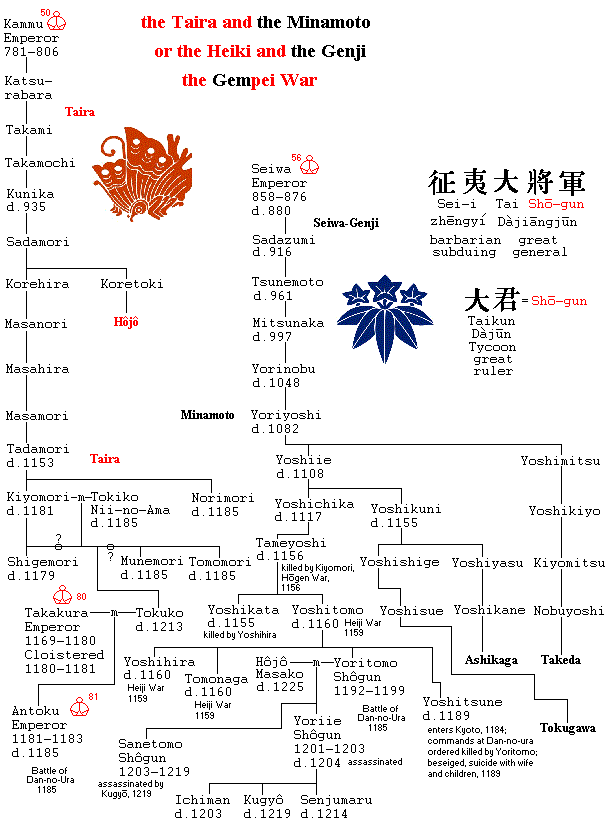
 The most famous member of the Takeda clan was Shingen (or Harunobu, d.1573), the subject of Hiroshi Inagaki's movie Furin Kazan,
  , "Samurai Banners" (1969) and Akira Kurosawa's Kagemusha (1980).


 ,
, 
 ,
, 
 ,
,

 , "Swift as wind, grave (or "silent") as the forest, aggressive ("raid, plunder") as fire, immovable as a mountain." This was an abbreviation of a statement in Chapter 7 of Sun Tzu,
 , , , , "Let him be as swift as wind, grave as forest, aggressive as fire, immovable as a mountain." At least according to Kagemusha, Shingen named the four divisions of his army in these terms, with the infantry center "forest," , flanked by cavalry "fire," , and "wind," , with Shingen himself commanding the infantry "mountain," , reserve.
| Kamakura Shōguns | |
|---|---|
| Minamotos | |
| 1 Yoritomo | 1192-1199 |
| 2 Yoriie | 1201-1203-1204 |
| 3 Sanetomo | 1203-1219 |
| Fujiwaras | |
| 4 Yoritsune | 1226-1244-1256 |
| 5 Yoritsugu | 1244-1252-1256 |
| Imperial Princes | |
| 6 Munetake | 1252-1266-1274 |
| 7 Koreyasu | 1266-1289-1326 |
| 8 Hisa-akira | 1289-1308-1428 |
| 9 Morkuni | 1308-1333 |
| After Hōjōs | |
| 10 Morinaga | 1333-1334-1335 |
| 11 Narinaga | 1334-1338 |
| The Kamakura Period, 1186-1336 | |
|---|---|
| 82 Go-Toba | 1184-1198- 1221-1239 |
| 83 Tsuchimikado | 1199-1210-1231 |
| 84 Juntoku | 1211-1221-1242 |
| 85 Chūkyō | 1221-1221-1234 |
| 86 Go-Horikawa | 1222-1232-1234 |
| 87 Shijō | 1233-1242 |
| 88 Go-Saga | 1243-1246-1272 |
| 89 Go-Fukakusa | 1247-1259-1304 |
| 90 Kameyama | 1260-1274-1305 |
| 91 Go-Uda | 1275-1287-1324 |
| 92 Fushimi | 1288-1298-1217 |
| 93 Go-Fushimi | 1299-1301-1336 |
| 94 Go-Nijō | 1302-1308 |
| 95 Hanazono | 1309-1318-1348 |
| 96 Go-Daigo | 1319-1338 |
)
| Hōjō Regents (Shikken) | |
|---|---|
| 1 Tokimasa | 1203-1205-1215 |
| 2 Yoshitoki | 1205-1224 |
| 3 Yasutoki | 1224-1242 |
| 4 Tsunetoki | 1242-1246 |
| 5 Tokiyori | 1246-1256-1263 |
| 6 Nagatoki | 1256-1264 |
| 7 Masamura | 1264-1268-1273 |
| 8 Tokimune | 1268-1284 |
| Mongol Invasions, 1274 & 1281 | |
| 9 Sadatoki | 1284-1301-1311 |
| 10 Morotoki | 1301-1311 |
| 11 Takatoki | 1311-1333 |
, "divine winds," of strategically occurring, even out of season, typhoons. The struggle, however, gravely weakened the Hōjō government, with consequences that would be felt shortly.| Northern Emperors | |
|---|---|
| Hōjō Pretender | |
| 1 Kōgon | 1331-1333-1364 |
| The Nambokuchō,, Period, 1336-1392 | |
| Ashikaga Pretenders | |
| 2 Kōmyō | 1336-1348-1380 |
| 3 Sukō | 1349-1352-1398 |
| 4 Go-Kōgon | 1353-1371-1374 |
| 5 Go-En-yū | 1372-1381-1393 |
| 6 Go- Komatsu | 1383-1392 (1392-1412- 1433) |

 , and a kind of Great Schism was created in Japanese history, the period of the "Northern and Southern Kingdoms," or the Nambokuchō Period. For the Eras of the Northern Emperors, see the popup page. Kusunoki Masashige was of some later significance. At the Meiji Restoration he was revered as the type of Loyal Retainer to the Emperor, and in World War II the Kamikaze pilots regarded his sacrifice at Minato-gawa as the exemplar of their own deaths.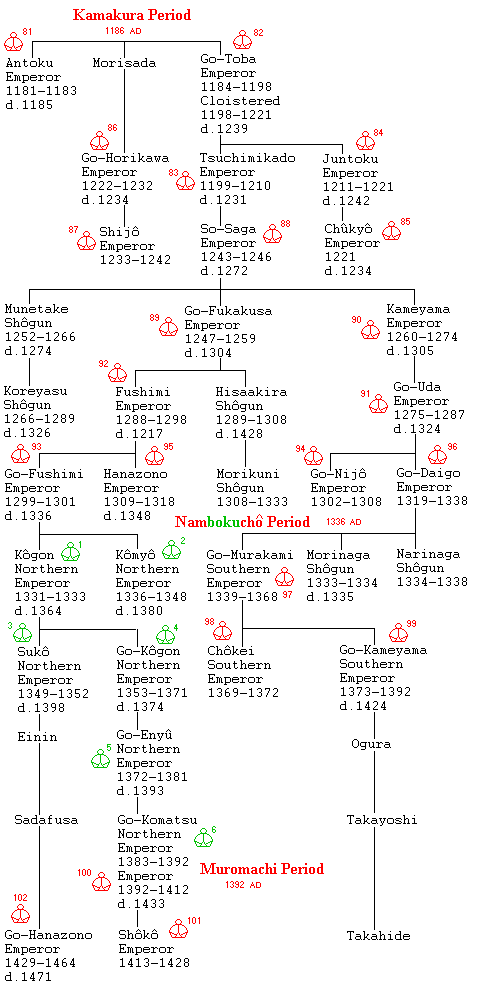
| The Nambokuchō,, Period, 1336-1392 | |
|---|---|
| Southern Emperors | |
| 97 Go-Murakami | 1339-1368 |
| 98 Chōkei | 1369-1372 |
| 99 Go-Kameyama | 1373-1392-1424 |
| The Muromachi Period, 1392-1573 | |
| 100 Go-Komatsu | 1392-1412-1433 |
| 101 Shōkō | 1413-1428 |
| 102 Go-Hanazono | 1429-1464-1471 |
| 103 Go-Tsuchimikado | 1465-1500 |
| 104 Go-Kashiwabara | 1501-1526 |
| 105 Go-Nara | 1527-1557 |
| 106 Oogimachi | 1558-1586-1593 |
For the Eras of the Nambokuchō and Muromachi Periods, see the popup page.
| Ashikaga Shōguns | |
|---|---|
| 1 Takauji | 1338-1358 |
| 2 Yoshiakira | 1358-1367-1368 |
| 3 Yoshimitsu | 1367-1395-1408 |
| 4 Yoshimochi | 1395-1423-1428 |
| 5 Yoshikazu | 1423-1425 |
| 6 Yoshinori | 1428-1441 |
| 7 Yoshikatsu | 1441-1443 |
| 8 Yoshimasa | 1449-1474-1490 |
| Ōnin War, 1467-1477 | |
| 9 Yoshihisa | 1474-1489 |
| 10 Yoshitane | 1490-1493 |
| 11 Yoshizumi | 1493-1508-1511 |
| 10 Yoshitane | 1508-1521-1522 |
| 12 Yoshiharu | 1521-1545-1550 |
| Hoke-ikki or "Lotus Uprising," 1532-1536 | |
| 13 Yoshiteru | 1545-1565 |
| Tempura introduced by Portuguese, 1549 | |
| 14 Yoshihide | 1568 |
| 15 Yoshiaki | 1568-1573-1597 |
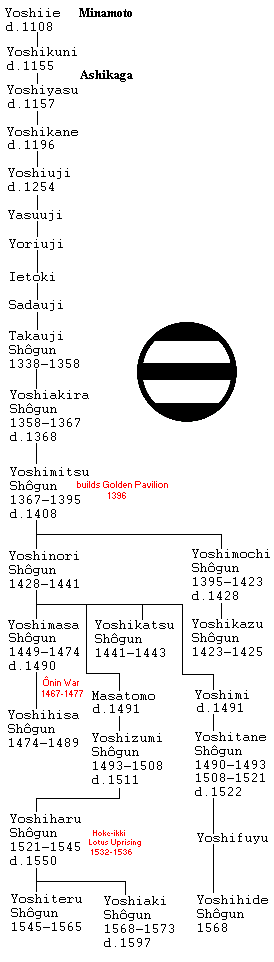
At times they even lost control of Kyōto, which itself suffered civil strike in the Ōnin War (1467-1477). The city was then in the hands of members of the Nichiren sect -- the Hoke-ikki, 法華一揆, or "Lotus Uprising," from 1532 to 1536. Parts of the Heian city became deserted during this period.
The principal Gate of the city, the southern Rashōmon, was famously abandoned and fell into ruin -- it is even said that it was no longer repaired after the reign of Enyū (969-984). Stories developed about it being haunted by demons. Nothing today marks its site but a small monument in, of all things, a playground. Now it is mainly remembered for Akira Kurosawa's movie Rashomon (1950), whence the name has entered international discourse to mean the difficulty or impossibility of reconstructing the truth of events from conflicting testimony.

It turned out to be uncommonly difficult to find the meaning of the name Rashōmon. Ra is a character whose principal meaning seems to be "gauze" and is often used to transliterate foreign words. It can also mean "net" and, by extension, "enclose." The second character is now usually replaced by another character (meaning "live"), but the older one (still on the marker on site) was jō and meant "castle" or, in Chinese, "city." It took some digging by my wife, outside the ordinary dictionaries, to discover that in Chinese luóchéng could mean the "outer/enclosure wall of a city." Luóchéngmén was thus the main gate of the outer wall of a city, and it had been used that way in Nara as well as in Kyōto -- though now, evidently, the original meaning is not often remembered.
Of the protective temples that flanked the Rashōmon, the Saiji ("Western Temple") and Tōji ("Eastern Temple"), only the Tōji remains. Hitherto remote areas of Kyōto, however, received enduring monuments from Ashikaga Shōguns, the Kinkaku-ji or "Golden Pavilion (Temple)" built in 1397 by Yoshimutsu just to the west of town (seen below), and the Ginkaku-ji or "Silver Pavilion (Temple)" built in 1473 by Yoshimasa in the hills to the east of the city. The former seems to represent the height of Ashikaga power, while the latter is a somber last gasp in its decline -- because money ran out, it was never covered in silver the way the Kinkaku-ji actually was with gold.

A remnant of the days of the dominance of Nichiren Buddhism in Kyōto is, below, the Honpo-ji, originally founded by the Nichiren saint Nishin, the "Pot Wearer," who had supposedly been tortured by the authorities with a red hot pot placed over his head. This is in a northern quarter of the city, Tera-no-uchi, 
 , where there are still several Nichiren temples and where in the old days it was said one could walk across the area and hear the Daimoku, the invocation of the Lotus Sutra, the whole way.

As the Ashikaga lost control of Japan, local warlords, or just gangs, took over. This has proven a rich era for Japanese samurai movies since it was, in its way, the golden age of the samurai -- with almost constant warfare. Especially memorable is Akira Kurosawa's Seven Samurai (1954), about a group of unemployed samurai (ronin) hired to protect a village from robbers,
) and Kurosawa'a Yojimbo (1961), about a lone, nameless ronin who gets the two gangs in one village to annihilate each other.
and Kurosawa'a Yojimbo (1961), about a lone, nameless ronin who gets the two gangs in one village to annihilate each other.
This was remade by Sergio Leone as the Western, A Fistful of Dollars in 1967, which began the movie career of Clint Eastwood; but the story seems to be based on a much earlier book, Red Harvest, by Dashiell Hammett, where Hammett's nameless "Continental Op" detective causes similar slaughter in a Montana mining town. A Fistful of Dollars led to a series of Westerns that seriously distorted the spirit of Yojimbo and the original Western.
The Seven Samurai was remade as a Western, twice, first as The Magnificent Seven, in 1960, and then remade, by the same name, and not was well, in 2016. A friend of mine, Lynn Burson, once taught a class at the University of Texas matching up samurai movies with Westerns. I don't know if she took it all the way back to Dashiell Hammett.
This era also became the golden age of castle building, though most of the surviving castles, like Himeji-jō, 
 , also known as the "White Heron Castle," Shirasagi-jō,
 , were rebuilt later to secure the pacification of the country effected in the following period. The image is of the elegant Ha-no-mon, or Third Gate, at Himeji, which was featured in Kurosawa's Kagemusha (1980). Click on the image for a map of the castle or here. My visit to the castle figures in my experience of eating in Japan.
| The Azuchi-Momoyama Period, 1573-1603 | |
|---|---|
| 107 Go-Yōzei | 1587-1611-1617 |
| Dictator | |
|---|---|
| Oda Nobunaga | 1568-1582 |
| enters Kyōto, 1568; burning of Mt. Hiei, 1571; Shōgun deposed, 1573 | |
Nobunaga became famous for his ferocity. Especially remembered was his burning of the temples on Mt. Hiei in 1571, which broke the secular power of the Buddhist establishment, and its monastic armies. Nobunaga then deposed the last Ashikaga Shōgun, his own creature, in 1573. He seemed on his way to personal rule of a unified Japan but didn't quite make it -- meeting betrayal and an assassination attempt in 1582 -- rather than be killed or captured in this attack, Nobunaga commited ritual suicide, as his son, also trapped, did soon afterward.
For all his power, Nobunaga had never assumed one of the traditional titles or offices of rule. It is usually said that this was because he was not of the qualfying Fujiwara or Minamoto descent. However, such descent could easily have been manufactured ("discovered"), so it may be that Nobunaga actually envisioned creating a new office.
For the Eras of the Azuchi-Momoyama Period, see the popup page. This is some dispute about when this Period should be regarded as having begun.
| Toyotomi Chancellors (Kampaku) | |
|---|---|
| 1 Hideyoshi | 1585-1591-1598 |
| 2 Hidetsugu | 1591-1595 |
 Later there was a story that illustrated the different styles of Nobunaga, Hideyoshi, and Ieyasu, about what each would say if a bird did not sing for him: Nobunaga would say, "Sing, or I will kill you"; Hideyoshi would say, "Sing, or I will make you sing"; and Ieyasu would say, "Sing, or I will wait for you to sing." Wait Ieyasu did, making an accomodation with Hideyoshi and henceforth supporting his rule. Hideyoshi then completed the reunification and pacification of Japan. He assumed the office of Imperial Chancellor in 1585, for which only Fujiwaras were hitherto qualified, and even assumed a new family name, Toyotomi, to go along with it, in 1586.
In 1592 Hideyoshi then invaded Korea. This didn't go well, but he tried again in 1597-1598. After he died in the latter year, Ieyasu wisely withdrew Japanese forces. Hideyoshi had also turned against the Christians in 1597, inaugurating executions and persecutions that later (under Iemitsu) would drive the small remnant of Japanese Christians into the secret practice of their religion for centuries.
The Edo,  , Period, 1603-1868 , Period, 1603-1868 | |
|---|---|
| 108 Go-Mi-no-o | 1612-1629- 1680 |
| 109 Meishō [Myōshō] | 1630-1643- 1696 |
| 110 Go-Kōmyō | 1644-1654 |
| 111 Go-Saiin | 1655-1662- 1685 |
| 112 Reigen | 1663-1686- 1732 |
| 113 Higashi-yama | 1687-1709 |
| "orphan" tsunami, 26 Jan 1700 | |
| 114 Nakamikado | 1710-1735- 1737 |
| 115 Sakuramachi | 1736-1746- 1750 |
| 116 Momozono | 1746-1762 |
| 117 Go- Sakuramachi | 1763-1770- 1813 |
| 118 Go-Momozono | 1771-1779 |
| 119 Kōkaku | 1780-1816- 1840 |
| 120 Ninkō | 1817-1846 |
| 121 Kōmei | 1847-1867 |
 (or just ), in 1600. But Ieyasu then went on to get himself appointed Shōgun in 1603. Hideyori later died, with the last of his cause, when Ieyasu broke into and burned Ōsaka Castle in 1615. Ieyasu, who had by then already "retired," thus firmly established the rule of his family, which henceforth ruled from Edo, , not far from where the Hōjōs had ruled at Kamakura.
For the Eras of the Edo Period, see the popup page.
The most frightening aspect of this event may have been the damage at the Fukushima nuclear power plant, which was right on the coast of Sendai. Hit by the tsunami, the plant immediately began to shut down its reactors. However, the waters knocked out the plant's backup generators, which interrupted the shutdown process and endangered and damaged the reactors, allowing radiation to leak. This astonished me, since the Japanese are otherwise so aware of what needs to be done in the case of earthquakes and tsunamis. That the generators were not protected from rising waters seemed incredible. Unlike the Sendai experience, on 26 January 1700, a major tsunami wave hit Japan without any warning. This was then an "orphan" tsunami. Its origin was a mystery until recently. Now it appears from the geological evidence that the earthquake, perhaps more than a 9 in magnitude, was in the Pacific Northwest of North America. Tree rings have even narrowed the event down to 1700 itself. Tsunamis crossing the Pacific to hit the opposite shore are now a familiar phenomenon, as we have just seen in 2011.
In international scientific discourse a tidal wave is now properly called a "tsunami," with the term borrowed from Japanese. Part of the issue is that a "tidal wave" has nothing to do with tides, while a true tide in certain conditions can generate a wave. "Tsunami," however, contains a similar malapropism. It means "port, harbor, ford, ferry, stream," However, the term "tidal wave" was probably based on the impression that they could come in like a tide. In 2011, we just saw in California that the small tsunami seemed to affect harbors the most dramatically. This is probably because, although harbors are sited to block the entrance of ordinary waves, a tsunami does come in anyway, as the sea itself is elevated like, indeeed, a tide. So "tidal wave" may actually be just as appropriate as "harbor wave." One wonders if there was simply some sort of politically correct urge to adopt a scientific term from another language. See the discussion here.
There is also the circumstance, on the other hand, that Japan, with a literate culture that often suffered from the waves, then had a long tradition of records and study of the phenomena. Even in the 18th century, Edward Gibbon knew so little about tsunamis that he doubted the truth of the description of one by the Roman historian Ammianus Marcellinus. Thus "tsunami" may properly represent a tribute to those who were first familiar with them in their details and had already made the connection with earthquakes. With the tsunami of 1700 we have a nice match between Japanese records and modern geology.
 The Japanese had long known that earthquakes could be followed by tidal waves, i.e. tsunami,
 . The most recent example of this now is the 9.0 earthquake of 11 March 2011, off Sendai, which was quickly followed by a tsunami that killed thousands of people (perhaps 20,000), sweeping away boats, cars, houses, etc. This was the largest earthquake in Japan since the Kantō quake of 1923, and press reports say it was the largest quake there in 140 years -- as well as being the 5th largest earthquake on Earth since the beginning of the 20th century. Tsunami waves arrived in Hawai'i and the Americas, but with minimal damage.
 While there turned out to be little danger from the radiation leaks, the event set off an absurd international panic about nuclear reactors, leading to shut-downs from California to Germany. Since this coincided with similarly absurd campaigns against "fossil fuels," countries like Germany, and States like New York and California, compounded the danger to the reliability of their power grids. Since then, some rethinking has occurred, especially in Germany; but not in the United States, where the increasing irrationality of politics has been as much a problem as natural disasters.
(the range of meaning in Chinese and Japanese), and "wave,"
While there turned out to be little danger from the radiation leaks, the event set off an absurd international panic about nuclear reactors, leading to shut-downs from California to Germany. Since this coincided with similarly absurd campaigns against "fossil fuels," countries like Germany, and States like New York and California, compounded the danger to the reliability of their power grids. Since then, some rethinking has occurred, especially in Germany; but not in the United States, where the increasing irrationality of politics has been as much a problem as natural disasters.
(the range of meaning in Chinese and Japanese), and "wave,"  . But tsunamis have no more essential connection to harbors or ferries than they do to tides.
| Tokugawa Shōguns | Buried | |
|---|---|---|
| 1 Ieyasu | 1603-1605-1616 | Nikko |
| 2 Hidetada | 1605-1623-1632 | Shiba |
| 3 Iemitsu | 1623-1651 | Nikko |
| 4 Ietsuna | 1651-1680 | Ueno |
| 5 Tsunayoshi | 1680-1709 | Ueno |
| 6 Ienobu | 1709-1712 | Shiba |
| 7 Ietsugu | 1712-1716 | Shiba |
| 8 Yoshimune | 1716-1745-1751 | Ueno |
| 9 Ieshige | 1745-1760-1761 | Shiba |
| 10 Ieharu | 1760-1786 | Ueno |
| 11 Ienari | 1786-1837-1841 | Ueno |
| 12 Ieyoshi | 1837-1853 | Shiba |
| 13 Iesada | 1853-1858 | Ueno |
| 14 Iemochi | 1858-1866 | Shiba |
| 15 Yoshinobu, Keiki | 1866-1868-1903 | Taitoku, Tōkyō |
Adams was the pilot, or sailing master, of the ship, rendered into Japanese as Anjin, 
 , "needle [i.e. compass] watcher." When Ieyasu granted him the fief of Miura, 三浦, near Yokusuka (which later became a Japanese and then, after World War II, American naval base), he became known as 三浦按針, Miura Anjin. Adams built ships for Ieyasu, advised him on geography, navigation, gunnery, and European politics, and dealt with foreign merchants, even marrying a Japanese wife.
  The Japanese were alerted to the imperial designs of Spain, and their occupation of the Philippines, and that the English and Dutch were the enemies of Spain and the Portuguese Jesuits. Unfortunately, the understanding that Christianity was used by Spain to undermine local governments contributed to the hostility and persecution of Christians in Japan.
When Adams died in 1620, he was at Nagasaki and was buried there. The Christian burials in Nagasaki were later demolished, but the remains of Adams, as a historic retainer of Ieyasu, a hatamoto, 旗本, were preserved and later reburied, with the marker we see at right. Recent forensic examination of the bones seems to confirm that they are Adams, but actual DNA testing will not help unless any of his relatives are identified; and they have not been. Adams' estate was divided between his Japanese family and that of his English wife, back in England.
Later, his son Joseph, born in Japan, created a monument in the hills above Yokosuka, the  , Anjinzuka.
  Since (citation form tsuka) can mean "tomb," this confused me for a long time, thinking that Adams was buried there. In fact, his Japanese wife may be.
A train station nearby, on the Keihin Kyūkō Line to Yokosuka, is named the "Anjinzuka," 安針塚駅, Anjinzuka-eki, although it was only given that name in 1940. On maps, especially for the Yokosuka train station, one sometimes finds, as we see here, , "peace," instead of in these place names.
Later, British occupation forces erected a small monument to Adams at Itō in Izu, where Adams had built ships, with now a sort of modernistic statue of Adams, installed in 1987, in the "Anjin Memorial Park," 按針メモリアルパーク, at the mouth of the Itō River, 伊東大川. Up river a little, past the bridge, is the Kawaguchi ("River Mouth") Park, 川口公園, where there is more material about Adams and the ships he built there. The ultimate fates of Joseph, who initially inherited Adams' titles, and Joseph's sister Susanna, are unknown.
Until 1923 a section of Tokyo, the "Anjin-chō," , the "pilot district," had been named after Adams, since he had a mansion there. After the great Kantō earthquake of that year, the rebuilding of Tokyo resulted in the elimination of the district.  This bothered the locals, who took up a collection and built a small shrine to Adams, which still exists, in the old neighborhood -- not far from the famous Nihombashi, 日本橋 ("Japan Bridge"), in the downtown district Nihombashi-Muromachi-1-chome. The monument was refurbished, by local contributions again, in 1951. The street of the monument is now called the Anjindori, 按針通り, although I missed seeing any street signs saying this.
 This is quite close to the A1 exit of the Mitsukoshimae subway station, where the Ginza and Hanzomon Lines intersect. However, having come up the stairs from the subway, one must double back, in the direction shown by the photograph, which is South, toward the actual Nihombashi Bridge, to find the right street, on the left. The monument is on the second block in, on the left again.
The story of Adams' advent in Japan was fictionalized by James Clavell in the very popular historical novel Shōgun (1976), later a television mini-series (1980) with Richard Chamberlain and Toshirō Mifune. The poignant reflections in the book on the wife and children he left behind in England did apply to Adams, who, although never returning home, was able to send money back to his family.
 |
|---|
| The Miura Anjin Memorial, Anjin dori, Nihombashi, Tokyo, August 2023; the inscription is legible if enlarged or viewed separately. |
Edo Castle, Tōkyō Imperial Palace -- originally built as the seat of the Tokugawas.
Ieyasu and then especially his grandson Iemitsu created a system of rule approaching totalitarian dimensions.  Every person in the country and everything they did was subject to oversight and review. Every family had to register with a local Buddhist temple, and even their diversions and travel were the business of the government. The country became closed to foreigners -- even as Japanese were prohibited from going abroad -- except for one Dutch ship annually, which put in to Nagasaki.
Christians were exterminated, and measures taken for years to hunt out any practicing secretly (not all were in fact found). "Samurai" changed from being a job description to being a caste. Commoners were forbidden to carry more than a single short sword for defense, while samurai were required to carry two swords and might summarily execute a commoner for insufficient deference. Firearms were forbidden and confiscated. Sumptuary laws limited the displays of wealth that commoners, like merchants, might engage in. All this was intended to freeze Japan in time, lock it away, and keep everything under the tight control of the government.
The extreme forms of the persecution of Christians we see in the movie Silence (2016), directed by Martin Scorsese, based on a 1966 novel by Shūsaku Endō. Andrew Garfield plays a Jesuit priest, Sebastião Rodrigues, who is sent to Japan in part to investigate reports of Jesuits becoming apostates. Rodrigues is captured and is required to become an apostate himself to stop the torture of Japanese Christians -- a scene not for the faint of heart. He hears the voice of Jesus telling him he must do this, and he does, living out the rest of his life helping the Tokugawa regime track down Christians.
 |
|---|
| Zōjō-ji Temple, Shiba Park, Tokyo, rebuilt in 1974, after being destroyed by bombing in World War II; home temple for the Tokugawa burials at Shiba; Tokyo Tower in the background |
The Tokugawa regime did produce peace, and one result was the familiar aesthetic of the samurai, who no longer needed to wear armor and fight battles, where the bow had always been the principal military weapon. Now they would usually do no more than fight duels, in which the sword rather than the bow could be celebrated as the "soul of the samurai." The problems of the samurai and their ethos in this era is explored in many movies. The plight of unemployed samurai from the demobilized feudal armies is seen in Masaki Kobayashi's Harakiri (1963). The story of Miyamoto Musashi, who went from digging trenches in the mud at Sekigahara to becoming the greatest of the dueling ronin (and whose own The Book of Five Rings has been kept in print as a key to Japanese business practices), is given in heavily fictionalized form in The Samurai Trilogy (1955), by Hiroshi Inagaki.
 |
|---|
| Guardian Deities outside the cemetery of the Zōjō-ji Temple, Shiba Park, Tokyo, Gate in background; site of Tokugawa reburials after the destruction of the Shiba mausoleum in World War II. |
Returning to the Sengakuji in 2009 after an absence of 16+ years, I found a great deal of new construction, with handsome granite approaches to the graves of Asano, and a new museum. This was on top of a level of an existing attention and tourism that, for instance, is still missing at Shimonoseki. There is also the interesting development that the Ronin are now generally referred to as the Gishi,  , the "righteous gentlemen," rather than as the Chūshin, , "loyal retainers."
Thus, on a street atlas of Tokyo, the place of the Akō burials within the temple is identified as the 
 , the "Tombs of the Akō-Gishi" [Tokyo City Atlas: A Bilingual Guide, Kodansha International Ltd, 2004, map 34]. This gives a much more strongly Confucian tone to their characterization, with an unambiguous Confucian virtue, righteousness, and a social class, , that would mean a scholar, not a warrior, in China. The moral problems with "loyalty," , in Japan are discussed elsewhere.
| The Modern Period, 1868-present | Era | |
|---|---|---|
| 122 Mutsuhito | 1866- 1912 | Meiji 1868 |
| Sino-Japanese War, 1894-1895; Russo-Japanese War, 1904-1905; Annexation of Korea, 1910 | ||
| 123 Yoshihito | 1912- 1926 | Taishō |
| "21 Demands" on China, 1915; Washington Naval Conference, 1921-1922; Great Kantō Earthquake, 1923 | ||
| 124 Hirohito | 1926- 1989 | Shōwa |
| Annexation of Manchuria, 1931; Invasion of China, 1937; World War II, 1941-1945; American Occupation, 1945-1952 | ||
| 125 Akihito | 1989- 2019, retired | Heisei |
| Tōhoku/Sendai Earthquake, Magnitude 9.0 9.1, devastating tsunami, Fukushima nuclear disaster, 2011 | ||
| 126 Naruhito | 2019- present | Reiwa  |
 Modern Japan began with much of the paradox and irony familiar in world history. When Commodore Perry arrived in Japan in 1853, it was with the determination to force the country open to trade and international contact. Why this was thought to be necessary, or the business of the United States, is a good question. Ninety years later, many Americans might have wondered if it had been a good idea. When the Shōgun agreed in 1854 to open trade and allow foreigners into the country, this set off a reaction against the Shogunate that had not been seen in its history. The cry became Sonnō Jōi!,
 , "Respect the Emperor; expel the foreigners!" The Emperor Kōmei wanted the foreigners expelled, so a movement gathered to depose the Shōgun and "Restore" the rule of the Emperor. In 1868 the Emperor was restored. The Shōgun resigned, and, after some fighting (the Shōgun, as the lord of the Kantō, didn't want to surrender his lands), Edo was occupied and the foreigners, well, were not expelled. Kōmei had died, and the forces of Chōshū and Satsuma, with foreign arms, had, with the young emperor Mutsuhito, changed their minds. The Imperial Court moved from Kyōto to Edo, which now became Tōkyō, , the "Eastern Capital." Not only were the foreigners not expelled, but, instead, the new government set out to completely overturn the traditional society and create a modern state. The samurai class was simply abolished in 1872, but die hard samurai had to be defeated with modern weapons.
The "Satsuma Rebellion" of Saigō Takamori in 1877 has recently been the subject of a Hollywood movie, The Last Samurai [2003], but the movie fictionalizes events beyond recognition. Saigō led 15,000 men and tried to take the castle and government garrison at Kumamoto,
 |
|---|
| The Keep of Kumamoto Castle, 2009; reconstructed, 1960; damaged in earthquake, 2016; under repair, 2021 |
A long siege failed, as conscript peasant soldiers held off the confident samurai. Fighting largely destroyed the town and castle of Kumamoto. With only forty men left, wounded in battle at Shiroyama, Saigō committed suicide with the help of a retainer (Beppu Shinsuke, not an American solider). Just as hopeless and vicious folly redeemed by suicide is often celebrated in Japanese history, in 1899 Saigō earned a statue at the entrance of Ueno Park in Tōykō.
In the aftermath shown in the movie, we see Tom Cruise, who had played Saigō's ahistorical American retainer, absurdly pleading with the Emperor Meiji to preserve the values of the Samurai ethos. Unfortunately, just such a preservation may be said to have led to multiple war crimes during World War II, especially in the treatment of prisoners of war, who were randomly tortured, starved, and murdered, much as the Samurai would have done to their prisoners.
There had already been trouble in Satsuma, a telling incident in 1863, when the British bombarded Kagoshima, the capital of Shimazu Hisamitsu, Daimyō of the Satsuma Clan, in revenge for the murder of an Englishman, Charles Richardson, by Hisamitsu's retainers in Yokohama. To the British the action was a disaster, because a number of the new breech-loading guns exploded. The Japanese, however, did not know that. All they saw was the fortress getting blown to bits.
The result was that the Satsuma Clan became patrons of the new Imperial Japanese Navy. This contrasts with the kind of thing that went on in China, where the first railroad, built with British money, was bought by the Chinese government simply to be torn up. Such things were apparently thought unnecessary. Trouble similar to that at Kagoshima, in the same year, occurred at Shimonoseki (near the site of the Battle of Dan-no-Ura), where the Daimyō of Chōshū, Mōri Motonori, ordered that foreign ships passing by be shot at.
Consequently, the French bombarded Shimonoseki, and the British, French, Americans, and Dutch did so also in 1864. Unlike at Kagoshima, where the Emperor thought that the Japanese had won because no action followed the bombardment, foreign troops landed at Shimonoseki and demolished the fortifications. Mōri had to agree not to molest, and sometimes even to provision, passing ships. The Chōshū Clan subsequently became the patron of the new Japanese Army, which drew on French advice, until France was defeated in the Franco-Prussian War (1870-1871), and then on German (not, as one might think from The Last Samurai, American).
So it turned out that, the way Nixon could go to China, Emperor Mutsuhito could put on pants and sit in a chair -- and build a modern nation.
With the "Meiji Restoration," the Japanese adopted the Chinese practice of the Ming and Ch'ing that only one Era Name is used per reign. Mutsuhito thus chose Meiji, Almost from the very beginning of modern Japan, its foreign policy was aggressive and expansionist. This was disagreeable to Britain, of whom Japan was a proud ally, and infuriating to the United States, which, with a soft spot for all the Chinese who were expected to convert to Christianity any day, suddenly became an international powerbroker by delivering victory to the Allies. Japan backed off and for a while was on relatively good behavior, the period of "Taishō Democracy." But darker impulses were always stirring, and the Depression did much the same work in Japan that it did in Germany. The greedy capitalists and the disloyal communists should both be defeated so that the National Essence could prosper and bring the Emperor's Benevolence to all of East Asia. The saddest thing about the business was that none of it was really a considered policy of the Japanese Government. Military zealots, usually on the spot, initiated actions that the Government was literally afraid to repudiate -- Prime Ministers were assassinated just for the impression of not being sufficiently hard-line (though some revisionist historians now argue that the whole business was masterminded by Emperor Hirohito himself). The only real military question was whether action should be aimed at the Soviet Union or at China.
This was decided, in effect, by the failure of a coup in Tokyo on February 26, 1936, the "2/26 Incident." This was sufficiently threatening that many participants were purged and executed, unlike individuals in earlier mutinies and assassinations, who had often been treated with lenience. The 2/16 faction, in favor of a Russian war, was eliminated. China would be the target.
Pretexts were duly arranged that were used to invade China in 1937. This began a war that lasted until 1945. Everything else, like the Pacific War with the United States and Britain, was just a detail coincident to the attack on China. For, as it happened, China was rather too large to be overrun by the Japanese, and Chiang Kai-shek was too stubborn, or stupid, to come to any accommodation with them. His expectation was that the Americans would eventually be drawn in, and then they would win the war. In that he turned out to be quite right.
The Communist line was that Chiang didn't want supplies to fight the Japanese anyway. He needed to prepare for the post-War struggle with the Communists and so avoided combat. Now, it turns out, this was the Communist strategy, not the Nationalist. We see many pitched battles between the Japanese and the Nationalists, but none really between the Japanese and the Communists. But the supplies flown over the Hump mainly went to the American Air Force in China and also came to be diverted from the Nationalists because of Communist influence in American ranks. Even the hot nature of the Nationalist fight against the Japanese worked against them, because peasants resented being drafted into the Army, and the Communists played on that discontent -- Communist armies were always formally "volunteers," even though not volunteering was a political crime. At the same time, Chiang's expectation that the participation of the Americans in the War would be decisive, although correct, could not take into account the role American Communist sympathizers would have in subverting his position vis-à-vis the Communists.
Attempts to call American sympathizers and Communist agents to account, conspicuous in the accusations of Joseph McCarthy, were deflected into attacks on him, whose effect was to protect such sympathizers and agents. Why this was tolerated and aided by the Eisenhower Administration, otherwise famously anti-Communist, remains a historical puzzle of the era. None of the treacherous State Department "China Hands," who facilitated the regime whose crimes have continued ever since, ever significantly suffered for what they had done.
One gets the impression that the whole affair had not been thought out very well, and it hadn't.
, "Enlightened Rule," for himself. As in the recent Chinese practice, with the death each Emperor, he then became known by the Era Name, i.e. "The Meiji Emperor," rather than a new posthumous name, which in Japanese practice tended to reflect his residence (e.g. Nijō, the "Second Street" Emperor).
 Not only the Japanese themselves, but the International Community, considered that Japan had come of age and become a Power with the Sino-Japanese War (1894-1895) and the Russo-Japanese War (1904-1905). While none of this, not even the annexation of Korea in 1910, was regarded as particularly predatory behavior at the time, things began to change when Japan tried to impose demands on China during World War I.
 The takeover of Manchuria in 1931 was the first major act of fascist aggression in the 1930's, though the Japanese had long stationed troops there, as the Russians had before them. The League of Nations, whose principal members already had their own colonial empires, now became queasy over the naked continuation of the old style imperialism. The United States, probably the most outraged, was no longer involved enough in international affairs to make much difference.
Japanese strategy can be observed on the map of their East Asian Empire at its height. China is in practical terms surrounded. The last route of overland supply, through Burma (the arduous "Burma Road"), was the last one cut off. The Allies were reduced to flying supplies in over "The Hump," i.e. the Himalayas. Curiously, the War in China has been both neglected in popular treatments and confused with remnants of Communist propaganda, promoted, understandably, by the People's Republic of China, but also by Western historians who were initially sympathetic with, and/or paid by, the Communists and now who may simply not know any better -- or be as sympathic to Communism as ever.
The takeover of Manchuria in 1931 was the first major act of fascist aggression in the 1930's, though the Japanese had long stationed troops there, as the Russians had before them. The League of Nations, whose principal members already had their own colonial empires, now became queasy over the naked continuation of the old style imperialism. The United States, probably the most outraged, was no longer involved enough in international affairs to make much difference.
Japanese strategy can be observed on the map of their East Asian Empire at its height. China is in practical terms surrounded. The last route of overland supply, through Burma (the arduous "Burma Road"), was the last one cut off. The Allies were reduced to flying supplies in over "The Hump," i.e. the Himalayas. Curiously, the War in China has been both neglected in popular treatments and confused with remnants of Communist propaganda, promoted, understandably, by the People's Republic of China, but also by Western historians who were initially sympathetic with, and/or paid by, the Communists and now who may simply not know any better -- or be as sympathic to Communism as ever.
 Meanwhile, in the War, the Japanese secured a strategic oil supply in Indonesia and protected it by conquering adjacent territories, like the Philippines. The military, however, had paid insufficient attention to boring practical questions like running the oil fields and then getting the fuel back to Japan. A convoy system, which the Allies had to use against German submarines in World War I and World War II in the Atlantic, was never used by Japan, even when American submarines were decimating and even annihilating ships carrying desperately needed strategic supplies.
 |
| Hirohito, the Shōwa Emperor, 1926-1989 |
|---|
The ironically named Shōwa, , "Radiant Harmony," Era brought down the world, and the Bomb, on Japan and its ambitions. China was left to the grave miscalculations of its own leaders and ostensive but treacherous Allies, and the Japanese were left to pick up the pieces of flattened, blasted cities.
Astonishingly, all the impractical foolishness and haughty disdain for mere mundane details were soon traded in for an economic and commercial practicality rivaled by few. Japan had rolled with the punches and remade itself before, and it did again. Whether the moral lesson had really been learned was a question often asked by the Asian neighbors who had experienced the old Japanese "benevolence" first hand.
But one thing remains clear from the experience of Japan: nothing but lack of imagination, determination, and capitalism has ever stopped "Third World" countries from entering the modern era and competing with European states as equals, in war and peace. Japan emerged from Tibetan isolation and xenophobia and, with no "natural resources" to speak of, save the human capital of its own people, became a Great Power in less than 40 years.
In the Nineties the Japanese economy was in a Tokugawan torpor, but no one was deceived that the frenzy of Japanese life could not most unexpectedly erupt in new achievements and ambitions (even alarming ones). That the economic stagnation of the Nineties continued into the new century, has allowed Japan to be surprassed by China as the world's second largest economy, and is astonishingly now emulated in American domestic policy (to similar results), nevertheless has not prevented Samsung from greater success in a mass market (as in China) than Apple has had in distributing its own technology -- Apple neglects the low end of the market (the same mistake it originally made with the Macintosh). Thus, there are flashes of the old Japanese entrepreneurial spirit, even as it has not shaken off the dead weight of crony capitalism that has bedeviled Asian, and now American, economies.
While the retirement of Emperors has been a notable feature of Japanese history, no Emperor has retired since the Meiji Restoration -- until now. On 30 April 2019, the Emperor Akihito retired, and his son Naruhito became Emperor on May 1st. An Era name was already picked, Reiwa, , said to mean "Beautiful Harmony."
There was some controversy about this, since the primary meaning of is "command" and some related meanings, which makes it look like Reiwa means "Harmony is Commanded." Indeed, we see in the Chinese expresson for "District Magistrate,"  , such as Judge Dee. However, Reiwa was taken from a 8th century collection of poems, the Man'yōshū, where the issue was viewing plum blossoms, not commanding anything. The notable thing about the name may be that it was taken from Japanese rather than Chinese literature.
Video game companies have recently been infiltrated by political activists. Often, the activists have replaced gifted and experienced game developers, whose problem may have just been that they were old white males, while the activists are themselves often young, inexperienced, and ungifted -- it is evident now that this was also done deliberately at Disney Studios. Such actions have been in pursuit of the "Diversity, Equity, and Inclusion" (DIE) agenda, which may have been promoted by institutional investors like Black Rock. The companies may also be tempted by the idea of the "modern audience" to be reached by the activists, which will add all sorts of "oppressed" minority groups to the customers.
Unfortunately, discriminating against white or old or male employees is illegal in the United States; but, illegal or not, the result has been financial disaster for some companies anyway. A recent example was a Stars Wars game, Star Wars Outlaws, in 2024. Although such games are often under development for years, costing even hundreds of millions of dollars to develop (in an industry whose income is actually greater than the movie business), Outlaws was released full of computer bugs, with a principal character who was a woman, based on an actual attractive female model, but "uglified" as is now required by anaesthetic feminism -- or that a character be masculinized to satisfy what Melonie Mac calls the "trans-gaze," i.e that women look androgenous. This is not appealing to gamers, who are predominantly male (as high as 85% by some surveys), but who also include (real) women who don't want to identify with ugly and/or masculinized characters.
Thus, Star Wars Outlaws did not do well; and this was a grave loss for its publisher, the French video game developer Ubisoft. The hopes of Ubisoft then rested on its next game, a new installment in its popular "Assassin's Creed" series of games, now Assassin's Creed Shadows (the fourteenth in the series).
This matter is addressed here on this webpage because Assassin's Creed Shadows is set in feudal Japan, the first time that an "Assassin's Creed" game would be in Japan. As such, the game was much anticipated, especially by Japanese gamers.
When a preview video was released for Assassin's Creed Shadows, there were immediately multiple objections to the game. A lot of it was about historical and cultural details. The architecture was often Chinese, not Japanese, and the seasons were confused, so that plants, like the cherry trees, might be flowering at the wrong times.
Most significant, however, were the identities of the action characters, a man and a woman, the "assassins." The woman, some kind of Ninja, Naoe, was Japanese, but the man was actually Black, even though there was no population of Black people in 16th Century Japan.
On line, there are fantasical theories that Black people were the original population of Japan and were the basis of all Japanese culture. It is not obvious whether some of this is actually a joke, but you never know. It is a large step beyond widely accepted fantasies of Afro-Centric Egypt or the "blackwashing" of Cleopatra.
This Black character in "Assassins Creed," however, was based on a historical person, who seems to have been the only Black man attested to have existed in Japan of that period. There may have been others, for whom some images seem to have occurred, but no documents or records refer to them. This Black man, however, is said to have been brought as a slave from Africa by Portuguese Jesuits. We do not even know his name.
Oda Nobunaga heard about the African man and wanted to meet him; so he was introduced at Court in 1581. Nobunaga was fascinated; and, as sometimes happens when Black people first appear in traditional societies, Nobunaga wanted to see if the color would rub or wash off. It didn't.
The Jesuits then allowed Nobunaga to take the man into his service. Whatever his name had been originally, Nobunaga called him Yasu̥ke, 弥助 (or 弥介), which is pronounced, more or less, as "Yaske." Nobunaga then gave him a sword, a house, and a stipend. Yasu̥ke also seems to have at least sometimes been charged with holding Nobunaga's own swords.
Here is where some of the controversy starts. For the game, it is essential that Yasu̥ke be identified as a "samurai," such that he would be out fighting battles, or doing whatever the "assassins" do in the "Assassin's Creed" games. However, there was not yet a formal status for samurai at the time, and the name wasn't even used. When there was formal status, later, under the Tokugawas, it was two swords, not one, that would distinguish them. If Yasu̥ke then carried Nobunaga's swords, this was more the equivalent of a "squire" in European feudalism, and in Japan it would not necessarily have distinguished him from many other of Nobunaga's retainers.
The matter starts becoming obscure, but Yasu̥ke may have been involved in fights perhaps twice. When Nobunaga was attacked by assassins in 1582, Yasu̥ke may have helped defend him. After Nobunaga's death, Yasu̥ke seems to have fallen in with his son, Oda Nobutada, who was then defeated and forced to commit suicide. All the Oda retainers also committed suicide; but Yasu̥ke, who was not Japanese, was not expected to do this, and he seems to have been returned to the Jesuits. Whether that happened or not, Yasu̥ke then disappears from history and his fate is unknown.
This thin record, over just a year, is then the basis of the "Assassin's Creed" character. Gamers and commentators immediately wondered why the first "Assassin's Creed" game in Japan not only did not bother having a Japanese lead character, but reached into the obscure historical record to pull out a lone 16th Century African and inflate him into a purported "samurai." Also, we might wonder how a large black man would suit the practice of "assassins," who would do better not to be conspicuous persons. "Inconspicuous," however, does not seem necessary in this game.
Thus, much of the material we may see on line, about the "legendary black Japanese samurai," is a fantasy and a confabulation. There is actually nothing "legendary" about him. Also, in Shadows, the preview videos seem to show Yasu̥ke, and Naoe, wandering around Japan, as we see in countless Samurai movies, but with Yasu̥ke in full battle armor, which is something we would only see in organized pitched battles. Such armor is in few Samurai movies, which tend to feature rōnin, who fight duels, not battles. That is what we see Yasu̥ke doing. Indeed, there is no particular reason that the historical Yasu̥ke would ever have had his own armor, which, because of his size, would have needed to have been made specifically for him.
The suspicion immediately arose that this was a political decision, by which Ubisoft wanted to demonstrate its virtue as an advocate of "Diversity, Equity, and Inclusion," with a demonstration of "diversity" and "representation," by having, not the typical male Japanese samurai, but with Black and female lead characters. Yet "diversity" is not what comes to mind when considering the ethnic makeup of 16th Century Japan, or of Japanese warriors. However, why weren't the Japanese already "diverse" enough? They weren't white, or European. So what was the complaint? Perhaps just that Japan, and, say, Japanese Americans and students in the United States, are too successful -- among the most successful of all ethnic groups in America. This is "white adjacent" or "acting white." That doesn't suit the demands of DIE politics, whose beneficiaries must be from "oppressed" social groups.
Suspicion was further created when the academic advisor for the game was not a proper historian of Japan but a political activist specializing in "gender" and "queer" subjects. Leaks claimed to have come from within Ubisoft then asserted that political considerations were decisive, when the game was being developed in 2020, as "Black Lives Matter" riots were occurring in the United States. The original Japanese lead character was then replaced by Yasu̥ke.
Predictably, the defense of Ubisoft was that all the complaints were from a "small minority" of racists, sexists, and homophobes. There were even accusations that American (male) racists were running their screeds through Google Translate and posting them in Japanese, to make it look like they were Japanese gamers. The defenders should have been so lucky. The actual Japanese backlash, reaching all the way to Cabinet officials, was so severe that Ubisoft cancelled their publicity campaign for the game in Japan, including a presence at Japanese game trade shows.
This was followed by an actual delay in the release of the game, which was postponed until February 14, 2025, whose coincidence with Valentine's Day may be accidental, but whose occurrence in "Black History Month" may not be. The explanation from Ubisoft was that some technical issues needed to be ironed out, perhaps like the computer bugs in Star Wars Outlaws, but skepticism about this was general.
Subsequently, the release of the game was delayed again, until March 20, 2025. This was another faux pas, since this turns out to be the 30th anniversary of the sarin gas attack in 1995, by the cult movement Aum Shinrikyo, in the Tokyo subway, the worse terrorist attack in Japanese history. Again, Ubisoft had not done their homework on Japan.
Ubisoft may just want time to consider what really to do about the mess on their hands, which large numbers of Japanese gamers, and government ministers, find insulting. In fact, the Japanese have more than a bit of their own racism -- or a Yukio Mishima (1925-1970) brand of nationalism -- but a bunch of Frenchmen, or American activists, are going to get nowhere with making accusations about that. American gamers and movie goers are now used to being attacked and smeared by developers, actors, and executives; but this irrational behavior does little good and is liable find even less traction among the Japanese, who might not even understand it.
Since a motto of business used to be "The customer is always right," we might stop to reflect how it happens that, when a product does not sell, or there are objections to it, the procedure of producers is now often to attack and insult the customers, often with inflammatory charges like "racism" and blanket condemnations of them as "toxic." This may not be as irrational as it seems when we consider that the strategy is to guilt-trip those who suffer from some kind of "liberal" guilt or self-hatred, who can be pushed into contrition and self-lacerating apologies.
It will not work, however, with anyone who sees the attacks for what they are, as insults, which will be anyone with their self-worth not corrupted by the vicious ideology of the Leftist ruling class. There are enough of such elites that the charges can be made in the comfortable echo chambers of New York, California, or the like, but there do not seem to be enough people there to retrieve the market for a mass distributed product. But even repeated failures, such as Disney has experienced, are not always enough to sober up sufficiently committed producers. Bankruptcy may be the only effective corrective.
Meanwhile, the Ubisoft stock value has fallen to a tenth of what it was not long ago, and it is not clear when the company can be expected to turn a profit. Stockholders and institutional investors are unhappy and restless, as Ubisoft, like many video game companies and movie studies, seems more interested in political agendas than in what customers want, or what stockholders also want. Going private, or bankruptcy, or a buy-out (by a Chinese company), is not beyond consideration.
As Ubisoft brushes off buy-outs and the release date for Assassin's Creed Shadows approaches, publicity releases and leaks exposed more of the insanity that has been built into the game. A good one was the reveal of another character for the game, who seems to be a large, female Sumo wrestler. There have been some women Sumo wrestlers, but not in the era of Nobunaga and never in the professional ranks of Sumo wrestlers, which are hedged around with Shinto pollution restrictions, which preclude women. So this is ahistorical and essentially ridiculous, since Sumo wrestlers have never been trained or prepared for battles. They fight their bouts while largely naked. Instead, we are justified in suspecting that a fat woman fake "warrior" is in the game as a virtue signaling example of "fat acceptance."
Then we get a couple other questionable characters. One is a young boy who is said to have been taken in and raised by a Buddhist monk. Unfortunately, the "consultant" that Ubisoft had been using for information on Japanese culture has written about pederastic Buddhist monks who kept young boys as catamites. So we are left to wonder if this boy is actually supposed to be one of those.
Otherwise, we get another character who is described with "they/them" pronouns, which exposes the whole business as designed to promote contemporatry leftist politics and gender ideology -- if this was not already obvious from the fantasy version of Yasu̥ke in the game.
Finally, we discover that Yasu̥ke is supposed to have stood as the "second" to the suicide of Nobunaga. This provokes the Japanese again. No parvenu foreigner would ever be used as the "second" for a high status Seppuku: It would be a disgrace. Also, the "second" is expected to decapitate the suicide with one skillful stroke, which leaves a flap of skin attached to the head, so that the head will not fly off on its own. This is a skill that Yasu̥ke cannot have acquired within the year (1581-1582) he spent as a retainer of Nobunaga, especially when there is no evidence he ever had any training in the use of the sword (although there is an attempt to pack training into the video game). Also, we still see Yasu̥ke in full body armor, even though Nobunaga was vulnerable to attack at the time because he and a few retainers were engaged in a tea ceremony. You don't wear armor to a tea ceremony.
Another complaint about something that has come out about the game is that we see Yasu̥ke apparently participating in the looting or destruction of a Buddhist temple. The complaint about this is that the Japanese would never desecrate a temple in such a way. However, we know that this is exactly when Nobonaga did, when he destroyed the source of the monastic armies on Mt. Hiei. Unfortunately, this was done in 1571, ten years before Yasu̥ke was introduced into the Court. So we simply have another, perhaps confused, example of historical revision.
However, I now see that the issue in the game is not about Nobunaga's attack on Mt. Hiei. It is about the looting or destruction of a Shinto shrine, namely the real and existing Itatehyozu-jinja Shrine near Himeji Castle. This seems gratuitous, and objections have been voiced by the shrine priests and the Japanese Shinto Shrine Association. They have even said, We will take appropriate action, whose form has not yet become clear.
Even worse, the game has been said to allow Yasu̥ke to loot an Imperial Tomb, in order to obtain particular sets of armor, which, of course, again, an "assassin" does not need and would not have fit Yasu̥ke anyway. The portrayal of such a thing may even violate Japanese law. All of this snowballs Japanese objections to this game.
After its release, sales of Assassins Creed Shadows have been tepid. Ubisoft has avoided releasing actual sales numbers, which is revealing, only claiming that it has had a certain number of "players," which means people who have essentially rented the game on particular platforms. But Ubisoft has been compelled to admit to losses to its stockholders. It has entered into agreements with a Chinese company, about which there are accusations from stockholders. How this plays out remains to be seen. At large, DIE programs are largely discredited, but diehards (or perhaps "DIEhards") are still fighting.
Fujiwara Chancellors and Imperial Regents, 858-1868
Transition Ministers, 1868-1885
The Problem with Assassin's Creed Shadows
Advanced Japanese Destroyers of World War II
A Guadalcanal Chronology, 7 August 1942 - 6 March 1943
Zen and the Art of Divebombing, or The Dark Side of the Tao
History of Philosophy, Buddhist Philosophy
Before the Meiji Period, there was not any kind of sharp distinction between Buddhism and Shintō in Japan. This was introduced in Meiji legislation, with the harsh requirement that structures and rites of the two religions share no facilities, as had hitherto been the practice. This went along with some official suppression of Buddhism, which was associated with the Tokugawa regime. These measures were subsequently relaxed, and the Japanese often do not pay much attention to whether they are in a (Buddhist) temple or (Shintō) shrine, but the formal distinction does persist.
Buddhist temples and Shintō shrines can generally be recognized by the suffix on their names, with Another intriguing character for "shrine" is Other changes in meanings of characters from Chinese to Japanese are also of some interest. The most general Chinese term for "temple" may be In Chinese
The Heian Period, Note;
Shrines and Temples, ji/dera, "temple," for the Buddhist and  or , sha/ja/yashiro and gū/miya, respectively, "shrine," for the Shintō. While the on or monosyllabic Chinese reading seems the most common to me, the names of some of the most famous temples in Japan have a complete kun or Japanese reading, such as the beautiful Kiyomizu-dera, ("Clear Water Temple"), in Kyoto. A , jingū, is used for the most important shrines, generally associated with the Imperial House, and the word alone specifically means the shrine of the Sun Goddess at Ise. The Akamajingū is thus significant as an Imperial shrine. Lesser shines, or shrines in general, are , jinja. , read -ja or -sha, is found as a suffix for lesser shrines; and , read -miya, may be for shrines of members of the Imperial House.
  Some shrines are , taisha, "great shrines," such as the Fushimi Inari Taisha, the shrine of the god Inari at Fushimi, just south of Kyōto (as named on the pillar on site at right). This is from a pre-war system of classifying shrines, which has survived at Fushimi. Fushimi Inari is the head of all the Inari shrines in Japan,
  about a third of the total number of Shinto shrines. The god Inari is of indeterminate sex and is often confused with the foxes that are his/her symbols, representatives, or messengers, as seen at left -- a natural confusion when, in the absence of direct iconography of the god, the foxes make do. Originally a rice god, Inari has become associated with prosperity and business, which probably accounts for the god's popularity.
 , mori, which in Japanese means "woods" or "grove," with the implication of the presence of kami -- although in Chinese the principal meaning is simply "to shut out, restrict, impede," etc. Mori can also be written and . It is thus intriguing to see groves as inhabited by kami the same way that there were sacred trees and groves in the old Celtic and Germanic religions of Europe, surviving in the most un-Christian institution of the Christmas Tree. One wonders if the change in meaning of the character from Chinese to Japanese reflects the imposition of a taboo (Chinese
  ) on the sacred groves.
is "palace" in Chinese; but although it can already mean "temple," most of its associations are with the Imperial Court and Palace, which is the meaning that carries over into Shintō usage. in Chinese means gods of the earth, and their altars. Again, one might speculate that the kami first appeared to be those sort of deities to early Chinese visitors to Japan. A general Chinese term for "altar," which we see in the name of the Temple of Heaven, ("Heaven Altar"), in Peking, is used less in Japan, except in the interesting expression danka,
) on the sacred groves.
is "palace" in Chinese; but although it can already mean "temple," most of its associations are with the Imperial Court and Palace, which is the meaning that carries over into Shintō usage. in Chinese means gods of the earth, and their altars. Again, one might speculate that the kami first appeared to be those sort of deities to early Chinese visitors to Japan. A general Chinese term for "altar," which we see in the name of the Temple of Heaven, ("Heaven Altar"), in Peking, is used less in Japan, except in the interesting expression danka,  , which are families, "temple families," dedicated for that purpose in the Edo Period, that continue to support local Buddhist temples.
 , as in the
  , the Temple of Confucius found in traditional Chinese cities, such as even the modern capital of Taiwan, Taipei. This term is strongly associated with the Confucian ancestor cult, and especially the Imperial ancestor cult. In Japanese, read byō, it is less used and can also mean "mausoleum."
can mean a "hall, court," a Buddhist monastery, or even a mosque. As in Japan, we see used as a suffix, as in the name of the famous
, the Temple of Confucius found in traditional Chinese cities, such as even the modern capital of Taiwan, Taipei. This term is strongly associated with the Confucian ancestor cult, and especially the Imperial ancestor cult. In Japanese, read byō, it is less used and can also mean "mausoleum."
can mean a "hall, court," a Buddhist monastery, or even a mosque. As in Japan, we see used as a suffix, as in the name of the famous  , the Buddhist Shaolin monastery where Kung-Fu was supposedly developed. In combination, means "temple."
 The situation in India in 1780 was with the British poised for conquest. At that point, wars had already been fought with Mysore and with the Marathans. More would come. The Punjab, in the distance, would be a project for some years later. Meanwhile, The French would shortly be down to four cities, which they would surrender to the newly independent India in 1947. The Portuguese, from their former hegemony, were reduced to three possessions, which they would retain until forcibly taken by India in 1961. The two Danish cities were sold to Britain in 1845. The British were unwilling to pay for the Danish Nicobar Islands, but then, after the Danes had left in 1837, they complained about piracy there. The Danes returned 1845-1848. After Denmark renounced sovereignty in 1868, the British occupied the islands.
 , Zhèng Hé (or Chêng Ho in Wade-Giles, 鄭和), a Moslem eunuch -- he was enslaved and castrated as a prisoner of war in the conquest of Yunnan in 1382 -- on seven great naval expeditions into the Indian Ocean between 1405 and 1433.

 The list of Japanese Emperors, etc., is based
  on Andrew N. Nelson, The Modern Reader's Japanese-English Character Dictionary [Charles E. Tuttle Company, 1987, pp. 1018-1022], The Princeton Companion to Classical Japanese Literature [Earl Miner, Hiroko Odagiri, and Robert E. Morrell, Princeton University Press, 1988, pp. 119-127 & 463-475], E. Papinot, Historical and Geographical Dictionary of Japan [Charles E. Tuttle Company, 1910, 1988], and other sources I've lost track of. The genealogies are entirely from Papinot.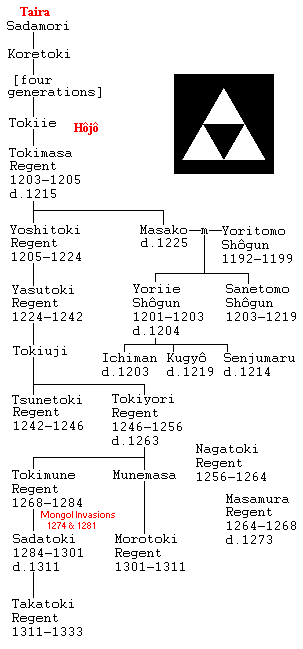
 At the time, this story became a kabuki play, and since the introduction of cinema there have been countless movie versions. One of the best is Inagaki's 1963 Chushingura,
  (the "Treasure of the Loyal [chū] Retainers [shin]").


)
)
)
)
)
)
)
)
)
)
)
)
)
)
)
)
)
)